
TLDR
Mystery shopping for brands in the UK means deploying real shoppers to act like normal customers and report back on what actually happens at the shelf, on a retailer product page, or during the buying journey. For FMCG teams, it now sits alongside retail audits, shopper advocacy programmes, and review generation rather than standing alone as a customer experience tool. The right method depends on the question: mystery shopping measures experience, audits measure execution, and review programmes build digital shelf trust.
What Is Mystery Shopping for Brands?
Mystery shopping for brands is the practice of sending trained or briefed shoppers into stores (or through online purchase journeys) to behave like normal customers and report what happened. The UK Market Research Society defines it as using trained individuals to experience and measure a customer service process by acting as potential customers and reporting back in a detailed, objective way, without declaring their presence at the time of interaction. MRS mystery shopping guidelines (PDF)
In the traditional sense, that means checking staff behaviour, greeting quality, product knowledge, store cleanliness, and service speed. A bank, hotel, or restaurant might use mystery shopping to see whether front-line teams follow training scripts. That version of the concept is well understood.
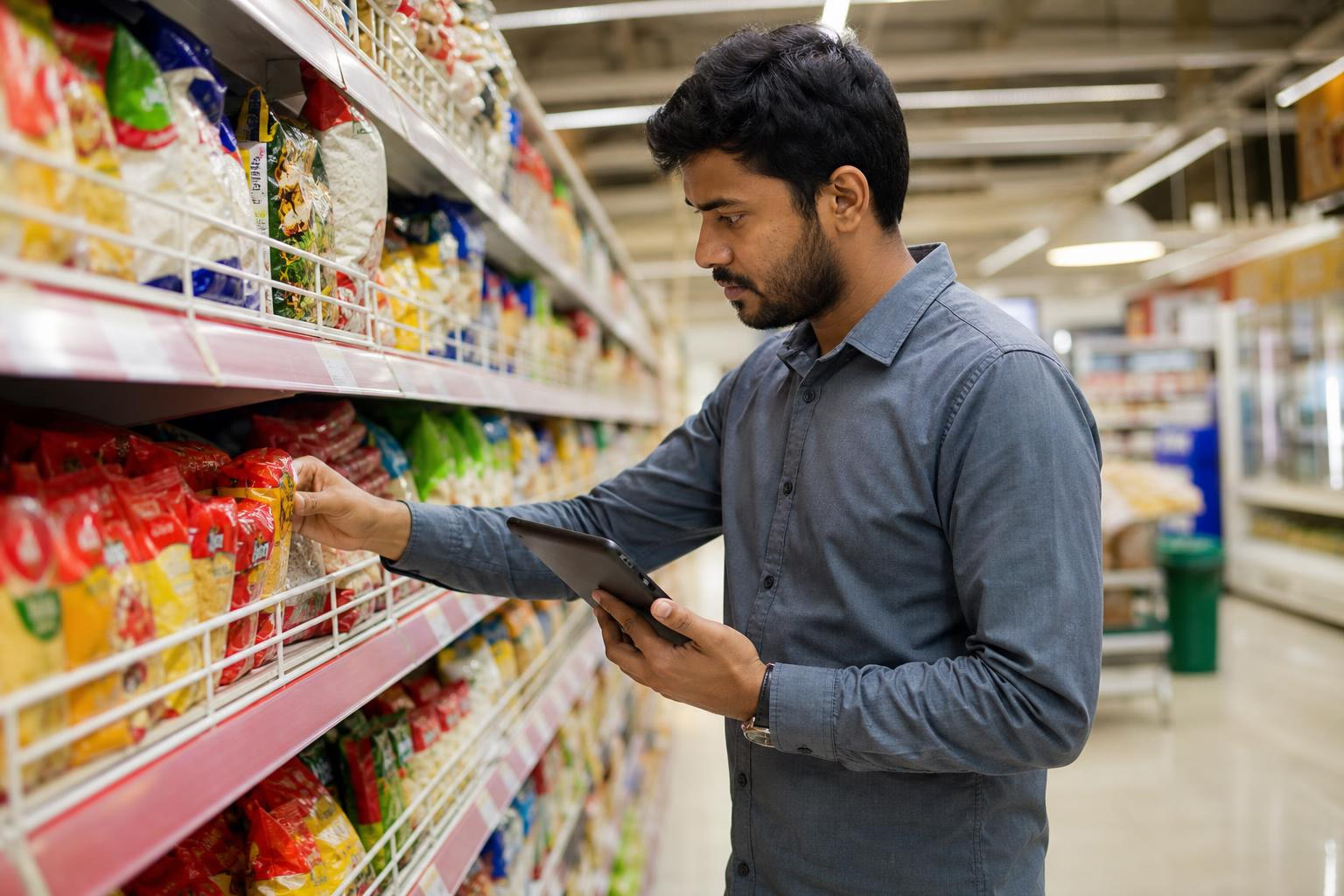
For UK FMCG brands, the meaning has expanded. A grocery or health-and-beauty brand selling through Tesco, Boots, or Sainsbury’s does not control the store. It cannot walk into 3,000 locations and see what is happening on shelf. Mystery shopping gives visibility into whether the product is available, whether the promotion is live, whether the POS is visible, whether staff recommend the product, and whether a shopper can find, buy, and review it without friction.
The important distinction: mystery shopping is not one tool. If the task is about checking facts (product on shelf, price correct, display built), that is a retail audit. If the task is about understanding the experience (was it easy to find? did staff help? what did the journey feel like?), that is mystery shopping. If the task is about generating honest product feedback on a retailer product page, that is shopper advocacy or review generation.
Explore Brand Allies’ online review service to see how these methods connect for UK FMCG brands.
Why UK FMCG Brands Use Mystery Shopping
EPOS data tells a brand what sold. It does not explain what failed to sell, or why. A product can underperform because of weak demand, or because it was out of stock, hidden behind a competitor, missing its shelf-edge label, sitting in the wrong fixture, or lacking the promotional support that was agreed and paid for.
The scale of this problem is real. Research from DHL Supply Chain and Retail Economics found that one in five UK grocery trips involves at least one out-of-stock item, putting an estimated £2.1bn of grocery sales at risk annually.
Online grocery has its own version of the problem. Which? found that one in five surveyed supermarket shoppers had a substitution in their most recent online order, with Tesco shoppers most likely to report out-of-stock items at 30%.
Practitioners on LinkedIn consistently frame shelf availability as a commercial KPI, not a supply chain side note. One retail execution post argues that a product that is not available cannot generate sales, loyalty, market share, or brand equity. Another notes that many “sales problems” in growing CPG brands are actually execution problems: shelves are out of stock, displays are incomplete, and planogram compliance breaks down at store level.
Mystery shopping for UK brands exists to close this visibility gap. The practical question is not “did the head office plan exist?” It is “what did the shopper actually see in store?”
For a deeper look at stock availability audits, that guide covers how brands measure on-shelf availability in UK grocery.
How a Brand Mystery Shopping Campaign Works
A typical campaign follows ten steps:
- Define the commercial question. What do you need to know? Staff recommendation? Shelf availability? Promo execution? Review gaps?
- Choose the method. Mystery shop, retail audit, review task, or a hybrid of all three.
- Select SKUs, retailers, locations, and timing. A new product launch in 200 Tesco stores during week one of a promotion needs different coverage than a quarterly check across all Boots stores.
- Write the shopper brief. MRS guidance says scenarios should be realistic, mimic natural customer behaviour, and be safe. Questionnaires should focus mostly on factual information.
- Recruit or assign shoppers. From a verified shopper community, gig platform, or contracted field team.
- Shopper visits, buys, checks, or reviews. They complete the task as a normal customer.
- Shopper submits evidence. Photos, receipts, timestamps, geo-location, written observations, review screenshots.
- QA validates the data. Correct store, correct product, correct date, clear photos, no duplicates.
- Brand receives a report and action list. Store-level findings, compliance rates, issue flags.
- Brand acts on the insight. Escalates to field team, raises with the retailer, adjusts the plan.
The process is straightforward in concept. The difficulty is in execution quality, which depends on brief clarity, shopper reliability, and rigorous QA.
Mystery Shopping vs Retail Audits vs Review Generation
This is the distinction most competitor guides miss. All three methods use shoppers. They answer different questions.
Mystery shopping answers: “What did the shopper experience?” Use it when staff recommendation, product findability, purchase friction, or the customer journey matters. The output is qualitative and experiential.
Retail audits answer: “Was the commercial plan executed?” Use it when you need proof of availability, price accuracy, POS presence, display compliance, or distribution. Roamler describes this as the distinction between perception and execution. The output is factual and photo-led.
Review generation answers: “Does the product have enough authentic digital shelf proof?” Use it when retailer product pages have low or zero reviews, when review recency is weak, or when conversion and retailer search ranking may suffer from a lack of ratings. The output is published, verified shopper feedback.
| If the brand asks… | Use… | Evidence needed |
|---|---|---|
| Is the SKU on shelf? | Stock availability audit | Shelf photo, SKU status, store/time |
| Is the promotion live? | Promo compliance check | Price, POS, display photo |
| Is the product easy to find? | Mystery shop | Shopper journey notes |
| Do staff recommend us? | Mystery shop | Interaction notes, recommendation outcome |
| Are reviews missing or stale? | Review generation | Purchase proof, published review status |
| Are faulty packs still in store? | Product withdrawal visit | Removal evidence, location coverage |
For a more detailed comparison, the guide on retail audits vs mystery shopping breaks down when to use which.
See Brand Allies’ in-store compliance service for how audits and compliance checks work in practice.
Mystery Shopping Glossary for UK Brands
Mystery shopping
A research or evaluation method where a briefed shopper behaves like a normal customer and reports on a defined experience. For UK FMCG brands, this can cover anything from staff recommendation quality to online purchase friction. It is most useful when the question is experiential rather than purely factual.
Mystery shopper / secret shopper
The person who completes the assignment anonymously. They might visit a store, search for a SKU, ask a staff member a question, buy a product, photograph the shelf, or leave a review. Quality varies by task design and pay. Practitioners on Reddit report that shoppers using UK mystery shopping apps like Roamler and Field Agent often compare platforms, avoid low-value jobs, and learn which tasks are worth the time. Low pay for complex, photo-heavy tasks is a recurring complaint.
Retail audit
An objective check of store execution. Measures factual conditions: product availability, display compliance, share of shelf, price, SEL accuracy, POS presence, distribution, and facings. Not about the experience. About whether the plan was executed.
In-store compliance check
Verifies whether an agreed retail activity happened. Examples: promo compliance, POS compliance, display compliance, price compliance, planogram compliance, stock checks. For FMCG brands, compliance checks answer the question “did the store do what was agreed?”
On-shelf availability (OSA)
The product is physically available to buy in the expected location at the moment a shopper wants it. A brand can have excellent advertising and strong review profiles, but if the product is missing from shelf, the sale is lost or diverted to a competitor.
Out-of-stock (OOS)
When a product that should be available is not. Research has found an average worldwide out-of-stock rate of roughly 8.3% in FMCG, with European rates in the 7 to 10% range. OOS is one of the most common reasons brands invest in mystery shopping for UK retailers.
Promo compliance
Measures whether an agreed promotion is visible, correctly priced, stocked, and live during the campaign window. Trade spend is wasted if stores do not execute the promotion. For more detail, the promotional compliance measurement guide covers how UK brands track this.
POS compliance
Checks whether point-of-sale materials (shelf talkers, barkers, dump bins, FSDUs, gondola ends, wobblers, chiller stickers) are present, visible, and correctly placed. POS compliance is a better term than mystery shopping when the brief is photo-led and factual.
Display compliance
Measures whether a brand’s secondary or promotional display has been built to the agreed standard. Display compliance can be a significant blind spot. Industry data suggests that CPG marketers expect compliance near 70%, while actual compliance has been found to average no higher than 40% in some studies. Read more about display compliance for UK FMCG brands.
Perfect store audit
Checks whether a store meets the brand’s agreed “perfect store” standards across availability, visibility, pricing, promotion, display, range, and merchandising. Often used as a scorecard that rolls up into retailer performance reviews.
Share of shelf
The percentage of shelf space a brand’s products occupy relative to competitors in the same category or fixture.
Shelf-edge label (SEL)
The price or product label displayed on the shelf. If the SEL is missing, wrong, or belongs to a different product, shoppers may walk past without realising the product is there.
Planogram compliance
Whether products are placed on the shelf in the layout agreed between brand and retailer. Planogram breaks can bury products, reduce visibility, or create shopper confusion.
Shopper advocacy
Mobilising real shoppers to try, buy, review, or recommend products in authentic ways. This sits at the intersection of mystery shopping, product trial, and review generation. The shopper advocacy strategies guide explains how UK FMCG brands approach this.
Buy, try, and review
A shopper buys or receives a product, tries it, and leaves honest feedback. Field Agent UK publicly describes “Buy & Try” and “Ratings & Reviews” tasks in its app, showing that review-generation tasks now overlap with the traditional mystery shopping ecosystem.
Review seeding
Generating early reviews for a product by putting it in the hands of real shoppers. Useful for new product launches where retailer PDPs would otherwise sit at zero reviews. Use “review generation” or “shopper advocacy” rather than anything that implies buying positive ratings.
Verified review
A review linked to evidence that the reviewer genuinely bought or used the product. Verified does not automatically mean unbiased. It means there is a purchase signal. The review still needs to be genuine, not manipulated, and properly disclosed where incentivised.
Incentivised review
A review written after the reviewer received a benefit: payment, reimbursement, a free product, points, or any other reward. UK rules require that the incentive be transparent where applicable, not conditional on positive sentiment, and not used to suppress negative feedback.
Fake review
A review that appears to be based on a genuine consumer experience but is not. CMA research estimated that fake review text causes between £50m and £312m of annual harm to UK consumers.
Review moderation
The process of accepting, rejecting, filtering, or removing reviews before or after publication. Retailer moderation can reject shopper reviews for various reasons. Campaign reporting should always distinguish between reviews submitted, reviews accepted, and reviews published.
Review volume
The number of reviews on a product page. Northwestern’s Spiegel Research Center found that purchase likelihood for a product with five reviews was 270% greater than for a product with no reviews. For FMCG, the first few reviews are disproportionately important because grocery PDPs often have very low review counts.
Review recency
How recently reviews were posted. Old reviews may not reflect current formulation, packaging, or quality. NIQ argues that reviews older than four months can have very little impact for many products, while review length and count may also affect search ranking. A one-off review spike is weaker than steady flow, which is why review velocity matters.
Retailer PDP
A product detail page on a retailer website such as Tesco, Sainsbury’s, Ocado, Boots, Amazon, or Holland & Barrett. For FMCG brands, the retailer PDP functions as the digital shelf. It affects conversion, discoverability, and retailer confidence.
Digital shelf
The collection of online retail touchpoints where a product is discovered, compared, and bought: search ranking, product title, images, content, price, availability, reviews, ratings, and Q&A. Traditional mystery shopping covers the physical shelf. Shopper advocacy and review programmes influence the digital shelf.
Retailer search ranking
The position a product earns in a retailer’s search or category results. Reviews can influence conversion and may affect visibility depending on the retailer or platform. NIQ notes that review count, length, and recency can be relevant factors on platforms like Amazon.
Crowdsourced retail audit
A retail audit completed by a distributed network of shoppers rather than an employed field team. Faster coverage and wider geographic reach, but variable quality. Reddit discussions about UK mystery shopping apps show real frictions: users mention low pay for high-effort tasks, awkward photo requirements, and task rejection risk. These frictions directly affect the quality of data brands receive.
Traditional field team
An employed or contracted merchandising and sales force that regularly visits stores, builds relationships, and fixes issues. Better for relationship-led selling, negotiation, and complex merchandising fixes. Crowdsourced shoppers are better for fast visibility, proof, and lightweight tasks. Many brands use both.
Evidence capture
The proof collected during a mystery shop or audit: shelf photos, display photos, receipts, timestamps, geo-location, written observations, staff interaction notes, or review screenshots. MRS guidance says questionnaires should mainly focus on factual information and precisely document what happened.
Discreet product withdrawal
A controlled removal of product from stores by shoppers or field workers, usually when a product needs to be removed quickly without full public recall mechanics. If a safety issue requires a formal public recall or regulatory notification, a discreet withdrawal is not a substitute.
Scenario design
The assignment instructions that tell the shopper what to do, ask, buy, and report. MRS guidance says scenarios should be realistic, safe, and not overly sophisticated, because complexity can reveal the shopper and compromise the study. Bad briefs create bad data.
See how Brand Allies supports promotional activations across UK retailers.
UK Compliance: What Brands Must Get Right
Mystery shopping for brands in the UK operates within clear rules. Ignoring them creates legal, reputational, and commercial risk.
Mystery shopping ethics
MRS guidance says staff should be advised that service delivery may be checked. Scenarios must be safe and objective. Participant anonymity and data protection matter. The questionnaire should document facts, not manufacture opinions.
Incentivised and fake reviews
UK law changed materially in April 2025. The CMA introduced a banned practice relating to fake reviews and concealed incentivised reviews. The law applies to businesses that create, commission, publish, or facilitate reviews or endorsements. The CMA can issue fines and directions directly.
ASA/CAP rules are equally explicit. Rules 3.44 to 3.46 state that marketing communications must not contain fake consumer reviews, must make clear where reviews have been incentivised, and must not publish reviews in a misleading way, including suppressing negative reviews or giving positive reviews greater prominence. Incentives must not depend on providing a positive review.
For a full breakdown of these rules, the product review compliance glossary covers CMA, ASA, and retailer moderation requirements.
Compliance checklist for review programmes
- No fake reviews.
- No “positive review only” incentives.
- No hidden incentives.
- No suppressing genuine negative reviews.
- No misleading aggregate ratings.
- Keep proof of purchase, reimbursement, and submission.
- Brief shoppers to leave honest feedback, not positive feedback.
- Disclose incentives where required by law and platform rules.
Why this matters commercially
Consumer scepticism is growing. Reddit threads show fatigue with constant review requests and suspicion around incentivised or generic five-star ratings. Research from Northwestern’s Spiegel Research Center found that purchase likelihood tends to peak when average star ratings sit between 4.2 and 4.5, and actually drops as ratings approach a perfect 5.0. Brands should not chase only five-star reviews. A credible review profile includes real detail, mixed language, and enough volume to feel trustworthy.
PowerReviews found that 98% of surveyed consumers were more likely to read reviews for a product they had never bought before. That makes review authenticity a conversion issue, not just a compliance one.
How to Write a Mystery Shopping Brief That Works
The quality of evidence a brand receives depends almost entirely on the quality of the brief. Shopper-side feedback makes this clear. Practitioners on Reddit report that photo-heavy audits can be awkward in small stores, that submissions get rejected for unclear reasons, and that some tasks only become worthwhile once shoppers learn which assignments are worth their time.
Brands should treat brief design as a data-quality investment:
- One clear objective per task.
- Simple, natural shopper scenario.
- Store and SKU identifiers.
- Required photo angles specified.
- Receipt required or not.
- Time window defined.
- Reimbursement rules stated upfront.
- What to do if the product is missing.
- What to do if challenged by staff.
- Disclosure instructions for any review tasks.
- Evidence upload deadline.
- Clear rejection criteria so shoppers know what counts.
If the task is underpaid, too long, or too ambiguous, the brand will get poor completion rates, rushed evidence, or rejected reports. Complexity needs budget, training, and QA.
How to Measure ROI
Different programme types produce different metrics. The right measurement depends on the question the brand asked in the first place.
Mystery shopping (experience): Staff recommendation rate, product findability, purchase completion rate, friction themes, competitor recommendation frequency.
Retail audits (execution): On-shelf availability rate, OOS rate, promo compliance rate, POS compliance rate, correct price rate, display presence, store-level issue count, fix rate after escalation.
Review generation (digital shelf): Reviews submitted, reviews accepted and published, average star rating, review count by retailer, review recency, review velocity, PDP conversion change where data is available, search rank movement where measurable.
The commercial case for review generation is strong. Northwestern found that five reviews can increase purchase likelihood by 270% compared to zero reviews. For FMCG brands launching new SKUs onto retailer PDPs with empty review sections, even a small number of authentic reviews can shift conversion meaningfully.
How Brand Allies Supports UK FMCG Brands
Brand Allies is a UK-only managed-service shopper advocacy platform for FMCG brands, powered by Redwigwam’s 250,000 UK shopper community. It supports three connected service lines:
Online Product Reviews. Shoppers buy products and leave honest reviews on retailer websites including Tesco, Sainsbury’s, Morrisons, Waitrose, Ocado, Boots, Iceland, Holland & Barrett, Amazon, and TikTok Shop. Revenue is pay per verified review.
In-Store Activations. Field audits for promo compliance, POS checks, and distribution, built on Redwigwam’s technology platform.
Discreet Product Withdrawals. Shoppers physically remove faulty or problematic product from shelves without triggering a public alert. This is closer to a market withdrawal than a formal recall, and should not be treated as a substitute for legally required safety notifications.
For brands, the value is that shopper review generation, in-store evidence capture, and product withdrawal support sit under one managed-service model rather than being split across separate tools, panels, and agencies.
Book a demo to discuss a UK shopper advocacy programme
FAQs
Is mystery shopping legal in the UK?
Yes. Mystery shopping is widely used and well established. MRS guidance covers issues like staff awareness, participant anonymity, data protection, safe scenarios, and objective reporting. It is legal provided it is designed responsibly and follows applicable research, employment, and data protection rules.
Can mystery shoppers leave product reviews?
They can leave honest reviews where the retailer platform permits it and where the programme complies with UK law and platform terms. Since April 2025, concealed incentivised reviews are a banned practice under CMA rules. Incentives must not depend on positive sentiment.
What is the difference between mystery shopping and a retail audit?
Mystery shopping measures the shopper experience: was the product easy to find, did staff help, what did the journey feel like? A retail audit measures execution: is the product on shelf, is the price correct, is the display built? Roamler describes this as perception versus execution. The best FMCG programmes often combine both.
How many stores should a brand mystery shop?
There is no universal number. The right sample depends on the objective, retailer footprint, SKU distribution, promotion timing, budget, and the level of statistical confidence needed. For directional insight, a smaller sample works. For retailer negotiation or compliance measurement, broader coverage with consistent evidence is necessary.
Can brands ask shoppers to leave five-star reviews?
No. The compliant approach is to ask for honest reviews. ASA/CAP states that incentives should not depend on providing a positive review. Reviews must not be published in a misleading way, and negative feedback must not be suppressed.
Why do shopper reviews get rejected by retailers?
Retailers may reject reviews because of moderation rules, missing proof, prohibited wording, duplicate content, suspicious patterns, incentivisation disclosure issues, or content that is not relevant to the product. Campaign reporting should track rejection rates separately.
What should a brand look for in a mystery shopping provider?
Geographic coverage, shopper verification, task design support, QA rigour, evidence standards, compliance with MRS and CMA rules, transparent pricing, and clear reporting. For FMCG brands specifically, check whether the provider covers retail audits and review generation alongside traditional mystery shopping.
Should brands use a shopper community or a traditional field team?
Use a shopper community for speed, scale, and store-level visibility across many locations. Use a field team for relationship-led selling, merchandising fixes, and ongoing account execution. Most UK FMCG brands benefit from both, using crowdsourced shoppers for evidence and field teams for action.