
TL;DR
A shopper activation campaign targets consumers at the point of purchase, online or in-store, to convert browsing into buying. This checklist covers six phases: objective setting, audience targeting, digital shelf readiness, in-store execution, promotional mechanics, and measurement. Most campaigns fail not because the strategy is wrong but because execution breaks down across the digital shelf, store compliance, and review coverage.
Most UK FMCG brand managers have a solid strategy deck. What they rarely have is a reliable system for making sure that strategy actually shows up at shelf level, on product detail pages, and in the shopper’s hand. That gap between plan and execution is where a shopper activation campaign checklist earns its value.
The problem is structural. According to Harvard Business Review, 90% of new products fail within their first year. Promotional compliance studies show that only about 10% of brands get the in-store execution they agreed to in the plan. And the average grocery product review rate sits at just 0.1% to 0.3%, meaning most PDPs on Tesco or Sainsbury’s are nearly bare of social proof when a shopper lands on them.
This guide defines what a shopper activation campaign actually is, distinguishes it from related concepts, and provides a phase-by-phase checklist built for the UK grocery and health-and-beauty context.
Explore review generation for UK retailers to see one of the three activation layers covered below.
What Is a Shopper Activation Campaign?
A shopper activation campaign is a set of targeted marketing tactics designed to engage consumers at critical decision points in their purchase journey, whether that’s a product detail page on Ocado, a shelf in Boots, or a promotional end-cap in Tesco. The goal is specific: convert browsing into buying.
The concept traces back to Procter & Gamble’s “First Moment of Truth” (FMOT) framework, coined around 2004/2005. P&G argued that shoppers make up their minds about products in the first three to seven seconds of seeing them on shelf. That insight launched an entire discipline focused on winning at the point of decision rather than just building awareness upstream.
Today, the purchase moment is no longer confined to the physical shelf. Shoppers engage with an average of nearly six touchpoints before buying. A Facebook ad, a friend’s recommendation, a retailer search result, and a product review page can all function as activation points. A proper shopper activation campaign checklist needs to account for all of them.
Shopper Activation vs. Brand Activation
Brand activation is broader. It includes experiential events, sponsorships, pop-ups, and awareness campaigns. Shopper activation is a subset, narrowed to the purchase moment itself: the shelf, the PDP, the basket. If brand activation asks “do they know us?”, shopper activation asks “will they buy us right now?”
Shopper Activation vs. Shopper Marketing
Shopper marketing is the long-term strategy. Shopper activation is the execution at the point of decision. Scanning a QR code, submitting a receipt for cashback, reading a review on a retailer page: these are activation moments within a broader shopper marketing strategy.
Shopper Activation vs. Loyalty Programmes
Loyalty programmes are ongoing initiatives designed to reward repeat customers and build long-term relationships. Shopper activation focuses on immediate actions at the point of purchase to drive short-term engagement and trial. They complement each other, but they operate on different timescales and require different checklists.
The Shopper Activation Campaign Checklist
This framework covers six phases. Each one matters independently, but they work best as a connected system. Skip the digital shelf phase and your in-store sampling drives trial without conversion evidence. Skip compliance checks and your trade spend disappears into stores that never built the display.
Phase 1: Set Objectives and KPIs
Every shopper activation campaign needs a specific outcome. “Increase awareness” is not specific enough. Here are objectives that actually drive planning decisions:
- Trial generation: Get the product into new hands, measured by redemption rate or sample-to-purchase conversion.
- NPD launch support: Seed reviews and build the credibility baseline before a range review, given that 90% of new products fail in year one.
- Review volume targets: Hit the credibility threshold on key retailer PDPs (more on this in Phase 3).
- Compliance verification: Confirm that the promotional plan you agreed with the retailer actually executes at store level.
- Repeat purchase: Drive a second or third buy from trialists using cashback mechanics or on-pack offers.
Define the campaign timeline, budget, staffing needs, and equipment. Establish clear KPIs before briefing anyone, because vague goals produce vague results. A good objective looks like this: “Generate 50 verified reviews on Tesco.com within six weeks of NPD launch” or “Achieve 85% planogram compliance across 200 stores during the promotional window.”
Phase 2: Audience and Retailer Targeting
The path to purchase is no longer linear. A shopper might see an Instagram ad, hear a recommendation from a colleague, browse a retailer app during their commute, and make a final decision at the shelf. With roughly six touchpoints on the average journey, your activation plan needs to meet shoppers where they actually are, not just where you wish they were.
Retailer-specific planning matters. Tesco, Boots, and Ocado have different shopper profiles, different PDP structures, and different review ecosystems. An activation campaign that treats them identically will underperform on at least one. Map out which retailers are priority for the campaign, then tailor your digital shelf requirements, promotional mechanics, and compliance checks to each.
Using purchase-based audience targeting, FMCG brands can engage actual buyers through digital campaigns even when those purchases happen offline. This is more precise than demographic targeting and reduces wasted spend. Forrester Research estimates that 37% of ad spend is wasted, often because campaigns lack granular, purchase-based audience insights.
Phase 3: Digital Shelf Readiness (Reviews and Ratings)
This is the most underserved area in most shopper activation campaign checklists, and it is the most consequential for UK FMCG brands selling through grocery retailer websites.
Why reviews matter at activation time:
- 98% of consumers consult online reviews before making a purchase.
- Conversion rates increase by 270% when retailers display five or more product reviews.
- When a shopper interacts with ratings and reviews on a product page, conversion lifts by 120.3%.
- Verified buyer badges enhance review credibility and improve purchase odds by 15%.
Review volume thresholds. Research from PowerReviews shows that 68% of consumers want at least 26 reviews before they consider a product credible. Below that threshold, you are asking shoppers to take a risk. For a deeper look at what counts as a verified product review, the distinction from anonymous or incentivised reviews is worth understanding.
Review recency. 77% of consumers don’t trust reviews older than three months. A product with 50 reviews from last year may perform worse than one with 15 reviews from the past month. This is why a one-time review push underperforms an always-on programme. Practitioners report that always-on review programmes deliver an ROI of 6:1 to 12:1 at gross margin level for FMCG brands.
The rating sweet spot. Purchase likelihood peaks at ratings between 4.0 and 4.7 stars, then begins to decrease as ratings approach a perfect 5.0. Shoppers are suspicious of perfection.
Fake review risk. 54% of consumers will not purchase a product if they detect fake reviews. And 83% of review readers say discovering compensated or fraudulent reviews makes them avoid a business entirely. Authenticity is not a nice-to-have. It is a conversion variable.
Your digital shelf readiness checklist should include: minimum review count per retailer PDP, review recency targets, star rating monitoring, verified buyer status on submitted reviews, and a process for flagging and responding to negative reviews.
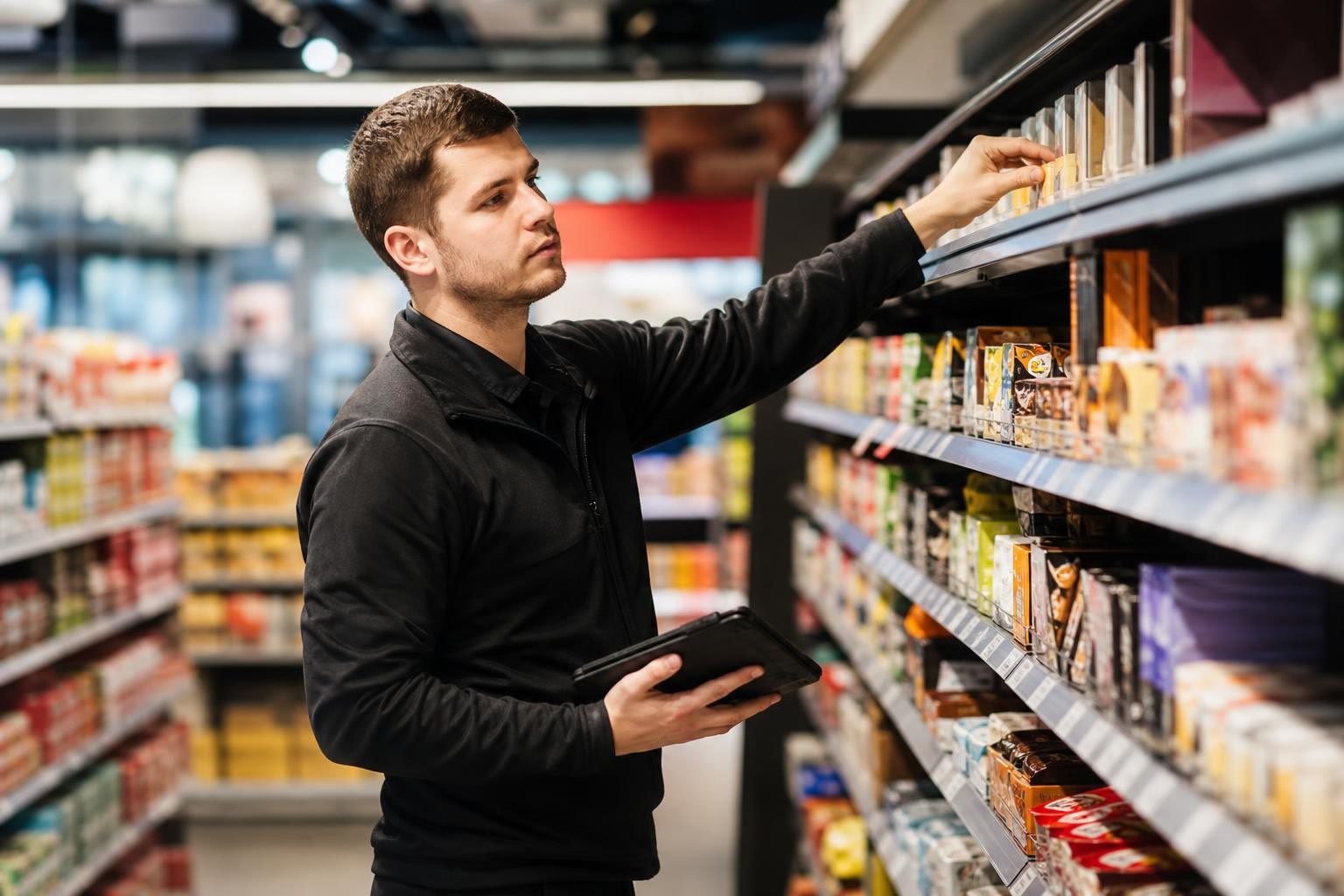
Phase 4: In-Store Execution and Compliance
Most FMCG brands structure their audits around the “Perfect Store” framework. The six core KPIs are:
-
On-shelf availability (OSA): Is the product physically on the shelf? This is the most fundamental metric. If it is not there, nothing else matters. Stockouts in FMCG average around 8% but jump to 10% for promoted lines. Harvard Business Review research found that 72% of out-of-stocks are caused by faulty in-store ordering and replenishment practices, not supply chain failures.
-
Planogram compliance: Is the product in the correct location, at the right shelf height, with the agreed number of facings?
-
Share of shelf: How does your facing count compare to competitors in the same category?
-
Promotional compliance: Is the agreed promotional display actually built? Is the POS material in place? A POI/Quri study found that only 10% of brands get the promotional performance they planned.
-
Pricing accuracy: Does the shelf-edge label match the agreed promotional price?
-
Out-of-stock rate for promoted lines: Promoted products go out of stock faster than base range, and the sales you lose during a promotional window are gone permanently.
One LinkedIn practitioner made a strong point: self-reported execution creates false confidence. Checklists get marked complete, photos can be selective, and dashboards turn green while displays are late or missing. Execution should be observable and verifiable through independent evidence, not just internal reporting.
For a detailed breakdown of audit approaches, including the tradeoffs between traditional field teams and crowdsourced retail audits, it is worth comparing both models before committing budget.
See how in-store compliance audits work across UK grocery and health-and-beauty retailers.
Phase 5: Promotional Mechanics
The promotional layer of your shopper activation campaign checklist should go beyond price cuts. An environment purely focused on price-based promotions is a race to the bottom in profit terms. With 72% of consumers saying they want more promotions and 62% saying they are loyal to retailers that offer them, the opportunity is clear. But promotion does not have to mean discount.
Common shopper activation mechanics include:
- Sampling: Physical in-store sampling or delivered trial packs. Compare the strengths of sampling versus cashback promotions to pick the right format for your objective.
- Cashback and “try me free”: Shoppers buy at full price and claim money back, creating a real sales signal at retailer level.
- On-pack promotions: QR codes linking to competitions, recipe content, or loyalty rewards.
- QR-activated rewards: Scanning on-pack codes to unlock discounts on a next purchase, building a direct relationship with the shopper.
- Review-driven activation: Asking verified purchasers to leave honest reviews on retailer PDPs, combining trial with digital shelf building.
Brands that master shopper activation strategies, particularly those powered by the right technology, are achieving sales uplifts of up to 26%. With investment in UK retail media forecast to reach £2 billion by 2027 (IAB UK), some brands are now allocating half of their marketing budgets toward this channel.
The key question for this phase: does your promotional mechanic create lasting value (reviews, data, repeat purchase) or just a temporary sales spike?
Phase 6: Measurement and Post-Campaign Review
Collect sales data before, during, and after the activation. The “before” period establishes a baseline. The “during” period measures immediate impact. The “after” period reveals whether the activation created sustained change or just pulled forward demand.
KPIs to track in your shopper activation campaign checklist:
| KPI | What It Tells You |
|---|---|
| Sales uplift (% vs. baseline) | Did the activation drive incremental volume? |
| Conversion rate change on PDP | Did review generation improve online purchase rates? |
| Review volume and recency | Are you above the credibility threshold? Is review flow sustained? |
| OSA improvement | Did compliance audits reduce out-of-stocks? |
| Promotional compliance rate | What percentage of stores executed the plan correctly? |
| ROI per verified review | What is the cost to generate one review, relative to its conversion impact? |
| Wasted spend identification | How much budget went to stores or tactics that underdelivered? |
The gap between planned and actual execution is where most revenue leaks occur. For a closer look at where budget disappears, read about invisible revenue leaks in retail execution.
Key Terms Glossary
| Term | Definition |
|---|---|
| Shopper activation campaign | A coordinated set of tactics targeting consumers at the point of purchase to drive immediate buying behaviour, spanning digital shelf, in-store, and promotional channels. |
| Brand activation | Broader marketing efforts (events, experiential, sponsorships) to build awareness. Shopper activation is a subset focused on the purchase moment. |
| First Moment of Truth (FMOT) | P&G’s concept that shoppers decide in 3 to 7 seconds whether to pick up a product on shelf. The foundational idea behind shopper marketing as a discipline. |
| Perfect Store framework | An audit model measuring six KPIs (OSA, planogram, share of shelf, promotional compliance, pricing, OOS rate) to assess in-store execution quality. |
| On-shelf availability (OSA) | Whether the product is physically present and accessible to shoppers. The most basic and critical in-store metric. |
| Planogram compliance | Whether products are placed in the correct shelf position, at the right height, with the agreed number of facings. |
| Promotional compliance | Whether the trade promotion you negotiated and paid for actually appears in-store as planned. |
| Digital shelf | The online equivalent of a physical shelf: product detail pages, search ranking, images, ratings, and reviews on retailer websites. |
| Review credibility threshold | The minimum number of reviews (roughly 26 or more) a product needs before most consumers consider it trustworthy enough to purchase. |
| Review recency | How recently reviews were posted. 77% of consumers distrust reviews older than three months. |
| Verified review | A review posted by a confirmed purchaser, often marked with a “verified buyer” badge. Increases purchase likelihood by 15% compared to anonymous reviews. |
| Retail media | Advertising space sold by retailers on their own platforms (websites, apps, in-store screens). Forecast to reach £2bn in UK spend by 2027. |
| Sales uplift | The percentage increase in sales attributable to a specific activation, measured against a pre-campaign baseline. |
| Share of shelf | The proportion of shelf space or facings a brand holds relative to its competitors in the same category. |
FAQs
What is the difference between shopper activation and brand activation?
Brand activation covers any marketing effort that drives awareness and engagement, including events, experiential campaigns, and sponsorships. Shopper activation is narrower, focused specifically on the point of purchase. It targets the moment when a consumer decides whether to put a product in their basket, whether that basket is physical or digital.
How many reviews does a UK grocery product need?
Research suggests at least 26 reviews to cross the credibility threshold where most consumers will consider the product. However, volume alone is not enough. Reviews must be recent (77% of shoppers distrust reviews older than three months) and authentic. A product with 15,000 reviews at 3.75 stars will typically outsell one with 100 reviews at 4.0 stars. Volume beats a perfect rating.
What KPIs should I track for a shopper activation campaign?
The core KPIs are sales uplift versus baseline, promotional compliance rate, on-shelf availability, review volume and recency on retailer PDPs, conversion rate changes, and ROI per activation tactic. The specific mix depends on your campaign objectives, but any good shopper activation campaign checklist should include both digital and physical metrics.
Is shopper activation only in-store?
No. That is a common misconception. Shopper activation happens anywhere a purchase decision is made, including retailer websites, apps, and marketplace PDPs. For UK FMCG brands, the digital shelf (Tesco.com, Sainsburys.co.uk, Ocado, Boots.com) is now as important as the physical shelf. A complete checklist covers both environments.
Why do most shopper activation campaigns underperform?
The strategy is usually sound. Execution is where campaigns break down. Only 10% of brands get the in-store promotional execution they planned. Stockouts hit 10% on promoted lines. And most retailer PDPs lack the review volume needed to convert online shoppers. Closing these gaps requires independent verification, not just internal reporting.
What is the Perfect Store framework?
It is an audit model used by most major FMCG companies to assess in-store execution. The six standard KPIs are on-shelf availability, planogram compliance, share of shelf, promotional compliance, pricing accuracy, and out-of-stock rate. For a full guide, read about retail execution audit KPIs.
Build Your Shopper Activation Campaign Checklist
A shopper activation campaign checklist that only covers one channel will miss the majority of failure points. The brands seeing consistent results treat activation as a three-layer system: digital shelf readiness (reviews, ratings, content), in-store compliance (audits, availability, POS), and shopper advocacy (real purchasers creating verified signals). Each layer reinforces the others.
Book a demo with Brand Allies to see how UK FMCG brands are building all three layers through a single managed-service platform backed by 250,000+ UK shoppers.