
TL;DR
Real shoppers marketing uses verified, everyday consumers (not influencers or agency teams) to buy, try, review, and advocate for products on retailer websites and in physical stores. It addresses the growing crisis of fake reviews and the chronic lack of review coverage on UK grocery product pages. For FMCG brands selling through Tesco, Sainsbury’s, Ocado, and similar retailers, it is one of the most direct ways to build authentic social proof where purchase decisions actually happen.
What Is Real Shoppers Marketing?
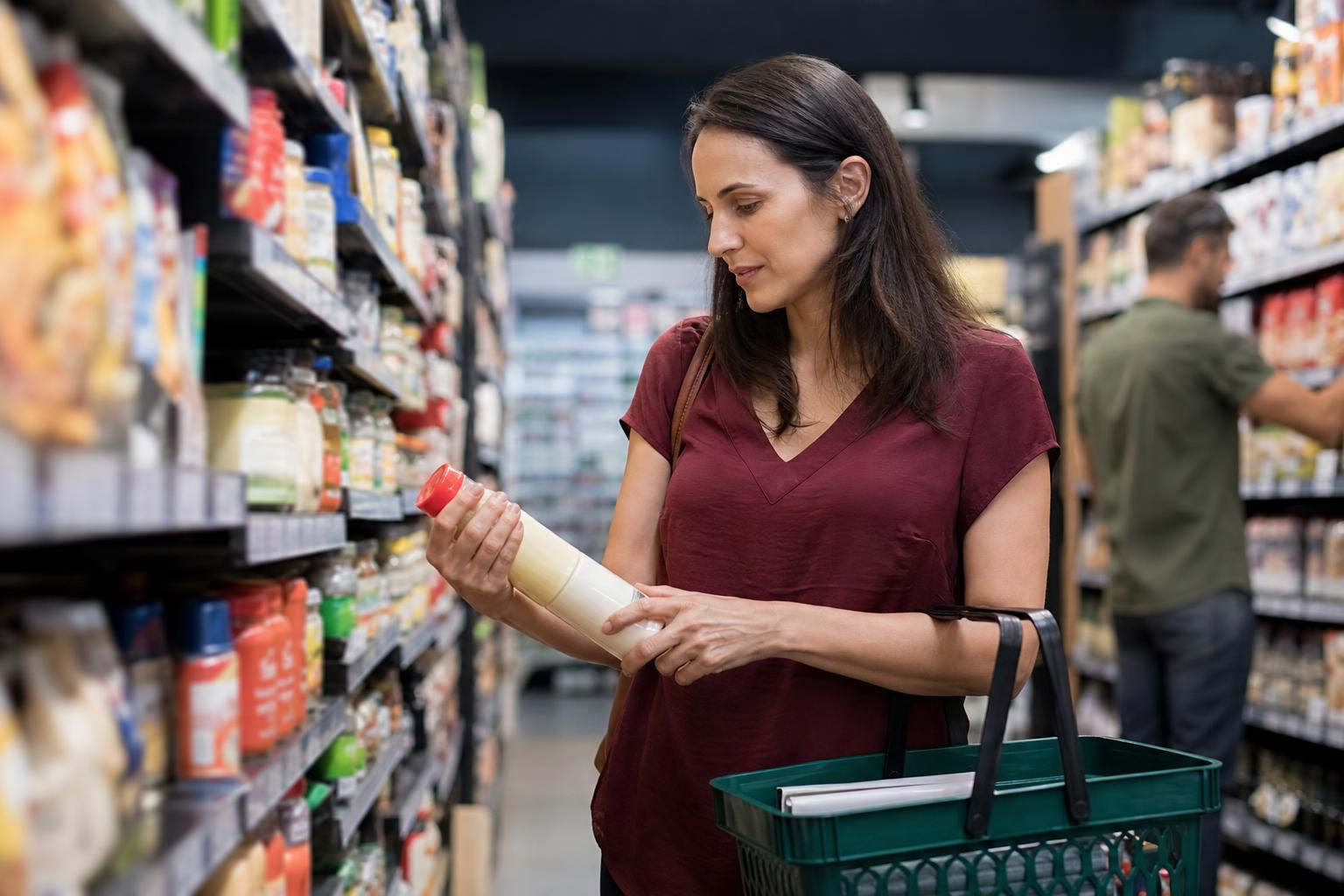
Real shoppers marketing is a form of shopper marketing where the marketing mechanism is the shopper themselves. Rather than relying on brand-created content, paid influencers, or agency creative teams, the approach deploys genuine, verified consumers to purchase products through normal retail channels and share their honest experiences, whether that means posting a review on a retailer’s product detail page (PDP), conducting a shelf audit in a local store, or generating user-created content after a product trial.
The concept builds on foundations laid decades ago. In 2005, A.G. Lafley, then CEO of Procter & Gamble, coined the “First Moment of Truth” (FMOT), the three to seven seconds when a shopper first encounters a product on a shelf or screen. Google later added the “Zero Moment of Truth” (ZMOT), the research phase that happens before a shopper even reaches the shelf. Real shoppers marketing adds what you might call the “Advocacy Moment,” where actual buyers become the proof that nudges the next shopper toward purchase.
One distinction matters here. Traditional marketing typically targets the consumer, the person who uses the product. Shopper marketing targets the shopper, the person who makes the purchase decision. These are often different people. A parent buying cereal for their children is the shopper; the children are the consumers. Real shoppers marketing focuses squarely on the shopper, because the shopper’s voice carries the most weight with other shoppers.
Explore verified review services for UK retailer product pages.
Why “Real” Matters: The Authenticity Gap
The word “real” is doing serious work in this term, and it is not just a marketing modifier. It is a direct response to a trust crisis that has been building for years.
Fake Reviews Are Everywhere
Roughly 30% of online reviews are considered fake as of 2025, costing consumers an estimated $770.7 billion globally in misdirected purchases. According to a Harris Poll report, 67% of consumers trust online reviews less than they did five years ago, and 90% say fake reviews are a concern. The problem is not abstract. It shapes how shoppers evaluate every product they consider buying online.
Taylor Strickland, director of media channel strategy at VML, put it plainly in an eMarketer interview: “People are becoming less trusting of product reviews on places like Amazon due to black hat tactics. They’re looking for authenticity.”
Consumers Want Proof From Actual Buyers
The data on this is consistent across studies. Sixty-five percent of consumers say they trust customer content more than influencer posts, and only 14% say celebrities influence their purchase decisions. Among Gen Z, 82% report greater trust in brands that feature real customers in their marketing. The message is clear: shoppers trust other shoppers, not spokespeople.
This preference extends to how reviews look. Nearly 40% of consumers consider reviews with photos more credible than text-only reviews, because images signal that a real person actually used the product.
The Grocery Review Desert
Here is the specific problem for FMCG brands. While Amazon products often accumulate hundreds or thousands of reviews, the average grocery review rate on UK retailer websites sits at just 0.1% to 0.3%. Analysis of product-level ratings and reviews on Sainsbury’s website found that a small number of suppliers had invested in gathering reviews while most had done almost nothing. Some categories had thousands of reviews. Others had a handful.
This creates a measurable competitive gap. Products with 50 or more reviews achieve 4.6 times higher conversion rates than products with fewer reviews. For low-priced items, reviews can boost conversion by 190%. For higher-priced items, the lift can reach 380%. Understanding your first 30 product reviews and how to reach that threshold is a concrete, measurable goal, not a vague brand-building exercise.
Real Shoppers Marketing vs. Related Approaches
The term is easy to confuse with adjacent marketing disciplines. This comparison should clarify where the boundaries sit.
| Dimension | Traditional Shopper Marketing | Influencer Marketing | Real Shoppers Marketing |
|---|---|---|---|
| Who executes | Brand and agency creative teams | Paid content creators | Verified, everyday shoppers |
| Primary channel | In-store POS, displays, promotions | Social media platforms | Retailer PDPs, stores, social |
| Trust signal | Brand-controlled messaging | Creator credibility and disclosure | Verified purchase proof |
| Primary output | Brand awareness, impulse purchase | Reach and brand awareness | Reviews, UGC, audit data |
| Authenticity level | Low (brand voice) | Medium (disclosed partnership) | High (real buyer experience) |
| UK grocery relevance | High in-store | Lower for grocery categories | Directly addresses the review gap |
A related distinction worth understanding is the difference between brand advocacy and influence. Influencer marketing pays for access to an audience. Shopper advocacy strategies cultivate relationships with people who genuinely enjoy the product. The outputs look similar (reviews, social posts, recommendations) but the motivation and credibility are fundamentally different.
Practitioners on Reddit and forums increasingly point to this difference. As Forbes noted in March 2026, consumers are “looking for real conversations that address their specific questions about a future purchase,” and platforms built on user-driven dialogue are gaining trust precisely because the recommendations come from actual buyers with no financial stake in the outcome.
How Real Shoppers Marketing Works in Practice
The approach spans three main activities, each using real consumers as the execution layer.
Verified Product Reviews on Retailer Websites
Real shoppers purchase products through normal retail channels (Tesco, Sainsbury’s, Ocado, Boots, and others) and then post honest reviews on the product detail page. Because the purchase is verified, the review carries a “verified buyer” badge on most retailer platforms, which increases purchase likelihood by 15% compared to anonymous reviews.
This matters especially for new product launches and challenger brands trying to build credibility against established competitors. A new SKU with zero reviews is nearly invisible on the digital shelf, both to shoppers browsing the category and to retailer search algorithms that weight review volume and recency.
For brands launching into UK grocery, understanding retailer search ranking factors and how reviews feed into those algorithms is essential context.
In-Store Activations and Compliance Audits
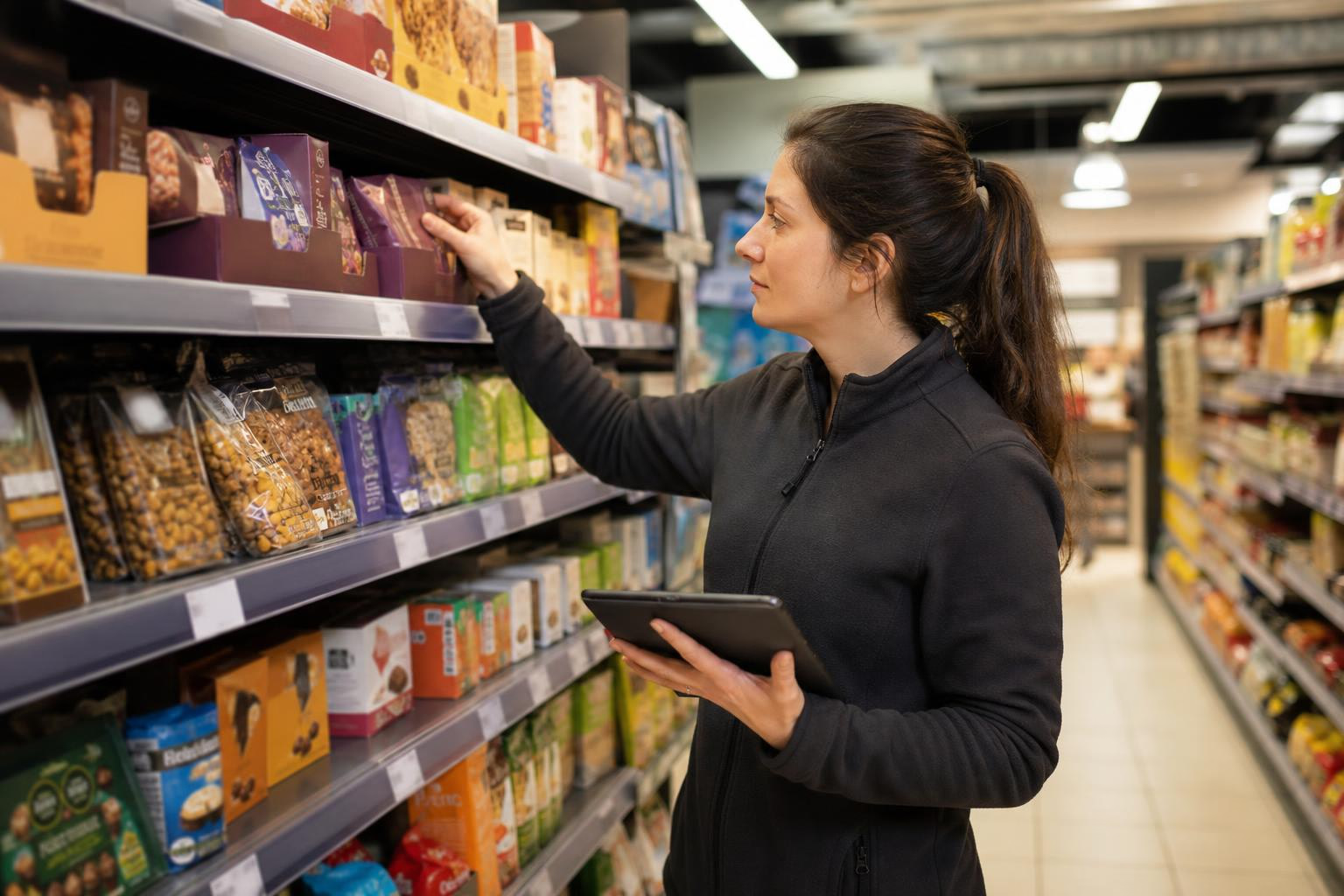
Real shoppers marketing is not purely digital. It also includes physical store activities conducted by genuine shoppers rather than dedicated field marketing teams. These shoppers visit stores to check whether promotional displays are correctly set up, whether pricing matches the agreed deal, whether products are actually on the shelf, and whether point-of-sale materials are visible.
This matters because up to 30% of products can be missing or incorrectly merchandised at any given time. Out-of-stocks alone can reduce sales by 30% to 50% immediately. Using real shoppers for in-store compliance audits gives brands faster, more scalable visibility into what is actually happening at shelf level.
Product Trial and UGC Campaigns
In product trial campaigns, real shoppers buy and try products, then share their genuine experiences through reviews, photos, or social content. The critical difference from traditional sampling programmes is that these shoppers make real purchases through real retail channels, creating verified transaction data alongside authentic content.
The performance data supports this approach. Shoppers who engage with user-generated content become paying customers 144% more often and generate 162% more revenue per visitor. UGC outperforms traditional brand advertising for 90% of consumers, and 84% of Millennials say it directly influences their purchasing decisions.
Key Metrics in Real Shoppers Marketing
This is not a “brand awareness” play that is hard to measure. The core metrics are specific and trackable.
Review velocity and recency. A steady flow of new reviews outperforms a one-time spike. Shoppers check when reviews were posted, and stale reviews reduce trust. Understanding what review velocity means and how to maintain it is a practical priority.
Star rating thresholds. The sweet spot for conversion is a rating between 4.0 and 4.7. Products rated a perfect 5.0 actually convert worse because shoppers suspect the ratings are not genuine. Counterintuitive, but consistent across studies.
The credibility threshold. Bazaarvoice research found that shoppers consider a product most credible when it has 10 to 50 reviews. Products with fewer than 10 reviews or more than 1,000 reviews are considered less credible. In UK grocery specifically, the functional threshold tends to sit around 20 to 30 reviews, the point where shoppers begin to trust the aggregate rating.
Conversion lift from reviews. The numbers are dramatic. Products crossing the credibility threshold see measurable increases in conversion rate, retailer search ranking, and inclusion in retailer media and promotional opportunities. Brands looking to quantify this should consider how to calculate review ROI against their specific category benchmarks.
In-store compliance rates. For the physical component, the metrics include on-shelf availability, POS compliance rates, pricing accuracy, and distribution checks, all reported by real shoppers in real stores.
The Digital Shelf Context
As of December 2025, approximately 10% of all UK food retail sales were made online. That figure continues to grow. For FMCG brands, this means the product detail page on Tesco.com or Sainsbury’s website is not a secondary channel. It is a primary sales environment.
In that environment, real shoppers marketing serves the same function that a good shelf position and eye-catching packaging serve in a physical store. It draws attention to a product in a crowded vertical where many items are essentially parity products. The difference is that on the digital shelf, the persuasion comes from peer validation rather than visual merchandising.
Products with higher ratings, greater review volume, and recent review activity are more likely to rank higher in retailer search results, get included in retailer media and promotional campaigns, and survive range reviews where retailers decide which products to keep and which to cut.
Common Misconceptions
“Isn’t this just paid reviews?”
No. Real shoppers marketing involves verified purchases through normal retail channels and honest, unscripted opinions. The shopper buys the product with real money, uses it, and writes what they actually think. Reviews that do not meet retailer moderation standards (for example, those that appear scripted or promotional) get rejected. The output is authentic product reviews, not manufactured endorsements.
“How is this different from product sampling clubs?”
Scale, retailer specificity, and the verified purchase signal. Traditional sampling programmes send free products and hope for social posts. Real shoppers marketing generates reviews on specific retailer PDPs, tied to verified transactions, which feed directly into retailer search algorithms and conversion metrics.
“Don’t retailers reject these reviews?”
Compliant programmes use real purchases and genuine opinions. Most UK retailers accept reviews from verified buyers regardless of how those buyers discovered the product. The key is compliance with retailer terms and ASA CAP Code requirements around disclosure.
“This only works for online.”
It doesn’t. The in-store component (shelf audits, compliance checks, availability monitoring) is equally important. Many brands find the combination of digital reviews and physical store intelligence creates a feedback loop that strengthens both channels.
When to Consider Real Shoppers Marketing
The approach is most valuable in specific situations:
- New product launches where the PDP has zero reviews and conversion is suffering as a result
- Challenger brands entering categories dominated by established products with significant review counts
- Range review preparation where demonstrating shopper demand and satisfaction can protect distribution
- Retailer negotiations where review data and in-store compliance evidence strengthen the brand’s position
- Seasonal or promotional pushes where a burst of fresh reviews and UGC can amplify the impact of existing media spend
For brands navigating any of these scenarios, a real shoppers marketing programme provides measurable, auditable proof of genuine consumer demand.
Book a demo to see how Brand Allies can help build authentic review coverage on UK retailer websites.
Frequently Asked Questions
What is the difference between real shoppers marketing and shopper marketing?
Shopper marketing is the broad discipline of influencing purchase decisions at or near the point of purchase, typically through in-store displays, promotions, and brand-controlled messaging. Real shoppers marketing is a specific approach within that discipline that uses verified, everyday consumers as the marketing mechanism, generating authentic reviews, UGC, and store-level intelligence rather than relying on agency-created content.
How many reviews does a grocery product need to be credible?
Research from Bazaarvoice indicates that 10 to 50 reviews is the most credible range. In UK grocery specifically, the practical threshold tends to be around 20 to 30 reviews, the point where shoppers begin to trust the aggregate star rating enough to influence their purchase decision.
Is real shoppers marketing compliant with retailer review policies?
Yes, when executed properly. Compliant programmes involve real purchases through normal retail channels and honest, unscripted opinions. Reviews are subject to each retailer’s standard moderation process. Any programme that scripts reviews or incentivises specific ratings would not qualify as real shoppers marketing.
Does real shoppers marketing only apply to online retail?
No. While verified product reviews on retailer websites are a major component, the approach also includes in-store activities such as shelf compliance audits, POS visibility checks, and product trial activations conducted by real shoppers in physical stores.
How does real shoppers marketing compare to influencer marketing for FMCG?
Influencer marketing pays creators with established audiences to promote products, primarily on social media. Real shoppers marketing uses ordinary, verified buyers to create content and reviews on retailer platforms. Research shows 65% of consumers trust customer content more than influencer posts, and verified reviews carry more weight in retailer search algorithms than social media mentions.
Why is the grocery review rate so low compared to Amazon?
Most UK grocery retailers have historically underinvested in review infrastructure, and the low unit price of grocery items means shoppers rarely feel motivated to leave reviews unprompted. The result is a review rate of roughly 0.1% to 0.3% on grocery retailer websites, compared to 2% to 5% on Amazon, creating both a problem and an opportunity for brands willing to act.
Can real shoppers marketing help during retailer range reviews?
Products with stronger review profiles (higher volume, better ratings, recent activity) are more likely to survive range reviews because they demonstrate active consumer demand. The review data provides concrete evidence that shoppers are buying, using, and valuing the product, which strengthens a brand’s position during negotiations with retail buyers.