
TL;DR
Product sampling for reviews is the practice of giving consumers free or discounted products with the specific goal of generating honest reviews on retailer websites. Unlike traditional sampling (which targets trial and awareness), the primary KPI here is published review content. For UK FMCG brands selling through supermarkets where organic review rates sit below 0.3%, it’s often the fastest compliant route to building the review coverage that drives conversion, retailer search ranking, and range retention.
Considering a review campaign for your products? Brand Allies’ review service generates verified purchase reviews on Tesco, Sainsbury’s, Boots, Ocado, and other major UK retailers.
What Is Product Sampling for Reviews?
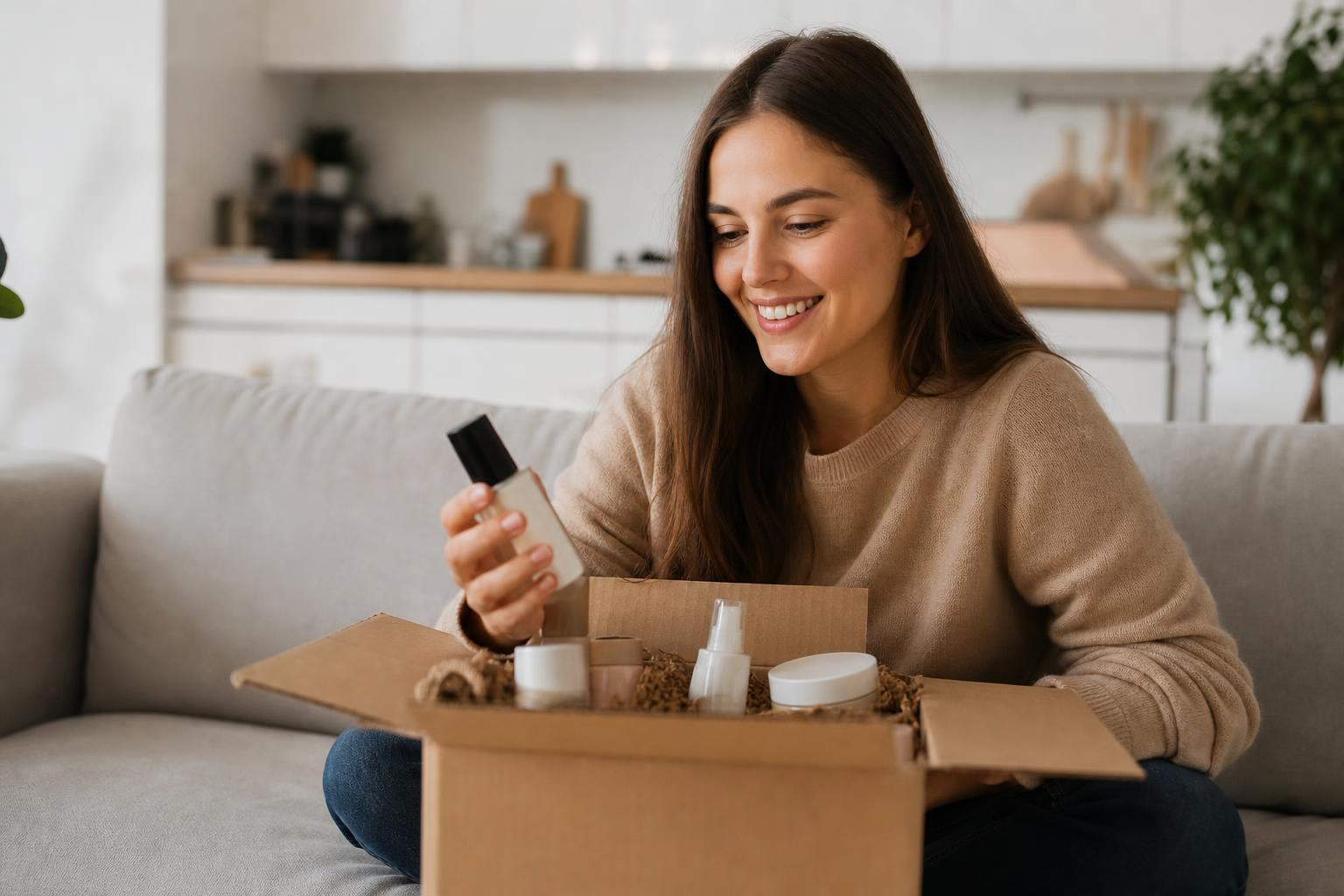
Product sampling for reviews is when a brand provides free or reimbursed products to consumers who then share their honest experience as a review, typically on a retailer’s product detail page (PDP). The consumer tries the product in a real-world setting and posts feedback where other shoppers can read it before buying.
This is different from traditional product sampling, where the goal is trial, awareness, or in-store purchase. With a traditional sampling station at Tesco or Sainsbury’s, success is measured by how many people tried the product and whether sales lifted that week. With product sampling for reviews, success is measured by how many published reviews appear on the retailer website afterward.
It’s also different from product seeding, which involves sending free products to a small, targeted group of influencers or content creators. Product seeding prioritises social media reach and user-generated content on platforms like Instagram or TikTok. Product sampling for reviews prioritises review content on the actual retailer pages where shoppers make purchase decisions. For a deeper comparison, see our guide on influencer gifting vs. review campaigns.
A simple way to think about it: traditional sampling asks “did they try it?”, product seeding asks “did they post about it?”, and product sampling for reviews asks “did they review it where shoppers buy it?”
How Sampling-for-Reviews Campaigns Work
The mechanics vary depending on the model, but the general flow looks like this:
-
Product selection. The brand identifies SKUs that need review coverage, usually new launches, reformulated products, or lines with thin review counts on key retailers.
-
Shopper recruitment. A community of shoppers is targeted based on demographics, shopping habits, and retailer preferences. Some platforms maintain their own panels; others recruit per campaign.
-
Purchase or receipt. Depending on the model, the shopper either receives the product by post or buys it at a specific retailer. The “buy” route matters because it generates a verified purchase review, which retailers treat as more credible.
-
Trial period. The shopper uses the product at home, long enough to form a genuine opinion.
-
Review submission. The shopper posts an honest review on the retailer’s website. The review must reflect their actual experience, and the brand cannot require a positive rating.
-
Moderation. The retailer’s own moderation system checks the review. Some get approved immediately; some get flagged or rejected. This is a real-world constraint that brands need to plan for.
The Five Main Sampling Models
Not all product sampling for reviews works the same way. Here are the main models, each with different trade-offs:
Physical mail-out sampling. The brand ships product directly to pre-screened panellists. They try it at home and post a review. This is the model used by large platforms like Bazaarvoice (through their Influenster community) and PowerReviews. The downside: reviews often need to be syndicated to retailer sites rather than appearing as verified purchase reviews. Our product sampling platform comparison breaks down how the major platforms handle this.
Digital cashback sampling (buy-try-review). The consumer buys the product at full price from a retailer, submits proof of purchase, and gets reimbursed. Because the shopper actually bought the product at that retailer, the review shows as a verified purchase. This is the model most relevant to UK grocery.
In-store demo sampling. The classic free sample station. Great for immediate trial (one study found a 475% sales increase on sampling day), but historically poor at converting to online reviews because there’s no structured follow-up mechanism.
Influencer seeding. Products sent to targeted creators expecting social content. Higher reach per unit, but much lower review-per-unit yield on retailer websites.
Subscription box or insert sampling. Placing samples inside subscription boxes (beauty boxes being the obvious example). Good for awareness but low review conversion without explicit follow-up prompts.
Verified Purchase Reviews vs. Syndicated Reviews
This distinction matters more than most brand managers realise. A verified purchase review is one where the retailer can confirm the reviewer actually bought the product through their platform. Syndicated reviews are written elsewhere (on a brand site or sampling platform) and then distributed to retailer sites.
Most UK grocery retailers treat verified purchase reviews with higher trust. Some retailers don’t accept syndicated reviews at all. This is why the buy-try-review model has become increasingly important for brands selling through Tesco, Sainsbury’s, and similar retailers. For more on what makes a review “verified,” see our verified product reviews glossary.
Why FMCG Brands Need Product Sampling for Reviews
The Grocery Review Gap
Here’s the core problem. The average review rate on UK supermarket websites sits at roughly 0.1% to 0.3% of purchases. On Amazon, that figure is 2% to 5%. This means a product selling steadily through Tesco Online might accumulate only a handful of reviews over several months, while the same product on Amazon builds dozens.
That gap creates a vicious cycle. Few reviews mean low visibility in retailer search. Low visibility means fewer sales. Fewer sales mean even fewer organic reviews.
Product sampling for reviews breaks that cycle by generating a critical mass of reviews in weeks rather than months.
The Conversion Impact of Reviews
The data on this is consistent and significant. Products with just five reviews are 270% more likely to be purchased than products with none. For lower-priced items (typical of grocery), reviews can lift conversion rates by 190%. For higher-priced items, the boost reaches 380%.
Engaged interaction with reviews, photos, and other user-generated content drives a 102% conversion rate increase according to Bazaarvoice’s data. These aren’t marginal gains. They’re the difference between a product that sells and one that gets delisted.
The 30-Review Credibility Threshold
Research from CheckoutSmart, based on 3,710 online supermarket shoppers, found something striking: if your product has fewer than 30 reviews and a competitor has 30 or more (even with a lower average star rating), the competitor gets chosen at least two-thirds of the time.
That number, 30, acts as a credibility threshold. Below it, shoppers don’t trust the rating enough to rely on it. Above it, additional reviews matter less for credibility and more for freshness. Our detailed breakdown of why those first 30 reviews matter explains how to plan around this threshold.
Review Recency as a Trust Signal
Volume alone isn’t enough. 81% of consumers consider review recency equal to or more important than review quality. Even more telling, 58% of consumers would rather buy a product with fewer but more recent reviews than one with more but older reviews.
This has a direct implication for how brands should think about product sampling for reviews. A one-time spike of 50 reviews that then goes stale for six months is less effective than a steady flow of 10 reviews per month. The CheckoutSmart research confirms this: once you reach 30 reviews, the main reason to keep generating them is freshness, not volume.
The Star Rating Sweet Spot
Brand managers often assume a perfect 5.0-star average is the goal. The data says otherwise. Shoppers are most likely to buy products rated between 4.0 and 4.7 stars. Hit a pristine 5.0, and shoppers get sceptical, suspecting the reviews are filtered or fake.
This is actually good news for sampling campaigns. Because the brand cannot (and legally must not) require positive reviews, the resulting mix of genuine 4- and 5-star reviews with the occasional 3-star lands right in that conversion sweet spot.
UK Compliance: What Changed in 2025
This is the section most guides on product sampling for reviews skip entirely, but for UK brands, it’s now the most important part. Two regulatory shifts have changed the rules.
The DMCCA 2024 Fake Reviews Ban
Since 6 April 2025, fake reviews are explicitly illegal under the Digital Markets, Competition and Consumers Act 2024. The Act defines a fake review as any consumer review that “purports to be, but is not, based on a person’s genuine experience.”
The banned practices include submitting or commissioning fake reviews, concealing incentives provided for reviews, and publishing reviews (or information derived from them) in a misleading way. The Competition and Markets Authority (CMA) now has powers to enforce this through administrative proceedings, including compliance directions and significant fines.
For product sampling for reviews, this means every review must be based on genuine product use. The shopper must actually try the product. The review must reflect their real opinion.
ASA CAP Code Rule 3.45: Incentivised Reviews
Rule 3.45 of the ASA CAP Code requires that when reviewers have received any incentive to leave a review (a free product, a discount voucher, cashback reimbursement), that incentive must be clearly disclosed. The review must be labelled so consumers understand the context.
Critically, the incentive must not be conditional on a positive review. Consumers must remain free to share their genuine experience, whether that’s 5 stars or 2 stars.
Rule 3.46: No Suppression of Negative Reviews
Brands cannot suppress negative reviews or give positive ones more prominence. This rule applies whether the reviews come from a sampling campaign or from organic purchases. Cherry-picking only favourable reviews from a sampling campaign would violate this rule.
Practical Compliance Checklist
For any product sampling for reviews campaign in the UK, brands should ensure:
- Shoppers actually purchase and use the product before reviewing
- All incentives (free product, cashback, reimbursement) are disclosed
- Rewards are rating-neutral, never conditional on a positive review
- No reviews are suppressed, filtered, or selectively published
- Retailer-specific moderation policies are understood and followed
For a full walkthrough of UK review campaign compliance, see our compliance guide for FMCG brands.
Key Benchmarks and What to Expect
Review Submission Rates
Managed sampling communities report high completion rates. PowerReviews found that 85% of consumers who receive a free sample go on to write a review. Bazaarvoice reports roughly 90%, with about 45 reviews returned per 50 samples sent.
These figures come from well-managed panels with clear expectations set upfront. Organic review rates (where no sampling is involved) are dramatically lower, especially on UK grocery sites.
Typical Timeline
Most managed sampling-for-reviews campaigns deliver published reviews within 2 to 4 weeks of kickoff. The actual speed depends on the model (mail-out adds shipping time, buy-try-review adds a purchase step), retailer moderation queues, and whether the shopper community is pre-recruited or assembled per campaign.
Cost Considerations
Pricing models vary widely. Large platforms like Bazaarvoice charge annual SaaS fees plus syndication costs. Practitioners on G2 reviewing PowerReviews have noted that “reviews are expensive but that’s part of the game,” reflecting the reality that the cost of generating reviews through sampling is significant, but the alternative (zero reviews on retailer PDPs) carries a bigger commercial penalty.
Users on TrustRadius evaluating Bazaarvoice have highlighted the syndication challenge: “We want to collect reviews from multiple touchpoints and it is difficult to aggregate that.” This points to a real operational friction that brand managers should factor into their model selection.
For a breakdown of what UK brands should expect to pay, see our review generation service pricing guide.
Common Mistakes in Product Sampling for Reviews
Targeting the wrong audience. Sending dairy products to people who don’t eat dairy, or sampling premium skincare to shoppers who buy budget ranges, leads to low completion rates and irrelevant reviews. Audience matching is the single biggest lever on campaign quality.
Not disclosing incentives. Under the ASA CAP Code and the DMCCA 2024, this is no longer just a best-practice recommendation. It’s a legal requirement. Failing to disclose that a reviewer received a free or reimbursed product risks enforcement action.
Expecting all five-star reviews. The 4.0 to 4.7 sweet spot means a realistic spread of ratings actually converts better than a wall of 5-star praise. Brands that panic about the occasional 3-star review are missing this point.
Running a one-time spike instead of a steady flow. A single burst of 50 reviews that ages for six months loses its conversion power. Review recency matters as much as volume. Plan for ongoing campaigns, not a one-off.
Ignoring retailer moderation. Each UK retailer has its own review moderation policies. Some reject reviews that seem templated or arrive in suspicious clusters. SoPost’s CEO has noted that “our most successful partners are not just doing sampling in a silo. Sampling is really integrated into their comms strategy, CRM strategy and broader marketing plans.” That integration extends to understanding how each retailer handles review moderation.
Treating all sampling models as equal. A mail-out sample that generates a syndicated review and a buy-try-review that generates a verified purchase review on Tesco are not the same thing. The latter carries more weight with both the retailer and the shopper.
The Market Opportunity
The global product sampling market is projected to reach $25 billion by 2027, growing at a CAGR of 8.2%. Digital sampling specifically shows a 25% higher conversion rate than physical sampling, and brands using sampling programs report 15% higher customer retention rates.
For UK FMCG brands, the opportunity is particularly acute. With 73% of consumers saying product samples would induce them to try a new brand and 84% of sample recipients leaving with positive purchase intent, sampling remains one of the most effective ways to drive trial. When that trial also generates reviews on the retailer websites where 98% of consumers check before purchasing, the ROI compounds.
Learn more about calculating the ROI of review campaigns.
Related Terms
Review seeding — The broader practice of proactively generating reviews for a product, whether through sampling, post-purchase emails, or other mechanisms.
Verified reviews — Reviews where the platform can confirm the reviewer purchased the product. Carry more weight with both shoppers and retailer algorithms.
Shopper advocacy — A marketing approach where real shoppers promote products through authentic actions like buying, reviewing, and recommending.
Digital shelf — The online equivalent of shelf space: how a product appears on retailer websites, including images, descriptions, ratings, reviews, and search position.
Retailer search ranking — The position a product appears in when shoppers search on retailer websites. Review volume, ratings, and recency all influence this. See our guide on retailer search ranking factors.
Ready to build review coverage on UK retailer websites? Brand Allies generates verified purchase reviews on Tesco, Sainsbury’s, Boots, Ocado, and more through a managed buy-try-review model with a UK shopper community. Book a demo to see how it works for your products.
Frequently Asked Questions
Is product sampling for reviews legal in the UK?
Yes, provided you follow the rules. Since April 2025, the DMCCA 2024 requires that all reviews reflect genuine product experience, incentives are disclosed, and brands do not suppress negative reviews or condition rewards on positive ratings. The ASA CAP Code (Rules 3.45 and 3.46) reinforces these requirements. Sampling-for-reviews campaigns that follow these rules are fully compliant.
How many reviews do I need to make a difference on a retailer website?
Research on UK supermarket shoppers shows that 30 reviews is the key credibility threshold. Below 30, shoppers will choose a competitor with more reviews even if that competitor has a lower star rating. Getting to 30 should be the first milestone for any product sampling for reviews campaign.
What’s the difference between syndicated reviews and verified purchase reviews?
Syndicated reviews are written on one platform and distributed to retailer sites. Verified purchase reviews are posted directly on the retailer where the shopper bought the product, and the retailer can confirm the purchase. Most UK grocery retailers give more weight to verified purchase reviews, and some don’t accept syndicated reviews at all.
How quickly will I see reviews from a sampling campaign?
Most managed campaigns produce published reviews within 2 to 4 weeks. The exact timeline depends on the sampling model, shipping logistics, trial period, and retailer moderation speed.
What review submission rate should I expect?
Well-managed sampling communities report 85% to 90% submission rates. These figures assume pre-screened, motivated participants with clear expectations. Unmanaged or loosely structured campaigns will see significantly lower rates.
Do sampling reviews always have to be positive?
No, and they shouldn’t be. UK law explicitly prohibits making incentives conditional on positive reviews. Beyond compliance, the data shows that products rated between 4.0 and 4.7 stars convert better than those with a perfect 5.0, because shoppers find a mix of ratings more trustworthy.
Should I run one big sampling campaign or spread it out?
Spread it out. Since 58% of consumers prefer products with fewer but more recent reviews, a steady flow beats a one-time spike. Once you reach 30 reviews, the primary value of additional reviews comes from maintaining freshness rather than adding volume.
Can retailers reject reviews generated through sampling?
Yes. Each retailer has its own moderation policies. Reviews that appear templated, arrive in suspicious clusters, or violate the retailer’s terms can be rejected. This is a normal part of the process, and brands should plan for a moderation rejection rate in their campaign targets.