
TL;DR
Product trial campaigns are structured programmes that get FMCG products into consumers’ hands for the first time, through sampling, cashback offers, buy and review schemes, or in store demonstrations. They matter because 73% of consumers are likely to buy a product after trying it, compared to just 25% after seeing a TV ad. In UK grocery e commerce, trial campaigns serve a dual purpose: driving first purchases and generating the verified reviews that future shoppers rely on when they can’t pick up a product from the shelf.
A product with zero reviews on Tesco.com might as well be invisible. Shoppers scroll past it. The retailer’s search algorithm buries it. And the category buyer notices at the next range review.
This is the problem product trial campaigns exist to solve, and it’s getting more urgent every year as grocery shopping shifts online. If you’re a brand manager or shopper marketing lead at a UK FMCG company, understanding how trial campaigns work (and how the best ones close the loop through review generation) is no longer optional.
Explore review generation services to see how trial connects to retailer PDP reviews.
What Is a Product Trial Campaign?
A product trial campaign is any structured programme designed to get a product into a consumer’s hands for the first time. The goal is to convert awareness into experience, and experience into purchase behaviour.
The term is broader than “product sampling,” though the two are often used interchangeably. Here’s the distinction worth remembering:
- Product sampling refers to distributing free or trial sized products, whether in store, by post, at events, or through digital platforms.
- Product trial campaign is the strategic wrapper around sampling and other trial mechanics, including cashback promotions, buy and review programmes, and try before you buy schemes.
Sampling is one execution method. A trial campaign is the plan that ties the execution to a measurable business outcome.
For a deeper look at the sampling side specifically, see our guide to product sampling campaigns.
Why Product Trial Campaigns Exist
For most FMCG brands, the real challenge is not awareness. It’s converting awareness into a first purchase.
The numbers make this case plainly. According to research from Sampling Effectiveness Advisors, 73% of consumers said they were likely to buy a product after trying it, compared to only 25% who said the same about seeing a television commercial. That gap, nearly three to one, explains why brands keep investing in trial even when budgets are tight.
The stakes are highest for new product launches. Roughly 80 to 85% of FMCG launches fail, a statistic that has barely moved in decades. Trial campaigns specifically combat this failure rate by generating word of mouth, creating real purchase signals that retailers notice, and collecting the reviews and user generated content that build credibility on product detail pages.
The Online Grocery Shift Changes Everything
In a physical store, trial happens naturally. Shoppers pick products up, read labels, sometimes taste a sample at a demonstration stand. Online, none of that exists. Retail Economics predicts that e commerce will account for 53% of UK sales by 2028, up from around a fifth. This creates what researchers call the “sensory gap,” the inability to touch, smell, or taste a product before buying it online.
Reviews fill that gap. They are the online proxy for in store trial. A product with 30 genuine reviews on Sainsbury’s or Ocado gives shoppers the confidence to add it to basket in a way that a product photo alone cannot.
This means product trial campaigns in UK grocery e commerce now serve a dual purpose: get someone to experience the product, and get them to leave a review that enables future shoppers to overcome the sensory gap themselves. If your trial campaign stops at the point of product distribution, you’re doing half the job.
Types of Product Trial Campaign
Not all trial formats are created equal. They differ in cost, targeting precision, scalability, and (critically) their ability to generate retailer reviews. Here’s a breakdown of the main types.
In Store Sampling and Demonstrations
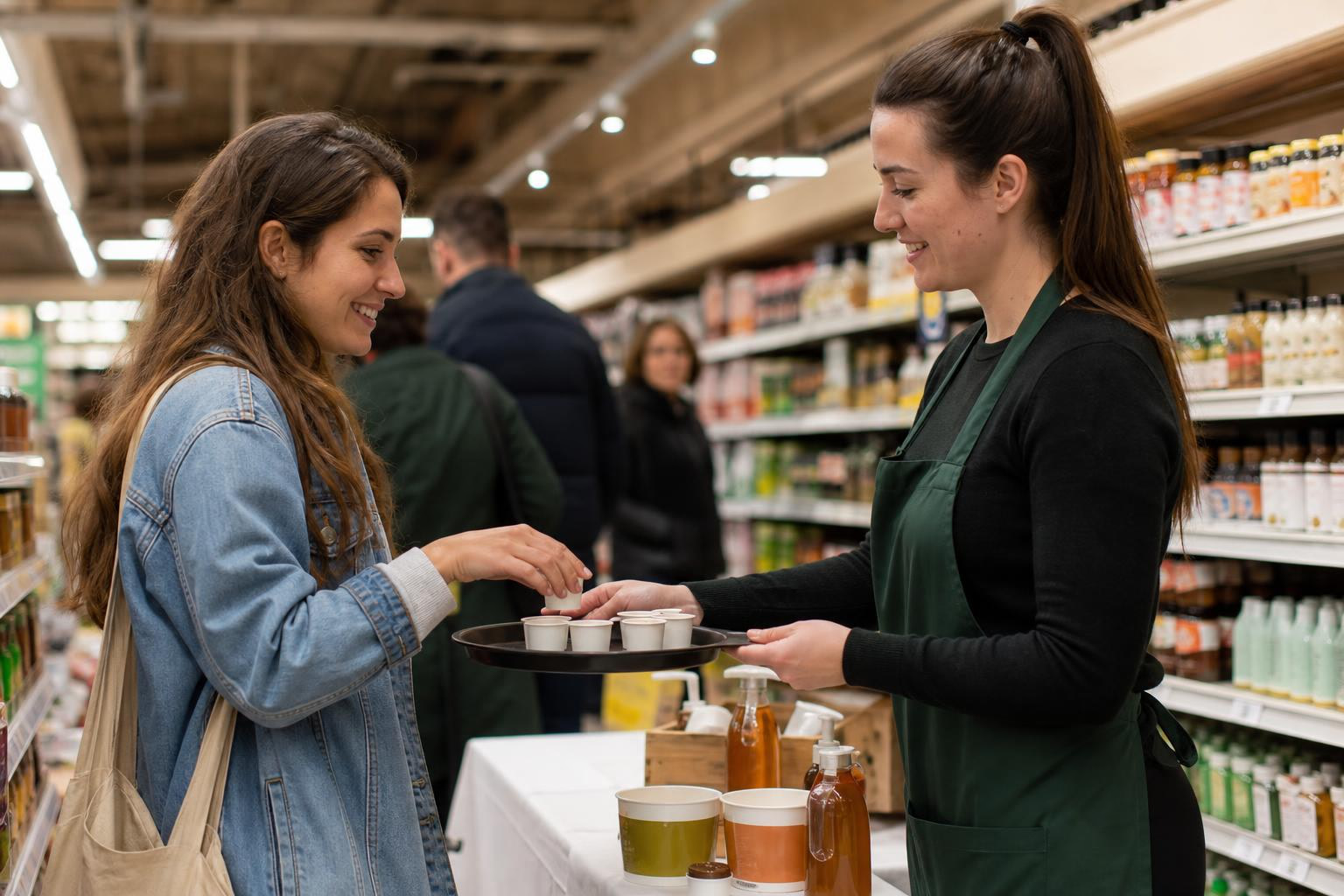
The classic approach. Set up a stand in a supermarket or shopping centre, hand out free samples, and let shoppers experience the product on the spot. It works particularly well for food and drink, where taste is the primary purchase driver. The limitation: it generates zero retailer site reviews unless you add a follow up loop, and it’s expensive to scale across multiple locations.
Brands running in store activity should also consider how in store compliance checks can verify that promotional displays are actually set up correctly, because up to 30% of products can be missing or incorrectly merchandised at any given time.
Direct to Home and Digital Sampling
Platforms like Sampl and SoPost ship physical samples to pre qualified consumers identified through digital targeting. This model offers better audience control than in store sampling and captures first party data. However, the reviews generated typically land on the platform’s own properties or social media, not directly on UK grocery retailer PDPs.
Word of Mouth Sampling
A specific variant of digital sampling where the programme is designed to spark organic conversations rather than just distribute products. Participants receive a product alongside a brief, with the expectation that they’ll share their genuine experience with friends, family, and social networks. Platforms like BzzAgent and The Insiders have built models around this approach. The strength is that recommendations from someone a consumer knows carry more weight than advertising. The weakness is the same as other non purchase models: word of mouth sampling rarely generates verified reviews on retailer websites unless the mechanic explicitly routes participants to buy and review on a specific retailer.
Community Sampling
Rather than targeting individuals through ads or lookalike audiences, community sampling taps into existing groups of engaged consumers. This might mean partnering with a parenting forum, a fitness community, a recipe sharing group, or a brand’s own loyalty programme members. The logic is simple: people who already self identify as interested in a category are more likely to try and talk about a new product. Practitioners on Reddit report that community based sampling tends to produce higher quality feedback than broad digital distribution, because participants genuinely care about the category. The trade off is smaller reach per activation, though the depth of engagement often compensates.
Cashback and Buy and Try Programmes
Consumers purchase the product at full price (or at a discount via cashback), try it at home, and are often encouraged to leave a review. This model is closer to real purchase behaviour because the shopper actually goes through the buying process. For a comparison of how these mechanics stack up, see our guide on sampling vs. cashback promotions.
Buy and Review Programmes
The format most relevant to UK grocery e commerce. Shoppers purchase the product from a specific retailer, use it, and post a verified review on that retailer’s website. Because the review is attached to a real transaction, it carries the “verified purchase” badge that builds shopper trust. This is the mechanic that directly addresses the review gap on Tesco, Sainsbury’s, Ocado, and other UK grocery PDPs.
Influencer Seeding
Product sent to creators for review content on social media. This generates reach and can reduce purchase hesitation when a trusted creator includes the product in their routine. The trade off: it doesn’t generate retailer site reviews, and attribution to actual sales is harder to track.
Event and Experiential Sampling
Distributing samples at festivals, sporting events, farmers’ markets, or trade shows. Good for awareness and brand building in specific demographics, but difficult to measure downstream purchase impact and unlikely to generate online reviews.
Collaborative and Bundled Sampling
Partnering with complementary brands to distribute samples together. A sauce brand bundling with a pasta brand, for instance. This reduces individual costs and extends reach, though targeting precision can suffer.
Comparison Table
| Format | Cost per Trial | Targeting Precision | Review Generation on Retailer PDPs | Scalability |
|---|---|---|---|---|
| In store sampling | High | Low | None (without follow up) | Limited by locations |
| Direct to home digital | Medium | High | Typically off site | High |
| Word of mouth sampling | Medium | Medium | Rarely on retailer PDPs | Medium to High |
| Community sampling | Low to Medium | High (within niche) | Depends on mechanic | Medium |
| Cashback / buy and try | Medium | Medium to High | Possible with follow up | High |
| Buy and review | Medium | High | Yes, verified purchase | High |
| Influencer seeding | Variable | Medium | No | Medium |
| Event sampling | High | Low to Medium | No | Limited by events |
| Collaborative sampling | Low to Medium | Medium | Depends on mechanic | Medium |
Choosing a Digital Sampling Platform
For brands moving beyond in store activity, selecting the right digital sampling platform is one of the most consequential decisions in campaign planning. The UK market has several options, and they differ in ways that matter.
The key evaluation criteria are audience quality, data capture capabilities, integration with retailer review ecosystems, and pricing model. Some platforms charge per sample shipped. Others take a flat campaign fee. A few operate on performance models tied to actions like reviews or social shares.
Sampl, for example, focuses on targeted digital sampling with strong data capture. SoPost specialises in social media integrated sampling where the sign up flow happens within an ad unit. Platforms like Shopmium and CheckoutSmart sit closer to the cashback model, routing consumers through a real purchase before reimbursement. Each has trade offs.
The question that separates good platform selection from bad: does the platform route trial participants toward the retailer where you need reviews, or does it capture feedback in its own walled garden? If reviews land on the platform’s website rather than on Tesco or Sainsbury’s, the trial may build social proof in one place while leaving the product detail page bare in another. For a side by side breakdown, see our sampling platform comparison.
Three questions worth asking any platform before signing:
- What percentage of participants actually complete the full trial and feedback loop?
- Can you share data on review moderation rejection rates at specific UK retailers?
- What first party data will the brand retain after the campaign ends?
Sampling Campaign Data Capture
One of the most undervalued outputs of a product trial campaign is the data it generates. Every trial interaction is an opportunity to capture insights that inform future marketing, product development, and retailer negotiations.
The basics include participant demographics, purchase channel, trial completion rate, and review submission rate. But the more interesting data sits one layer deeper: category purchase frequency, brand switching behaviour, specific product feedback (taste, texture, packaging, value perception), and likelihood to recommend.
Smart brands use this data in three ways. First, to refine targeting for future campaigns. If your first wave reveals that trial participants from parenting communities convert at twice the rate of general digital audiences, that shapes your next brief. Second, to feed retailer conversations with evidence of shopper demand. A category buyer is more likely to expand distribution when you can show that 68% of trial participants rated the product 4 or 5 stars and 45% said they’d switch from their current brand. Third, to identify product issues early, before negative reviews pile up publicly.
Practitioners in LinkedIn discussions about FMCG sampling consistently emphasise that brands which treat data capture as a secondary benefit (rather than a core objective) miss half the value of their trial spend.
The data capture plan should be designed before the first sample ships, not bolted on afterwards.
Product Trial Campaigns in UK Grocery
UK grocery operates differently from US retail when it comes to reviews, and this difference fundamentally shapes how trial campaigns should be designed.
No Cross Retailer Review Syndication
In the US, platforms like Bazaarvoice syndicate reviews across retailers. A review written on one retailer’s site can appear on another’s. UK grocery doesn’t work this way. A review on Tesco stays on Tesco. A review on Ocado stays on Ocado. This means brands must generate reviews retailer by retailer, which is operationally harder and more expensive than the US model.
This is why US built solutions like Bazaarvoice, while powerful in their home market, often disappoint UK FMCG brands. For teams evaluating their options, our Bazaarvoice alternative guide covers the differences in detail.
The Credibility Threshold
Shoppers are significantly less likely to buy products with fewer than 20 to 30 reviews. This is the “credibility threshold,” the point at which a product’s review count is large enough that shoppers trust the overall rating as representative. Below this number, a single negative review can tank the perceived quality. Above it, individual outliers matter less.
The average grocery review rate sits at just 0.1% to 0.3%, meaning organic review accumulation is painfully slow. A product selling 1,000 units a month might organically receive one to three reviews. At that rate, reaching the credibility threshold takes years. Trial campaigns compress that timeline dramatically.
Recency Matters as Much as Volume
A burst of 50 reviews eighteen months ago is worse than a steady trickle of 5 new reviews per month. Retailer algorithms factor in review recency when ranking products in search results, and shoppers themselves filter by “most recent.” Stale reviews signal a stale product.
This is why the best product trial campaigns are structured as ongoing programmes rather than one shot launch events. They maintain a steady flow of fresh reviews that keeps the product visible and credible.
For more on how reviews affect where your product appears, see our breakdown of retailer search ranking factors.
Retailer Listing Strategy for Trial Reach
A trial campaign can only generate reviews where the product is actually listed and available to buy. This sounds obvious, but it’s a point many brands overlook when planning campaigns across multiple retailers.
Before launching a buy and review programme on a given retailer, confirm three things: the product is listed, it’s in stock (both online and in relevant stores), and the PDP is complete with correct images, descriptions, and pricing. One project manager shared in a YouTube walkthrough of their NPD launch process that they lost nearly two weeks of a trial campaign window because their product wasn’t showing as available on Ocado despite being technically listed, the inventory feed hadn’t synced.
For brands with limited distribution, it often makes more sense to concentrate trial activity on one or two retailers where the product has the strongest listing, rather than spreading thin across five. This creates a critical mass of reviews on the PDPs that matter most, which in turn strengthens your position in range reviews and buyer conversations. For guidance on timing trial campaigns around new listings, see the NPD launch execution timeline.
Retailers also vary in how quickly they moderate and publish reviews. Tesco and Ocado tend to process reviews within days. Others can take longer. Factor moderation timelines into your campaign calendar so reviews land when they’re most useful, not weeks after a promotional push has ended.
Category Suitability for Sampling Channel
Not every product works equally well across every trial channel. Category characteristics should dictate which sampling or trial format you choose.
Food and drink products benefit enormously from in store sampling where taste drives conversion. But they’re harder to ship as direct to home samples due to perishability, cold chain requirements, and the cost of packaging relative to product value. Ambient snacks, sauces, and drinks are the sweet spot for postal sampling. Chilled and frozen categories almost always need an in store or buy and try mechanic.
Health and beauty products (skincare, haircare, supplements) work well with direct to home digital sampling because trial sizes are easy to produce and ship, and consumers expect to test before committing to a full size purchase. These categories also tend to generate longer, more detailed reviews, which makes the trial to review pipeline especially valuable.
Household cleaning and laundry products are harder to sample because consumers need to use them over multiple occasions to form a genuine opinion. Buy and review programmes work better here than one off sample distribution, since the consumer purchases a full size product and lives with it.
Baby and pet care categories are ideal for community sampling, because parents and pet owners actively participate in forums and groups where they discuss product recommendations. Targeting these communities generates both trial and authentic word of mouth.
The general principle: match the trial format to how the consumer naturally evaluates the product. If they need to taste it, get it in their mouth. If they need to use it for a week, make sure the trial mechanic allows for that.
Targeting Early Adopter Segments
The most effective product trial campaigns don’t target “everyone in the category.” They target early adopters, the consumers most likely to try something new, form an opinion quickly, and share that opinion with others.
Early adopters in FMCG tend to share a few characteristics. They actively seek out new products rather than defaulting to the same brands. They’re comfortable buying online. They read and write reviews. And they often influence the purchasing decisions of their wider household or social circle.
Identifying these people before a campaign starts makes a significant difference to results. Some brands use purchase data from loyalty programmes to find category switchers (shoppers who’ve tried three or more brands in a category within the past six months). Others recruit from shopper communities where members have opted in specifically because they enjoy discovering and reviewing new products.
The risk of not targeting early adopters is real. Untargeted campaigns often attract “freebie hunters,” people who claim samples with no intention of buying again or leaving a thoughtful review. Practitioners on Reddit frequently point out that untargeted sampling generates enormous waste, with one thread estimating that over half of free samples go to people who would never purchase in the category. Sampl reported that in 2025, 40%+ of sample requests were filtered out before fulfilment to address exactly this problem.
Quality of participants always beats quantity. A campaign that reaches 500 well targeted early adopters will outperform one that distributes 5,000 samples to a general audience, both in review yield and in repeat purchase rates.
How Product Trial Campaigns Work: Step by Step
1. Define the Objective
The objective shapes everything. Common goals include:
- Generating a specific number of verified reviews on a target retailer
- Building review coverage ahead of a range review
- Creating purchase signals to demonstrate sell through to a buyer
- Capturing shopper feedback on a new product before wider rollout
2. Choose the Trial Mechanic
Match the mechanic to the objective. If you need verified purchase reviews on Tesco, in store sampling at a food festival won’t get you there. A buy and review programme will. If the goal is broad awareness and word of mouth ahead of a listing expansion, community or digital sampling might be the better fit.
3. Target the Right Shoppers
This is where many campaigns go wrong. Sending free products to freebie hunters who have no intention of becoming repeat buyers wastes budget and generates low quality feedback. The best programmes target shoppers who already buy in the category, shop at the target retailer, and are willing to share honest opinions.
4. Execute the Trial
Whether it’s shipping a sample, activating a cashback offer, or deploying shoppers to purchase in store, execution needs to be smooth and trackable. Delays or friction at this stage kill response rates.
5. Capture Feedback and Reviews
This is the step most brands miss. The product gets into hands, the shopper tries it, and then nothing. No follow up. No review prompt. No feedback capture.
The best trial campaigns build the review step into the process from the start. The shopper knows upfront that leaving a verified product review is part of the programme. Timing matters too: prompting a review 5 to 7 days after purchase (enough time to use the product, not so long they’ve forgotten) maximises completion rates.
6. Measure and Optimise
Track everything. Adjust targeting, messaging, and timing based on what the data shows. A trial campaign should improve with every cycle.
See how Brand Allies runs review campaigns to close the gap between trial and retailer PDP reviews.
Per Campaign Pricing for Sampling
Budgeting for product trial campaigns is notoriously confusing because pricing models vary so much across providers and mechanics. Here’s a practical breakdown of what brands should expect.
In store sampling is the most expensive format on a per trial basis. Staffing costs, stand hire, logistics, and product wastage can push the cost per sample to £3 to £8 or more, depending on location and duration. A single day activation in a high footfall supermarket can easily cost £500 to £1,500 before product costs.
Digital sampling platforms typically charge per sample shipped, with costs ranging from £1.50 to £5 per completed trial depending on targeting precision and whether data capture is included. Some platforms charge a flat campaign management fee on top of per unit costs.
Buy and review programmes operate differently because the consumer pays for the product. The brand’s cost covers recruitment, platform fees, and any cashback or incentive offered. Per review costs vary, but dedicated review generation services typically charge on a per verified review basis. For detailed pricing benchmarks, see the review generation pricing guide.
Cashback promotions involve reimbursing part or all of the purchase price, plus platform fees. The effective cost per trial depends on the cashback amount and the redemption rate.
The most meaningful cost metric across all formats is cost per verified review, not cost per sample distributed. A campaign that distributes 1,000 free samples but generates 12 reviews has worse unit economics than one that sends 200 targeted shoppers to buy and review, generating 150 verified reviews. Always calculate backwards from the output you actually need.
KPIs for Product Trial Campaigns
Measuring trial campaigns purely on “samples distributed” is like measuring an ad campaign on impressions alone. Here are the metrics that actually matter:
| KPI | What It Measures | Why It Matters |
|---|---|---|
| Trial to purchase conversion rate | % of trial participants who go on to buy | Shows whether the product converts tryers into buyers |
| Review yield per trial | Reviews generated per trial unit distributed | The efficiency of your trial to review pipeline |
| Cost per verified review | Total campaign cost / verified reviews generated | The core unit economics of review driven trial |
| Review recency score | Freshness of reviews on retailer PDPs | Determines ongoing search visibility |
| PDP conversion rate uplift | Change in conversion after reviews appear | Connects trial spend to sales outcomes |
| Repeat purchase rate | % of trial participants who buy again | The true measure of product market fit |
| Retailer search ranking change | Movement in category search results | Shows how reviews translate to visibility |
First Six Month Penetration and Repeat Benchmarks
Most brands ask “did the trial campaign work?” but struggle to define what success actually looks like beyond review counts. Setting penetration and repeat purchase benchmarks for the first six months after a trial campaign gives a much clearer picture.
Penetration refers to the percentage of your target audience that has tried the product at least once. For a new FMCG product in UK grocery, reaching 5 to 10% household penetration within the target demographic during the first six months is a reasonable benchmark for a well supported launch. Trial campaigns directly accelerate this by putting the product in front of category buyers who wouldn’t have discovered it organically.
Repeat purchase rate is the percentage of first time buyers who come back for a second purchase within a defined window. According to Kantar’s research on FMCG repeat rates, a healthy repeat rate for a new grocery product sits around 30 to 40% within six months. Products that fall below 20% repeat typically have a product quality or value perception problem that no amount of trial spend will fix.
These two metrics together tell brands whether their trial campaign is doing what it should. High penetration with low repeat means the product itself needs work. Low penetration with high repeat means the product is good but the trial campaign isn’t reaching enough people. The ideal outcome is strong on both.
Tracking repeat rates also helps justify ongoing trial investment to finance teams. If you can show that every 100 trial participants generate 35 repeat buyers with an average basket contribution of £X over six months, the ROI calculation becomes straightforward.
Common Mistakes in Product Trial Campaigns
Treating trial as a one off event. A launch week sampling blitz generates a spike and then silence. The product’s review count flatlines, recency drops, and three months later it’s back to square one. Build ongoing programmes.
Not capturing reviews or feedback post trial. If sampling ends the moment you give away the product, the value is lost. No follow up, no feedback, no relationships. The trial to review link must be designed in from the start.
Targeting the wrong audience. Giving free products to anyone who raises their hand is wasteful. Brands need shoppers in the right category, at the right retailer, with a genuine propensity to buy. Quality of trial participants matters more than quantity.
Ignoring retailer review moderation rules. Each UK retailer has its own moderation policy. Reviews that feel incentivised, generic, or are posted in suspicious patterns get rejected. Understanding review compliance requirements before launching saves wasted effort and protects brand reputation.
Skipping the retailer listing check. Running a buy and review campaign to a retailer where the product is out of stock, delisted, or missing from search results is a surprisingly common and entirely avoidable mistake.
No measurement framework. If you can’t connect trial activity to reviews generated, conversion uplift, or sales impact, you’re flying blind. Set up measurement before the first sample ships, not after.
Frequently Asked Questions
What is the difference between a product trial campaign and product sampling?
Product sampling is one tactic within the broader category of product trial campaigns. Sampling specifically involves distributing free or trial sized products. A product trial campaign is the strategic programme that wraps around sampling and other mechanics (cashback, buy and review, try before you buy) and ties them to measurable business outcomes like review generation or retail sales impact.
How many reviews does a product need before shoppers trust it?
Research and industry data consistently point to 20 to 30 reviews as the “credibility threshold.” Below this number, shoppers view the rating as unreliable. Above it, the aggregate score becomes persuasive. Given the average grocery review rate of 0.1% to 0.3%, reaching this threshold organically can take years without a trial campaign.
Do product trial campaigns work for established products, or just new launches?
Both. New launches use trial campaigns to build initial review coverage and purchase signals. Established products use them to refresh review recency, support seasonal pushes, and maintain visibility ahead of range reviews. The mechanics may differ, but the principle is the same.
Can reviews from trial campaigns be syndicated across UK retailers?
No. Unlike the US market, UK grocery retailers do not accept syndicated reviews. A review left on Tesco.com only appears on Tesco.com. This means brands running trial campaigns in the UK need to plan retailer by retailer review generation, which adds operational complexity but also makes each review more valuable.
How should brands choose between digital sampling platforms?
Evaluate platforms on audience quality, data capture depth, ability to route participants to specific retailer purchases, and pricing transparency. The most important question is whether the platform generates verified reviews on the retailer PDPs where your product is sold, or captures feedback elsewhere. For a detailed comparison, see the sampling platform comparison.
What categories work best for product trial campaigns?
Almost every FMCG category benefits from trial, but the ideal format varies. Ambient food and drink work well with postal sampling. Chilled and frozen products need in store or buy and try mechanics. Health and beauty products suit direct to home trial sizes. Household products perform best with buy and review programmes that allow extended use.
How long does it take to see results from a product trial campaign?
Most brands see measurable review growth within 2 to 4 weeks of a campaign starting. The impact on PDP conversion and retailer search ranking typically follows within 4 to 8 weeks as review volume and recency accumulate. Ongoing programmes show compounding results over time.
What does a product trial campaign cost?
Costs vary widely by mechanic. In store sampling with staffed demonstration stands is the most expensive per trial. Digital sampling and buy and review programmes typically offer better unit economics because they’re more targeted and scalable. The most meaningful cost metric is cost per verified review, not cost per sample distributed.
Are reviews generated from trial campaigns authentic?
They should be. The best trial programmes recruit real shoppers who genuinely purchase, use, and review the product in their own words. Reviews must comply with ASA CAP Code requirements and retailer specific moderation policies. The goal is honest feedback from verified purchasers, not manufactured praise.
Product trial campaigns are the bridge between a product sitting on a digital shelf and a product that shoppers actually trust enough to buy. In UK grocery, where review syndication doesn’t exist and the average review rate barely reaches 0.3%, that bridge needs to be built deliberately, retailer by retailer.
If your current trial campaigns aren’t generating verified reviews on the retailer PDPs where your product is sold, you’re leaving the most valuable part of the investment on the table.
Book a demo with Brand Allies to see how buy and review campaigns generate verified reviews directly on Tesco, Sainsbury’s, Ocado, and other UK retailer sites.