
TL;DR
Advocacy marketing for FMCG brands is the practice of turning real shoppers into vocal supporters who generate reviews, ratings, and user-generated content on the retailer platforms where purchases actually happen. Unlike generic advocacy advice built for SaaS or DTC brands, the FMCG version must account for the fact that brands don’t own the customer relationship, organic grocery review rates sit at just 0.1%–0.3%, and there is no cross-retailer review syndication in UK grocery. Getting this right creates a compounding advantage on the digital shelf that price promotions simply can’t match.
What Is Advocacy Marketing for FMCG Brands?
Advocacy marketing, at its broadest, is the process of turning customers into brand advocates who share their genuine experiences through reviews, social posts, recommendations, and word-of-mouth. As business.com frames it, advocacy marketing is “the best way to turn word of mouth into a positive force that drives your business forward.”
That definition works fine for a software company or a restaurant chain. But it falls apart the moment you try to apply it to a £3.50 jar of pasta sauce sold through Tesco.
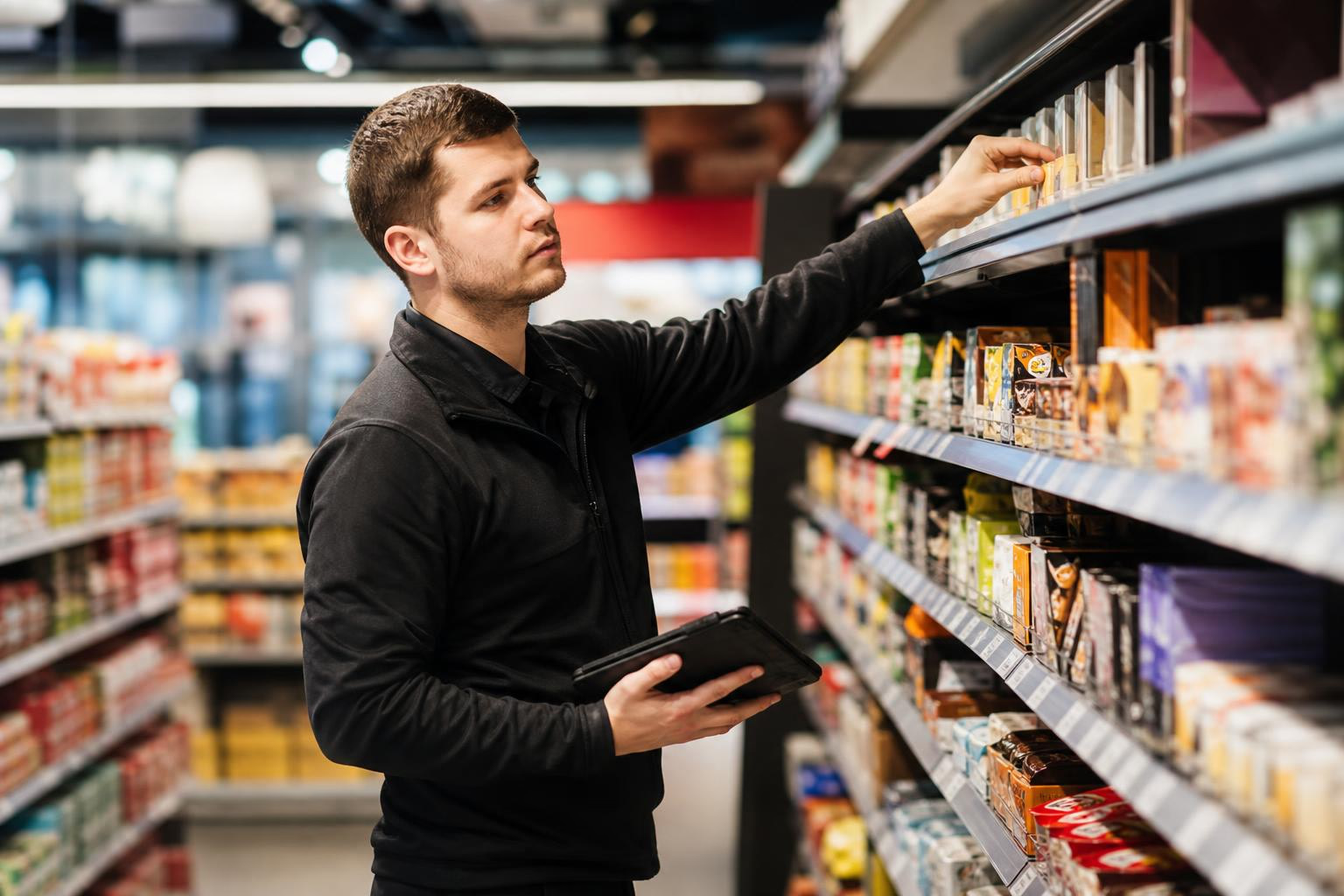
For FMCG brands specifically, advocacy marketing is the practice of mobilising real shoppers to generate authentic social proof, primarily reviews, ratings, and user-generated content, on the retailer product pages where purchase decisions happen. The critical difference: you’re building advocacy on someone else’s platform, through someone else’s checkout, for products that most shoppers will never feel compelled to review on their own.
That distinction matters more than it sounds. Every piece of generic advocacy advice you’ll find online assumes the brand owns the customer relationship. FMCG brands rarely do.
Explore shopper advocacy strategies built specifically for this reality.
How Advocacy Marketing Differs from Influencer and Referral Marketing
These three terms get used interchangeably in FMCG marketing decks, but they describe fundamentally different things.
Advocacy marketing vs. influencer marketing. Influencer marketing focuses on paid partnerships with content creators who have audience reach. It works for awareness. But research shows consumers find authentic advocacy content nearly 10x more impactful than influencer content when making a purchasing decision. One practitioner writing in The Grocer put it bluntly: “When it comes to deciding what brand of cheese to buy, or trying out a chocolate NPD, I don’t think it’s quite the same” as the influencer-driven purchase behaviour seen in fashion or beauty.
The core distinction is this: influencers are paid for reach; advocates act from genuine experience. Influencer content lives on Instagram or TikTok. Advocacy content lives on the Tesco PDP where the shopper is one click from adding to basket.
Advocacy marketing vs. referral marketing. Referral marketing turns organic advocacy into a structured growth channel by incentivising sharing with rewards. It works brilliantly for subscription boxes or meal kits. It struggles with FMCG because the unit economics don’t support it. Nobody is referring a friend to buy a specific brand of washing up liquid for a £1 reward.
Where advocacy marketing sits. It’s the umbrella concept. Referral programmes and influencer collaborations can be tools within an advocacy strategy, but advocacy marketing for FMCG brands is broader. It encompasses any deliberate effort to generate authentic, shopper-driven social proof where it influences purchase decisions.
Why FMCG Brands Need a Completely Different Advocacy Approach
Generic advocacy marketing advice tells you to build a loyalty programme, send post-purchase review request emails, create a referral programme, or use your NPS scores to identify advocates. None of that works cleanly in FMCG, for structural reasons.
Brands don’t own the transaction data. When a shopper buys your hummus on Sainsbury’s, Sainsbury’s has the email address, the purchase history, and the relationship. You don’t. You can’t send a post-purchase email asking for a review because you don’t know who bought your product.
Grocery review rates are extraordinarily low. The average grocery review rate sits at just 0.1%–0.3%, compared to 2–5% on Amazon. Most shoppers don’t think to review a grocery item. They eat it and move on. This creates a massive deficit: the majority of FMCG products on retailer websites have zero or single-digit reviews.
There is no cross-retailer review syndication in UK grocery. In the US market, Bazaarvoice syndication can push one review across multiple retailers. In the UK, that infrastructure doesn’t exist for grocery. A review on Tesco.com stays on Tesco.com. A review on Ocado stays on Ocado. This means advocacy efforts must be retailer-specific, multiplying the work required.
The stakes are higher than they appear. Research from the Spiegel Research Center found that products with five reviews see purchase likelihood 270% greater than products with zero reviews. PowerReviews data shows that shoppers visiting product pages with 11 to 30 reviews convert at more than double the rate of those visiting pages with no reviews.
For FMCG brands, reaching that first 30 product reviews threshold on each retailer PDP is the credibility threshold that separates products shoppers trust from products shoppers scroll past.
And it goes beyond conversion. Low review volume can signal weak consumer demand during retailer range reviews, putting distribution at risk. Reviews aren’t just a marketing metric. They’re a commercial survival tool.
The Five Types of Advocacy Marketing for FMCG
Not all advocacy is the same. Here’s a framework for thinking about the different types and where each creates value.
Customer Advocacy
Organic reviews and word-of-mouth from existing buyers. This is the purest form of advocacy, and the hardest to generate at scale in grocery. A shopper who genuinely loves your product tells friends, leaves an unprompted review, or posts about it on social media. The problem: with organic review rates below 0.3%, relying solely on customer advocacy leaves most PDPs bare.
Shopper Advocacy
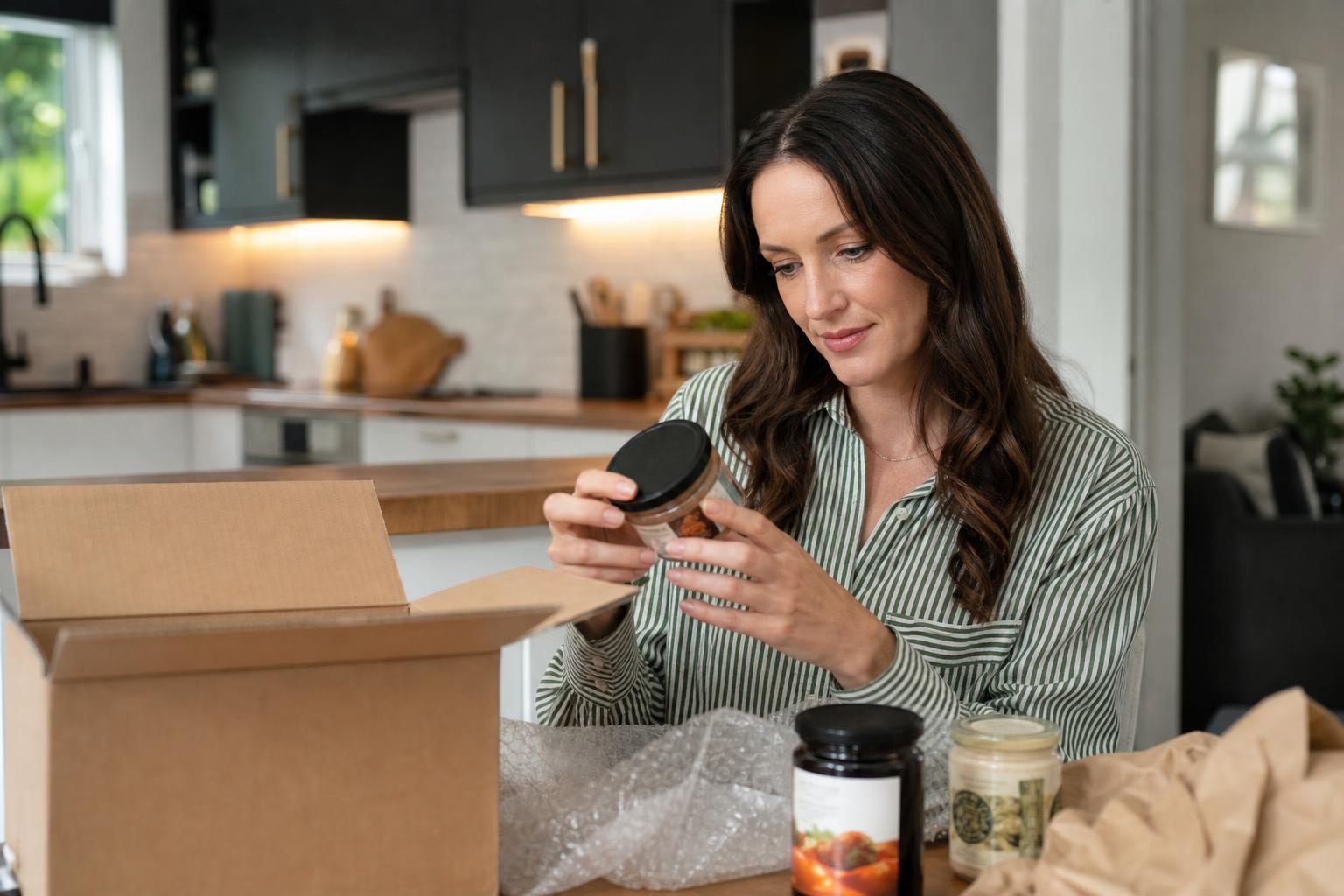
This is the FMCG-specific version of advocacy marketing. Shopper advocacy involves structured programmes where real shoppers buy, try, and review products through retailer-native purchase flows. The reviews are verified by the retailer because the shopper actually completed the transaction. This is the operational model that closes the grocery review gap.
See how managed review services work for UK FMCG brands.
Employee Advocacy
Brand teams, field sales staff, and in-store representatives who promote products through their own networks. Employee advocacy is often overlooked in FMCG, but field teams conducting in-store compliance checks already interact with store staff daily. Turning those interactions into genuine advocacy moments (product education, tastings, enthusiasm) has a real impact on shelf-level recommendations.
Retailer and Trade Advocacy
Getting the retailer itself excited about your product. This crosses into trade marketing, but the connection is real. One of the clearest examples comes from the Waitrose and Bazaarvoice partnership, where an in-store promotion highlighted items with the highest shopper ratings online. The “As Rated By You” campaign became Waitrose’s most successful in-store promotion in 2015. Reviews generated online drove physical store sales.
Influencer Advocacy
Paid or organic social proof from content creators. Useful for awareness, especially for NPD launches, but limited in its ability to generate the retailer-level reviews that drive digital shelf performance. FMCG was the highest-spending category on influencer marketing in 2021, increasing spend by more than 62%. Yet only about 7% of grocery shopping takes place online compared to 25% of fashion purchases, which means influencer reach doesn’t automatically translate to the places where most grocery shoppers actually buy.
The takeaway: a complete advocacy marketing strategy for FMCG brands usually combines shopper advocacy (for retailer PDP reviews), customer advocacy (organic growth), and influencer advocacy (awareness), with the balance weighted toward wherever purchase decisions happen.
How Advocacy Marketing Works on the Digital Shelf
The digital shelf is where advocacy marketing converts from a brand-building exercise into a revenue driver. Here’s the mechanism.
Reviews influence retailer search rankings. When a shopper searches “oat milk” on Tesco.com, the algorithm considers multiple factors, including review volume, recency, and star ratings. Products with more reviews and higher ratings tend to appear higher in results. For a deeper look at how this works, retailer search ranking factors explains the mechanics for UK grocery.
Recency matters as much as volume. A product with 50 reviews that are all 18 months old sends a different signal than a product with 30 reviews spread across the last three months. Steady review velocity, a consistent flow of new reviews, outperforms a one-time spike followed by silence.
The virtuous cycle. More reviews lead to higher search rankings, which create more visibility, which drive more sales, which generate more organic reviews. The brands that invest in advocacy marketing early create a flywheel that becomes increasingly difficult for competitors to match.
Star ratings have a sweet spot. A perfect 5.0 rating actually triggers suspicion. Research suggests the optimal range is 4.2 to 4.7 stars with some visible negative reviews and thoughtful responses. Shoppers trust imperfection more than perfection.
AI is changing how reviews influence shoppers. According to the 2025 Edelman Trust Barometer, among consumers using generative AI (55% of those surveyed), 91% use them for shopping in some way, including researching brands, comparing products, and summarising reviews. This means the actual text content of reviews matters more than ever. AI tools are pulling review content into shopping recommendations, making every authentic review a potential touchpoint in someone else’s purchase journey.
Advocacy Marketing vs. Standard FMCG Promotional Mechanics
FMCG brands know how to run promotions. Price cuts, BOGOFs, feature space, gondola ends. These are proven mechanics for short-term volume. But they come with well-known problems: margin erosion, shopper training toward deal-only purchasing, and zero lasting impact once the promotion ends.
Advocacy marketing works differently because its output (reviews, ratings, UGC) persists on the product page long after the campaign concludes. A price cut ends on Sunday and the sales lift vanishes by Monday. A review stays on the PDP for months or years, influencing every subsequent shopper who visits.
The numbers support this. Visitors who actively read reviews tend to have an average order value roughly 30% higher than those who do not. Food and beverage is already one of the highest-converting e-commerce categories, with conversion rates that can top 6% against a global average of 2.5–3%. Strong review coverage amplifies that natural advantage.
This doesn’t mean advocacy replaces promotional campaigns. It means the two work best in combination: promotions drive trial volume, and advocacy captures the social proof from that trial volume so the benefit compounds.
For a full breakdown, see the guide to calculating product review ROI.
Compliance and Authenticity in FMCG Advocacy
This is where many brands either get nervous or get sloppy. Neither reaction helps.
UK regulatory framework. Incentivised reviews fall under the ASA CAP Code, which requires transparency about any commercial relationship between the reviewer and the brand. If a shopper receives a product for free or gets compensated for leaving a review, that relationship must be disclosed. UK grocery retailers also maintain their own terms of service requiring genuine purchase verification.
The difference between incentivised reviews and fake reviews. These are not the same thing. An incentivised review comes from a real person who actually bought and used the product, with appropriate disclosure. A fake review is fabricated. In the US, the FTC now enforces penalties of up to $50,120 per fake review. UK brands face equivalent scrutiny under ASA and CMA consumer protection guidance. For the full compliance picture, the product review compliance guide covers the rules in detail.
Why compliance is also a ranking factor. This is the part many brands miss. Retailer algorithms prioritise verified-buyer reviews. Reviews from unverified accounts, or reviews that get flagged by moderation systems, either get filtered out entirely or carry less weight in ranking algorithms. Cutting corners on authenticity doesn’t just create regulatory risk. It produces reviews that don’t actually help your search position.
Authenticity drives trust. The 2025 Edelman Trust Barometer found that consumers trust their own experiences most, but the experiences of others, such as reviews and peer recommendations, strongly shape brand perception, often more than what the brand itself says. Authentic reviews with real detail, including honest mentions of drawbacks, build more trust than generic five-star praise.
Getting Started with Advocacy Marketing for FMCG
Implementing advocacy marketing doesn’t require a massive upfront investment. It requires focus.
Step 1: Audit your current review coverage. Check every SKU across every retailer where you’re listed. How many reviews does each product have on Tesco? On Sainsbury’s? On Ocado? You’ll almost certainly find that most products are below the 20–30 review credibility threshold, and many have zero.
Step 2: Identify the SKUs that matter most. Not every product needs the same level of attention. Prioritise NPD launches (where zero reviews mean zero social proof), hero SKUs (where review gaps create unnecessary vulnerability), and products facing upcoming range reviews.
Step 3: Decide on your approach. DIY options exist but are limited for FMCG brands that don’t own shopper data. Managed service approaches, where a shopper advocacy platform recruits real consumers to buy, try, and review through normal retailer purchase flows, close the gap faster and with verified purchase credentials.
Step 4: Start with your highest-volume retailers. If 60% of your volume goes through Tesco and Sainsbury’s, start there. Build review coverage where the most shoppers will see it, then expand to other retailers.
Step 5: Sustain the flow. A one-time review push is better than nothing, but steady review velocity is what keeps you visible in retailer search results over time. Plan for ongoing campaigns rather than a single burst.
Related Terms
Brand advocacy: The broadest term, covering anyone (customers, employees, partners) who actively promotes a brand.
Customer advocacy: Specifically refers to customers who recommend or review products based on genuine experience.
Review velocity: The rate at which new reviews are posted over a given period. Steady velocity signals ongoing consumer engagement to retailer algorithms.
Review recency: How recently reviews were posted. Fresh reviews carry more weight than old ones.
Digital shelf: The collection of product pages, search results, and content that represents a brand’s presence on retailer websites.
PDP (Product Detail Page): The individual product page on a retailer website where reviews, ratings, images, and purchase options appear.
Verified review: A review from a shopper whose purchase can be confirmed by the retailer’s system.
UGC (User-Generated Content): Any content (reviews, photos, videos) created by consumers rather than the brand.
Social proof: The psychological principle that people look to others’ behaviour and opinions when making decisions. Reviews are the primary form of social proof on the digital shelf.
Star rating: The numerical score (typically 1–5) aggregated from individual reviews. The sweet spot for conversion is 4.2–4.7.
Frequently Asked Questions
What makes advocacy marketing different for FMCG compared to other industries?
FMCG brands sell through retailers, which means they don’t own the customer relationship, the transaction data, or the product page. Generic advocacy tactics like post-purchase emails or referral codes don’t apply because the brand never has direct contact with the buyer. FMCG advocacy marketing must focus on generating social proof on retailer PDPs where purchase decisions actually happen.
How many reviews does an FMCG product need to make a difference?
Research from the Spiegel Research Center shows that purchase likelihood jumps 270% once a product reaches just five reviews. PowerReviews data indicates conversion rates more than double when products have 11 to 30 reviews compared to zero. For FMCG brands, reaching 20 to 30 reviews per SKU per retailer is a practical credibility threshold to target.
Can reviews from one UK retailer be shared to another?
No. Unlike the US market where Bazaarvoice syndication can push reviews across multiple retailers, UK grocery operates in silos. A review posted on Tesco.com stays on Tesco.com. This means brands need separate advocacy efforts for each retailer where they’re listed.
Is incentivised review generation legal in the UK?
Yes, provided it complies with the ASA CAP Code and retailer terms of service. The key requirements are transparency about any commercial relationship and genuine purchase verification. The distinction between a properly disclosed incentivised review and a fake review is significant, both legally and practically.
How does advocacy marketing affect retailer search rankings?
Retailer search algorithms on platforms like Tesco, Sainsbury’s, and Ocado factor in review volume, recency, and star ratings when determining product visibility. Products with strong, recent review coverage tend to rank higher in on-site search results, creating more visibility and driving more sales.
What’s the ROI of advocacy marketing compared to price promotions?
Price promotions deliver short-term volume lifts that disappear when the promotion ends. Reviews persist on the PDP for months or years, continuing to influence every shopper who visits that page. Visitors who read reviews also tend to spend roughly 30% more per order. The two approaches work best together, but reviews compound over time while promotions don’t.
How quickly can an FMCG brand build review coverage?
It depends on the approach. Organic review generation at grocery-level rates (0.1%–0.3%) takes years to build meaningful coverage. Managed shopper advocacy programmes can generate verified reviews within weeks, though the exact timeline varies by retailer moderation processes and the number of SKUs involved.