
TL;DR
Nine field marketing agencies stand out for UK FMCG brands in 2026, but the right choice depends on your operating model, not just the agency name. Traditional employed-team agencies (CPM, Smollan, Logobrand, Powerforce, eXPD8, SIG) dominate large-scale retail execution. Crowdsourced platforms (Field Agent UK, Roamler) offer speed and audit coverage at lower cost. Brand Allies sits in a third category, combining shopper-led audits, retailer product reviews, and discreet product recalls under one managed service with pay-per-verified-review pricing.
Why Field Marketing Still Makes or Breaks FMCG Brands
Out-of-stock levels for FMCG products across Europe average 8.3%, costing the industry at least €4 billion every year according to SymphonyIRI. IHL’s 2026 research puts global inventory distortion at $1.7 trillion, with 65.6% attributable to out-of-stocks. That number only captures lost sales. It ignores the compounding damage: poor shelf compliance erodes retailer confidence, weakens range review negotiations, and starves product detail pages of the review volume that drives online conversion.
Field marketing agencies exist to close these gaps. They put people in stores to check availability, fix displays, run sampling campaigns, and generate real purchase data. But the agency market has splintered. The old model of salaried reps on fixed call cycles now coexists with app-based crowdsourced audit platforms and, more recently, managed shopper advocacy services that bridge in-store execution with digital shelf support.
This guide groups the best field marketing agencies for FMCG in the UK by model type, so you can match the right structure to your brand’s stage, budget, and priorities.
Explore how in-store compliance audits work
At-a-Glance Comparison Table
| Agency | Model | FMCG Focus | UK Coverage | Key Services | Best For | Pricing Model |
|---|---|---|---|---|---|---|
| Brand Allies | Hybrid managed service | Core | National | Reviews, audits, recalls | Challenger and mid-market FMCG needing reviews + store execution | Pay per verified review |
| CPM | Employed field team | Core | National + global | Sales, merchandising, auditing, sampling | Enterprise FMCG at scale | Bespoke retainer |
| Smollan | Employed field team | Core | National + 60 markets | Sales, merchandising, compliance, sampling | Multi-market FMCG execution | Bespoke retainer |
| Logobrand | Employed field team | Core (grocery) | National | Compliance, sales, AI auditing | Independent, data-driven grocery compliance | Retainer / per-visit |
| Powerforce | Employed field team | Core | National | Merchandising, audits, sampling, mystery shopping | Tactical on-demand activations | Per-campaign / retainer |
| eXPD8 | Employed field team | Core (retail-aligned) | National | Merchandising, seasonal support, retail implementation | Retailer-aligned volume merchandising | Retainer / per-visit |
| SIG | Employed field team | Core | National + 24 EU markets | Sales, merchandising, compliance | B Corp-certified European field marketing | Bespoke retainer |
| Field Agent UK | Crowdsourced | One of many | National | Audits, insights, on-demand tasks | Rapid nationwide retail audits | Per-audit / per-task |
| Roamler | Crowdsourced | Core | UK + Europe | Audits, reviews, merchandising | Pan-European crowdsourced auditing | Per-task |
How to Choose a Field Marketing Agency for FMCG
Before comparing names, answer three questions.
Do you need store-level relationships, or speed and breadth? Traditional agencies build rapport with store managers over months. Their reps know the back-room stock system, the deputy who controls the gondola end, and the best time to visit. Crowdsourced platforms trade that intimacy for speed: hundreds of shoppers deployed in 24 to 48 hours across thousands of postcodes.
Do you need in-store execution, digital shelf support, or both? Most field marketing agencies stop at the store door. They don’t generate product reviews on Tesco.com or Ocado. If your PDP conversion rate is suffering because you have fewer than 20 reviews on a key retailer, that’s a separate problem, and only a handful of providers address it.
Are you enterprise or challenger? Enterprise brands can absorb the retainer minimums and long contracts that full-service agencies require. Challenger brands, or mid-market brands launching NPD, often need a more flexible cost structure. Our retail execution guide for challenger brands covers this in more detail.
Other criteria worth weighting: FMBE award track record (the industry’s longest-running awards scheme), reporting quality and real-time dashboards, Glassdoor and Indeed sentiment from field staff (because unhappy reps deliver poor store visits), and pricing transparency.
Shopper Advocacy and Hybrid Managed Services
This is the category that no other UK field marketing listicle covers. It combines elements of crowdsourced field execution with digital shelf services like review generation, managed through a single provider.
1. Brand Allies (powered by redwigwam)

Best for: UK FMCG brands that need retailer product reviews, in-store compliance audits, and discreet product recalls under one contract.
Brand Allies launched in 2024 as the retail and FMCG sub-brand of redwigwam, a staffing marketplace with a 10-year track record and a 250,000-strong UK shopper community. Rather than employing permanent field reps or relying on anonymous gig workers, Brand Allies deploys its community of already ID-verified, geo-indexed shoppers to complete brand tasks, from writing verified reviews on Tesco.com to auditing a promotional display in a Sainsbury’s Local.
Three service lines:
- Online product reviews: Shoppers buy, try, and review products on major UK retailers including Tesco, Sainsbury’s, Morrisons, Waitrose, Ocado, Boots, Holland & Barrett, Amazon, and TikTok Shop. See how reviews work.
- In-store activations and audits: Compliance checks, POS verification, distribution audits, and availability monitoring, built on redwigwam’s Kellogg’s “24/7 Availability” pilot.
- Discreet product recalls: Shoppers physically remove faulty product from shelves without triggering a public alert, functioning as a market withdrawal rather than a formal FSA recall.
Key strengths:
- Pay-per-verified-review pricing with no SaaS subscription or syndication fees
- Reviews appear natively on the retailer where the purchase happened, not syndicated from a third-party platform
- Shopper community is pre-verified and geo-indexed, enabling activation in hours rather than weeks
- Client roster includes Coca-Cola, Strong Roots, Little Moons, Bol Foods, and Jordans
- Single contract replaces what typically requires three separate vendors
Limitations:
- No cross-retailer review syndication: a review posted on Tesco stays on Tesco
- Under two years of trading history as Brand Allies (though redwigwam provides a decade of operational track record)
- Compensated review approach must comply with ASA CAP Code and retailer moderation guidelines, meaning some reviews may be rejected
- Not a replacement for traditional agencies in stores where ongoing rep-to-manager relationships are critical
Brand Allies is best suited for challenger and mid-market FMCG brands that need to build review volume on retailer PDPs while maintaining in-store compliance, without committing to enterprise-level retainers.
Traditional Field Marketing Agencies
These agencies operate on the established model: salaried or contracted field representatives on scheduled call cycles, with regional managers, branded vehicles, and direct relationships with store teams.
1. CPM
Best for: Enterprise FMCG brands needing integrated field sales at national and global scale.
CPM has been driving field sales for over 75 years, now backed by Omnicom, the world’s largest marketing communications group. The company employs 34,000 people globally and claims an average uplift of 31 to 44% for its clients.
Key strengths:
- Won the 2025 FMBE Campaign of the Year award with Asahi
- Full-service offering spanning sales, merchandising, compliance auditing, and experiential campaigns
- Deep retailer relationships across all major UK grocery multiples
- Omnicom integration allows joined-up above-the-line and in-store execution
Limitations:
- Enterprise pricing with high minimum commitment; not suited for brands spending under six figures annually
- Size creates layers of account management that can slow decision-making
- No public pricing, which is standard in this tier but makes early budgeting difficult
CPM is the safe choice for FMCG brands with established distribution and the budget to match. For brands at an earlier stage, the overhead rarely justifies the cost.
2. Smollan (formerly REL Field Marketing)
Best for: Multi-market FMCG execution across the UK and Europe under one contract.
From January 2026, REL Field Marketing began operating fully under the Smollan brand, joining a unified global business present in over 60 markets. The rebrand caps a long history: REL was a year-one FMBE winner with Sainsbury’s, and the combined operation is described as “the most garlanded agency in FMBE history.”
Key strengths:
- 2025 FMBE Agency of the Year and FMCG Team winner (with BrewDog)
- Services span sampling, experiential, demonstrations, sales, merchandising, compliance, and POS placement
- Single point of contact for UK plus European activation
- Strong grocery credentials, particularly in convenience and impulse categories
Limitations:
- Global rebrand is still bedding in; some clients and retailers may not immediately recognise the Smollan name in a UK context
- Overlap with Powerforce (also part of the Smollan group) can create confusion about which team handles what
- Like CPM, pricing is bespoke and enterprise-weighted
For a detailed comparison of Smollan’s traditional model versus a shopper advocacy approach, see our REL vs. Brand Allies breakdown.
3. Logobrand
Best for: Independent, data-led grocery compliance and sales execution.
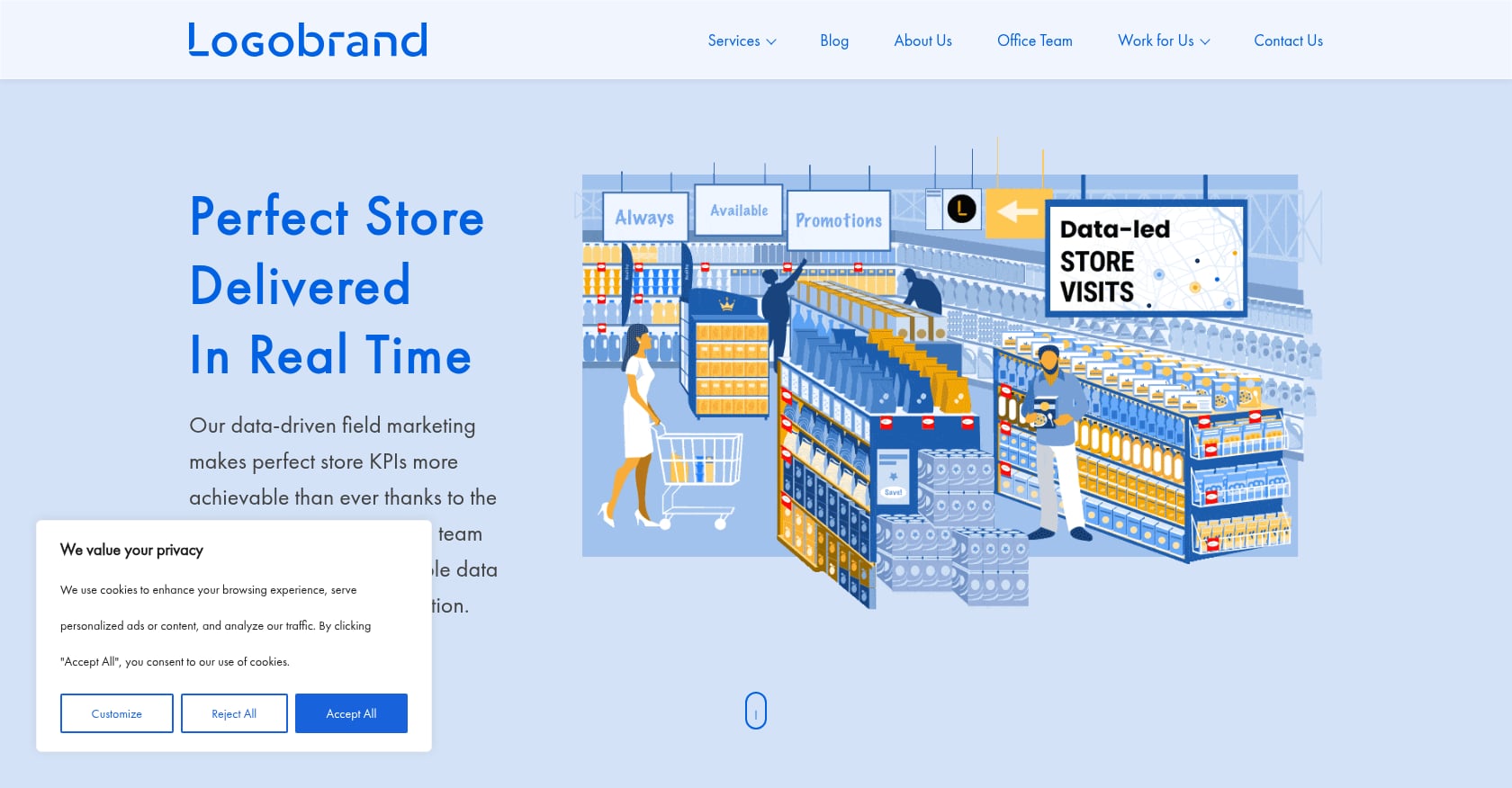
Established in 1990, Logobrand has been an independent field marketing agency for over three decades. What sets it apart is a technology layer that most traditional agencies lack: AI image recognition for shelf audits, a bespoke field app, and a Perfect Store portal that benchmarks compliance KPIs against multiple data sets.
Key strengths:
- 15 awards in the past three years, with an “unrivalled successful win-to-entry ratio” at the FMBEs
- Approximately 400 nationwide field team members, all employed
- Grocery-first focus means deep understanding of JBP cycles, GSCOP, and category management
- Glassdoor rating of 4.0 out of 5 based on 22 reviews, which is strong for a field agency
Limitations:
- Smaller headcount than CPM or Smollan, which means capacity constraints during peak periods like Christmas or major NPD launches
- No significant European footprint, so not ideal for brands needing pan-European coordination
- Independent ownership means less cross-channel integration compared to holding-group agencies
Logobrand is the go-to for mid-market FMCG brands that want serious data alongside traditional field execution, without paying holding-group premiums.
4. Powerforce
Best for: Tactical, on-demand FMCG brand activation campaigns.
Powerforce is an award-winning field marketing and sales solutions agency specialising in strategic and on-demand brand activation. Part of the Advantage Smollan group, it operates with 1,086 employees and a strong cultural identity: 91% of employees say it’s a great place to work, compared to 54% at a typical UK company.
Key strengths:
- Services include merchandising, audits, mystery shopping, Check & Fix visits, consumer sampling, and demonstrations
- Great Place to Work certification signals lower staff turnover and more consistent store visits
- Flexible campaign structures suit brands that need tactical bursts rather than 12-month retainers
- Strong FMCG client base across grocery and convenience
Limitations:
- Overlap with Smollan/REL within the same parent group can confuse procurement teams
- “On-demand” positioning still operates through employed teams, so it’s faster than CPM but slower than true crowdsourced platforms
- Mystery shopping capability exists but is not its primary strength
If you’re evaluating mystery shopping providers specifically, our separate guide covers that niche in more depth.
5. eXPD8
Best for: Retailer-aligned merchandising and seasonal in-store support at volume.
Founded in 2003 and based in Bristol, eXPD8 has a field team of 2,800 across the UK, making it one of the largest retail support operations in the country. The company claims 50 years of dedicated experience across retail and FMCG (counting the combined tenure of its leadership team).
Key strengths:
- Strong retailer-side relationships, particularly with Sainsbury’s and Morrisons
- Client testimonial from Incomm: “eXPD8 has helped us to deliver our biggest ever Q4 within Sainsbury’s”
- Seasonal and launch merchandising is a core competency; the volume of their field team handles national rollouts efficiently
- Compliance reporting and photo capture built into workflows
Limitations:
- Glassdoor rating of 3.3 out of 5 based on 177 reviews, lower than other agencies on this list
- Long-term employees on Indeed report that “flexibility was extremely good” initially but “gradually over the years, all of these strengths have vanished”
- Primarily a merchandising and retail implementation agency; less suited for complex sales-driven field campaigns or digital shelf support
Worker sentiment matters in field marketing because disengaged reps deliver worse store visits. The mixed Glassdoor scores are worth factoring into due diligence conversations.
6. Service Innovation Group (SIG)
Best for: B Corp-certified field marketing with European reach.
SIG has operated since 1979 and now supports brands across 24 European markets. Its B Corp certification sets it apart from every other agency on this list, confirming it has met rigorous standards of social and environmental performance, transparency, and accountability.
Key strengths:
- Capable of responding and delivering activity in less than 48 hours
- Around 400 employed UK field staff, with the European network adding significant scale
- B Corp status is increasingly valued in procurement, particularly by FMCG brands with sustainability commitments
- Full service: sales, merchandising, compliance, and tactical campaigns
Limitations:
- UK team of approximately 400 is smaller than CPM, Smollan, or eXPD8 in raw headcount
- European coordination adds value for multi-market brands but adds cost for UK-only campaigns
- Less publicly visible award history than Logobrand or Smollan at the FMBEs
For a direct comparison of SIG’s traditional approach versus a shopper advocacy model, we’ve published a separate analysis.
Crowdsourced Field Marketing Platforms
These platforms replace salaried reps with networks of gig-economy shoppers who complete tasks through a mobile app. The model trades store relationships for speed, scale, and lower per-visit costs.
1. Field Agent UK
Best for: Rapid, nationwide retail audits and shopper insights at low per-task cost.
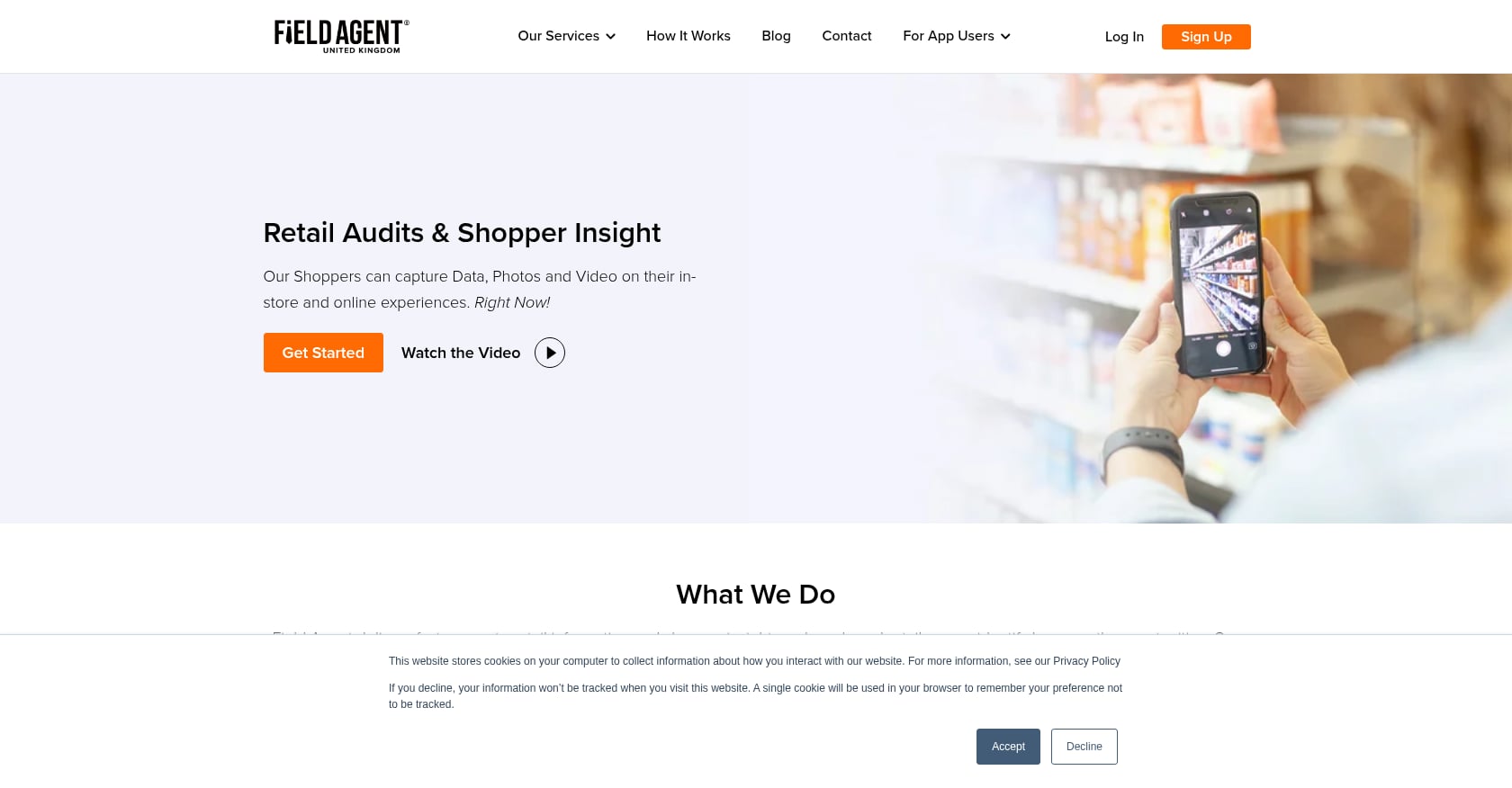
Field Agent harnesses a crowd of over 200,000 shoppers across the UK who have downloaded its app. Originally US-founded in 2010, the UK operation focuses on audits, shopper insights, product reviews, and on-demand sales tasks.
Key strengths:
- Massive agent pool enables same-day or next-day audit coverage across thousands of stores
- Photo-verified data provides objective compliance evidence
- Per-task pricing keeps costs predictable and accessible for challenger brands
- App-based workflow makes brief setup fast
Limitations:
- Agents are gig workers with no store relationships, so they cannot influence stock replenishment or negotiate shelf position
- Covers fewer countries than some competitors, limiting its value for brands needing European coordination
- Quality varies by agent; there’s no guarantee of retail expertise
For a detailed head-to-head between Field Agent and Brand Allies, including pricing models and service scope, see our comparison guide.
2. Roamler
Best for: Pan-European crowdsourced auditing and data collection with a reviews module.
Roamler describes itself as the European leader in crowd-supported field marketing, performing tasks for some of the biggest FMCG manufacturers, including Unilever, P&G, and Red Bull. In 2020, it received €20 million in funding from Endeit Capital, Smartfin, and Achmea Innovation Fund.
Key strengths:
- Genuine European footprint across multiple markets
- Offers a Ratings & Reviews module (one client noted: “We use Ratings & Reviews mostly for new products in order to rapidly create reviews”)
- Strong FMCG client roster validates credibility
- Gamified app with quality scoring helps maintain task accuracy
Limitations:
- Netherlands-headquartered; the UK is one market among several, which can affect prioritisation and local support
- Absence of customer reviews for Roamler on major platforms could be a concern during vendor evaluation
- Like Field Agent, crowd agents lack the store relationships needed for ongoing merchandising fixes
A practical comparison of all three crowdsourced and hybrid options is available in our Roamler vs. Field Agent vs. Brand Allies guide.
Traditional vs. Crowdsourced vs. Managed Shopper: Which Model Fits?
| Dimension | Traditional Agency | Crowdsourced Platform | Managed Shopper (Brand Allies) |
|---|---|---|---|
| Speed to deploy | 2 to 6 weeks | 24 to 48 hours | Hours to days |
| Cost model | Monthly retainer or per-FTE | Per-task / per-audit | Pay per verified review or per activation |
| Store relationships | Strong (named reps) | None | Light (shoppers are real customers) |
| Digital shelf coverage | None | Limited (Roamler only) | Core: reviews on 10+ UK retailers |
| Minimum commitment | Typically 6 to 12 months | Per-project | Per-project |
| Best for | Enterprise brands, ongoing programmes | Fast audits, broad geographic sweeps | Review generation, compliance audits, product recalls |
Many large FMCG brands use multiple models simultaneously. As Roamler’s own guidance suggests: “If you need continuous coverage of stores, a traditional agency may make sense. If you need fast, scalable audits across many stores or markets, an on-demand platform is usually the better fit.” The most effective approach layers a traditional agency for core retail accounts with a crowdsourced or managed shopper service for everything else, especially digital shelf priorities like review volume.
A 2025 grocery retail study that analysed roughly 24,000 SKUs across 11 stores found that inventory audits alone produced an 11% store-wide sales lift. Whether those audits come from employed reps or shopper communities matters less than whether they happen at all.
For brands wrestling with this decision, our guide to shopper-led store audits walks through real use cases and examples.
How We Chose This List
This list was built on five criteria: FMBE awards track record (the field marketing industry’s primary benchmark since its inception), verified FMCG client credentials, model type and service breadth, Glassdoor and Indeed sentiment from field staff, and freshness of service offering. We weighted agencies that have adapted their model for the current market, not just those with the longest history.
Disclosure: Brand Allies is included in this list. This article is published on the Brand Allies website. We’ve applied the same evaluation criteria to our own entry and have acknowledged our limitations alongside our strengths.
Frequently Asked Questions
What is a field marketing agency?
A field marketing agency deploys people into retail stores on behalf of brands. In the FMCG context, this includes checking shelf compliance, fixing merchandising errors, running sampling campaigns, auditing promotional displays, and generating sales data at store level. Some newer agencies extend this to digital shelf tasks like generating product reviews on retailer websites.
How much does a field marketing agency cost in the UK?
No major UK field marketing agency publishes pricing, largely because the range of services makes standardisation difficult. Traditional agencies typically charge monthly retainers or per-FTE rates starting from several thousand pounds per month. Crowdsourced platforms price per task or per audit, often starting from a few pounds per store visit. Brand Allies uses a pay-per-verified-review model with no SaaS subscription, which removes the fixed-cost risk for brands testing the approach.
What is the difference between a field marketing agency and a crowdsourced audit platform?
Traditional field marketing agencies employ salaried or contracted representatives who visit stores on regular call cycles and build relationships with store staff. Crowdsourced platforms use gig-economy shoppers who complete one-off tasks through a mobile app. The trade-off is depth versus speed: employed reps can influence stock replenishment and negotiate shelf space, while crowdsourced agents can cover thousands of stores in 24 hours but have no ongoing store relationships.
Can a field marketing agency also generate product reviews?
Most traditional field marketing agencies do not offer review generation. Among crowdsourced platforms, Roamler has a Ratings and Reviews module. Brand Allies was built around this capability, with shoppers purchasing products and posting verified reviews directly on retailer websites including Tesco, Sainsbury’s, and Ocado. If review volume on your PDPs is a priority, check whether your agency or platform can address it, or budget for a separate review generation service.
How do I measure field marketing ROI?
The most common metrics are sales uplift during and after field campaigns, on-shelf availability improvement, promotional compliance rates, and cost per store visit. Research suggests that successful field management can improve stock performance by as much as 62%, and a 3% increase in availability can equal a 1% increase in sales for manufacturers. For review-focused programmes, track review volume growth, average star rating, and PDP conversion rate changes over time. Our retail audit ROI guide provides benchmarks and formulas.
What are the FMBE Awards?
The FMBE Awards are the longest-running awards scheme for field marketing and brand experience in the UK. In the 2025 cycle (held January 2026), Smollan won Agency of the Year and FMCG Team (with BrewDog), while CPM won Campaign of the Year (with Asahi). FMBE award history is a reliable signal of agency credibility when shortlisting.
Should a challenger FMCG brand use a field marketing agency?
Yes, but probably not a traditional full-service agency with enterprise-level retainers. Challenger brands typically get better value from crowdsourced platforms for audit coverage and managed shopper services for review generation and targeted compliance checks. The key is matching your budget and priorities to the right model rather than defaulting to the biggest name.