
TL;DR
SIG (Service Innovation Group) is a traditional field marketing agency with 400+ employed staff delivering merchandising, POS installation, and retail audits across the UK and Europe. Brand Allies is a managed-service shopper advocacy platform using a 250,000-strong UK shopper community to generate verified product reviews on retailer websites, run in-store compliance audits, and handle discreet product recalls. They solve different problems. SIG handles physical in-store execution. Brand Allies handles the digital shelf and tactical store checks. Many brands use both.
What Is SIG (Service Innovation Group)?
First, a quick disambiguation. “SIG” in this context does not refer to SIG Group (the packaging company) or SIG plc (roofing and insulation). In FMCG retail execution, SIG means Service Innovation Group, a field marketing agency headquartered in Watford, Hertfordshire.
SIG has been operating since 1979, giving it over 45 years in the field marketing space. The company employs around 400 field staff in the UK and operates across 24 European markets, with a wider global network of more than 25,000 brand ambassadors.
Their core services include:
Field sales with dedicated teams visiting stores on recurring schedules
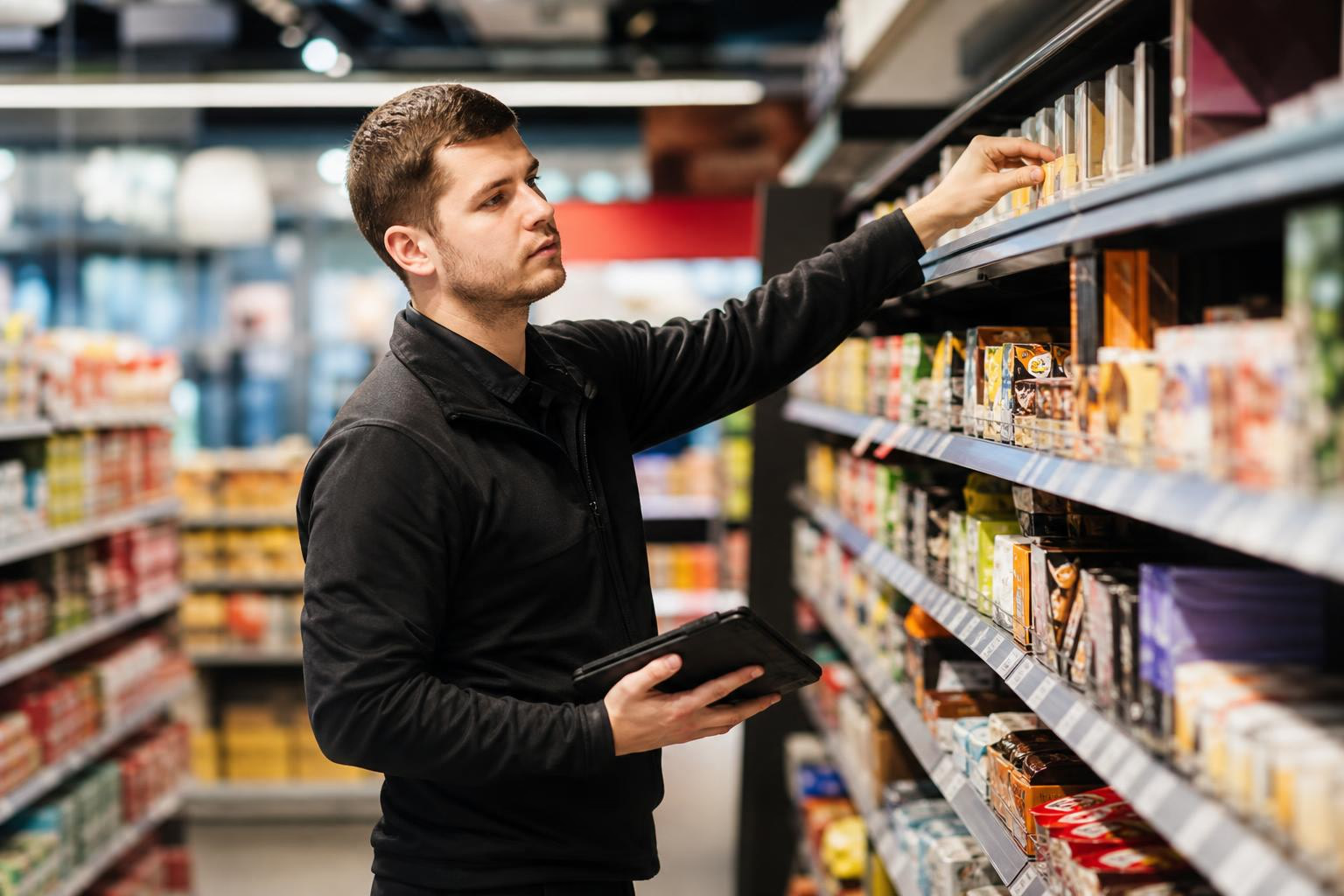
Merchandising and replenishment to keep shelves stocked and displays compliant
POS and display installation for product launches and seasonal campaigns
Retail audits covering distribution, pricing, and shelf compliance
Mystery shopping for brand experience measurement
In-store training and brand education for retail staff
SIG’s technology backbone is Celero One, a cloud-based workforce management platform that gives brands real-time reporting from the field, geo-mapping of store visits, and live dashboards.
The company is also a certified B Corp with a score of 84.0 and has been recognised as a Great Place to Work, with 85% of employees saying it is a great place to work compared to the UK average of 54%.
What SIG does not offer is any form of online review generation. There is no service for seeding product reviews on Tesco, Sainsbury’s, Boots, Ocado, or any other retailer product page. Their model is entirely about physical in-store execution.
What Is Brand Allies?
Brand Allies is a managed-service shopper advocacy platform launched in 2024, powered by Redwigwam’s 250,000 UK shopper community. It operates across three service lines:
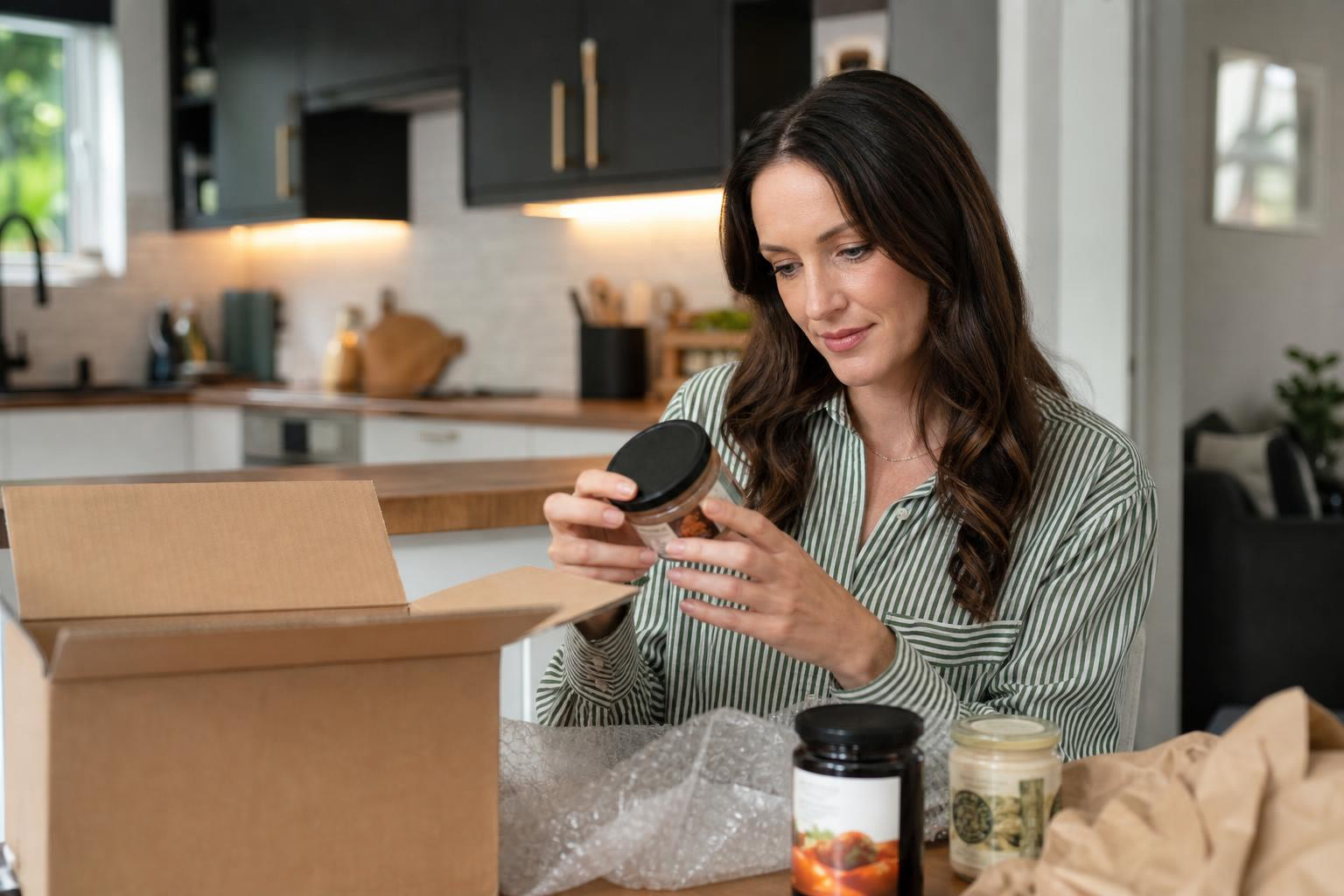
Online product reviews: Real shoppers buy products at participating retailers, then post verified reviews on the retailer’s website. Reviews appear on Tesco, Sainsbury’s, Morrisons, Waitrose, Ocado, Boots, Iceland, Holland & Barrett, Amazon, and TikTok Shop.
In-store activations: Shoppers complete photo-verified field audits covering promo compliance, POS checks, on-shelf availability, and distribution. The model follows a “Check, Ask, Purchase” framework that creates real sales signals while gathering compliance data.
Discreet product recalls: Shoppers physically remove faulty or recalled product from shelves without triggering a public alert, functioning as a market withdrawal rather than a formal FSA recall.
The pricing model is pay per verified review. No SaaS subscription, no enterprise minimum spend. The shopper community is already ID-verified and geo-indexed through the Redwigwam infrastructure, which means campaigns can activate in hours rather than weeks. Clients include Coca-Cola, Strong Roots, Little Moons, Bol Foods, and Jordans.
Brand Allies does not offer dedicated field sales teams, multi-market European coverage, or ongoing merchandising programs with employed staff. It is UK-only.
SIG vs Brand Allies: Head-to-Head Comparison
This is the core of the SIG vs Brand Allies decision. The table below covers the dimensions that matter most to a UK FMCG brand manager choosing between the two.
Dimension | SIG (Service Innovation Group) | Brand Allies |
|---|---|---|
Founded | 1979 (45+ years) | 2024 (powered by Redwigwam’s 10-year infrastructure) |
Core model | Employed field marketing agency | Crowdsourced shopper advocacy platform |
UK workforce | ~400 employed field staff | 250,000 registered shoppers (task-based) |
Geographic scope | UK + 24 European markets | UK only |
Online reviews | Not offered | Core service, 10+ UK retailer sites |
In-store execution | Merchandising, POS install, replenishment, display builds | Photo-verified audits, compliance checks, “Check, Ask, Purchase” |
Field sales | Yes, dedicated teams | Yes |
Mystery shopping | Yes | Yes |
Discreet product recalls | Listed capability | Yes |
Technology | Celero One (workforce management, live dashboards, geo-mapping) | Brand Allies portal + app (built on Redwigwam infrastructure) |
Pricing | Retained/project fees (bespoke) | Pay per verified review (bespoke for audits) |
Accreditations | B Corp certified, Great Place to Work | Redwigwam backbone with Maven/NPIF funding |
The comparison makes the distinction clear. These are not competing solutions for the same problem. SIG is built for ongoing, physical retail execution. Brand Allies is built for digital shelf coverage and tactical store-level intelligence.
When to Choose SIG
SIG is the right choice when your brand needs deep, sustained in-store presence with people who build relationships with store staff over time.
You need dedicated field reps visiting the same stores every week. SIG’s employed workforce model means the same person walks into the same Tesco Express or Sainsbury’s Local on a recurring schedule. They know the store manager. They know where the back stock is. That continuity matters for brands running ongoing replenishment or merchandising programmes.
You’re running multi-market European campaigns. If your product launches simultaneously in the UK, Germany, France, and the Nordics, SIG’s 24-market footprint and global network of 25,000 brand ambassadors gives you a single agency relationship across borders.
You need physical installation work. Fixture builds, premium branded displays, gondola end resets. SIG’s DJI case study is a good example: they installed premium branded fixtures and delivered launch-day staff training, increasing in-store visibility and product knowledge.
You need in-store staff training. When retail staff need to understand a new product category or demonstrate a device, SIG’s employed team can deliver structured training sessions in-store.
You have the budget for retained agency relationships. Traditional field marketing agencies typically operate on retained or project fee models. This represents a significant and ongoing commitment, best suited to brands with established distribution and the trade marketing budget to match.
On Glassdoor, SIG holds a 4.0 out of 5 employee rating, with 82% of employees recommending the company to a friend. On Indeed, employees describe good colleagues and work-life balance, though product launches can mean long hours. These are useful proxy signals for operational quality, since happy field teams tend to deliver better in-store results.
For brands evaluating whether on-shelf availability audits should be handled by an employed team or a crowdsourced network, the answer often depends on visit frequency and relationship depth.
When to Choose Brand Allies
Brand Allies is the right fit when your primary gap is on the digital shelf, or when you need flexible store-level intelligence without building a permanent field operation.
You need verified reviews on UK retailer product pages. The average grocery review rate sits at just 0.1% to 0.3%, compared to 2% to 5% on Amazon. That gap is the core problem Brand Allies exists to solve. Products with thin review coverage rank lower in retailer search, convert worse on the product detail page, and are more vulnerable in range reviews.
Get a demo of the reviews service →
You want pay-per-review pricing without platform lock-in. Unlike SaaS review platforms that charge annual subscriptions plus syndication fees, Brand Allies charges per verified review. That removes the budget-risk objection that stops many e-commerce managers from acting.
You need fast, scalable in-store audits without building a field team. Practitioners on crowdsourced audit platforms report that the main advantage is flexibility: brands can scale coverage up or down without maintaining a dedicated workforce. As Roamler’s competitor analysis notes, “if you need fast, scalable audits across many stores, an on-demand platform is usually the better fit.” Brand Allies operates on the same principle, with the added benefit that auditors are genuine shoppers making real purchases.
The reporting bias question matters here too. Field Agent Canada’s research points out that crowdsourced auditors are everyday shoppers with no personal relationship to store management or the brand, so they “capture raw, unfiltered reality.” Traditional reps, by contrast, are sometimes incentivised to make their assigned stores look good.
You’re a challenger brand scaling distribution faster than operations. If you’ve just landed 500 Tesco listings but don’t have the headcount to check whether your product actually made it to shelf, shopper-led store audits let you get photo-verified evidence within 24 to 72 hours. For more on how challenger brands approach this, see the guide on retail execution for challenger brands.
You need a discreet product withdrawal capability. Brand Allies’ shopper community can physically remove product from shelves without the visibility of a formal recall, an option that sits somewhere between a quiet market withdrawal and a full FSA alert.
Can You Use Both?
Yes. And many large FMCG brands already do something similar.
The hybrid model is straightforward: use a traditional field marketing agency like SIG for your core accounts (the top 200 stores where you need weekly visits, relationship management, and physical merchandising) and use a crowdsourced platform like Brand Allies for broader coverage and peak-period burst activity.
SIG handles the depth. Brand Allies handles the breadth and the digital shelf.
Here is what that looks like in practice:
SIG visits your top stores weekly, installs new POS, trains staff on your NPD, and replenishes stock.
Brand Allies generates 50 verified reviews on your Tesco PDP ahead of a retailer media push, runs in-store compliance audits across 300 stores you could never reach with a 20-person field team, and confirms that your promotional display is actually up in the stores that matter.
The SIG vs Brand Allies question is not really “which one” but “which one for what.” A CheckoutSmart case study with Lactalis reported a 13% online sales uplift across supported SKUs when review volume and star ratings improved. That kind of digital shelf gain is invisible to a traditional field marketing agency, no matter how good their in-store execution is.
Conversely, Brand Allies cannot install a six-foot branded fixture or run a two-week in-store staff training programme. Different tools, different jobs.
For brands thinking about how to measure the value of each model, the retail audit ROI benchmarks guide breaks down the formulas.
The Bigger Picture: Why This Comparison Matters Now
The split between physical retail execution and digital shelf management is widening. Five years ago, a brand manager could reasonably say “if it’s on shelf and priced right, it’ll sell.” That’s no longer true. Products with fewer than 20 to 30 reviews struggle to convert online shoppers. Fresh review content feeds both human purchasing decisions and AI-powered recommendation tools. A product might look well-reviewed overall while having weak coverage on the retailer responsible for most of its sales.
Meanwhile, up to 30% of products can be missing or incorrectly merchandised in-store at any given time, and out-of-stocks can reduce sales by 30% to 50% immediately. Physical execution still matters enormously.
The SIG vs Brand Allies comparison, at its core, reflects this dual reality. The brands winning in UK grocery are the ones that manage both the physical shelf and the digital shelf as two halves of the same strategy.
Frequently Asked Questions
Does SIG offer online review generation?
No. SIG is a field marketing agency focused on physical in-store execution: merchandising, POS installation, field sales, retail audits, and mystery shopping. They do not generate or manage product reviews on any retailer website.
Does Brand Allies offer dedicated field sales teams?
No. Brand Allies uses a task-based shopper community model, not employed field reps. Shoppers complete specific missions (buying and reviewing products, running store audits) rather than making recurring sales visits to the same stores.
Can Brand Allies handle in-store execution across Europe?
No. Brand Allies operates in the UK only. SIG covers the UK plus 24 European markets, making it the choice for brands needing multi-market field execution from a single provider.
What does “SIG” stand for in FMCG?
In the context of retail execution and field marketing, SIG stands for Service Innovation Group. It should not be confused with SIG Group (packaging) or SIG plc (roofing and insulation).
How does pricing compare between SIG and Brand Allies?
SIG operates on retained or project fee models typical of field marketing agencies, with bespoke pricing based on team size, visit frequency, and geographic scope. Brand Allies uses a pay-per-verified-review model for its reviews service, with bespoke pricing for in-store audits and recalls. There is no SaaS subscription or enterprise minimum spend with Brand Allies.
Which is better for a new product launch?
It depends on the launch. If you need fixture installation, staff training, and merchandising across hundreds of stores, SIG is better equipped. If you need 50+ verified reviews live on Tesco and Sainsbury’s PDPs before launch week to support retailer media spend, Brand Allies fills that gap. Many brands use both for major launches.
Is SIG’s field team employed or freelance?
SIG’s UK field team of approximately 400 staff is fully employed by the company, not freelance or gig-based. SIG highlights this as a deliberate choice, stating that employed staff are more reliable and receive ongoing training investment.
What is the review gap in UK grocery that Brand Allies addresses?
The average grocery product page on UK retailer websites has a review rate of just 0.1% to 0.3%, compared to 2% to 5% on Amazon. This means most grocery products have little or no review content on the retailer sites where they actually sell. That gap suppresses search ranking, conversion rates, and performance in range reviews. Brand Allies’ advocacy marketing model exists specifically to close it.