TL;DR
Advocacy marketing uses real customers who already buy and love your product to generate trust through reviews, ratings, and word of mouth. Influencer marketing pays external creators for reach and awareness. For FMCG brands selling through UK grocers, the critical difference is where the content lives: influencer posts decay on social feeds within hours, while verified shopper reviews sit permanently on retailer product pages where purchasing decisions actually happen. The strongest strategy uses both, but puts advocacy at the centre.
What Is Advocacy Marketing?
Advocacy marketing is the promotion of your brand by people who genuinely use and love your products. These advocates might be loyal customers, employees, or fans who share their experience without needing a script. They leave reviews, recommend products to friends, post on social media unprompted, and write testimonials.
The key word is “genuine.” Advocates are existing buyers. They have firsthand experience with your product, and their recommendations carry the credibility of real use.
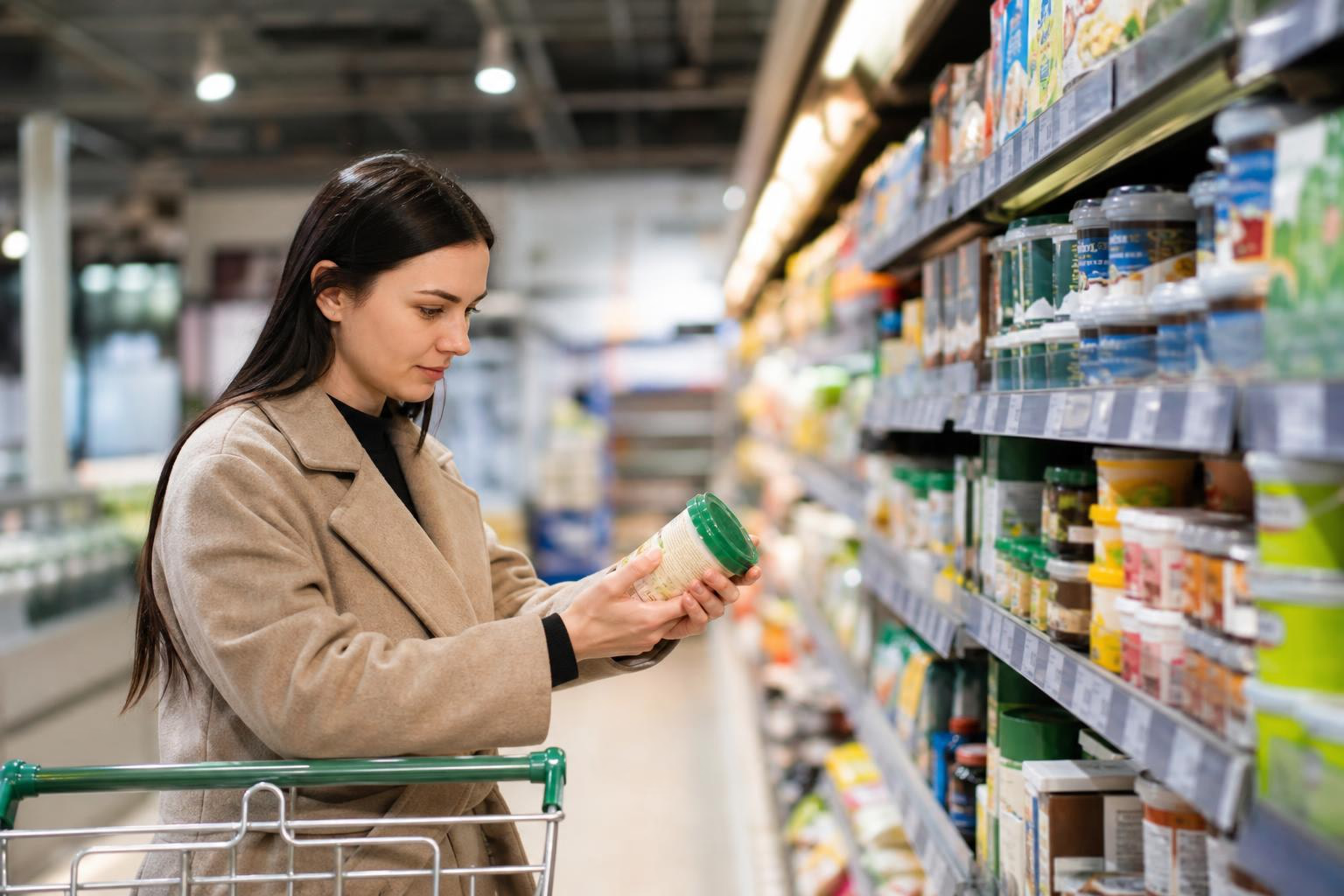
For FMCG brands specifically, advocacy takes a particular form that most marketing content overlooks: shopper advocacy. This is where real purchasers buy a product from a retailer, try it, and then leave a verified review on that retailer’s website. It’s advocacy that lives at the point of purchase, not on someone’s Instagram story.
If you’re unfamiliar with how verified product reviews work in the UK FMCG context, that distinction matters enormously.
What Is Influencer Marketing?
Influencer marketing pays individuals with established audiences to promote your product. These people aren’t necessarily customers. They could be celebrities, niche content creators, industry experts, or social media personalities with large followings. Companies collaborate with them to access their dedicated audience.
The global influencer marketing industry is projected to reach roughly $32.55 billion in 2025, up from $24 billion in 2024. Half of influencers charge between $250 and $1,000 per post.
Influencer marketing is effective for awareness. It puts products in front of new eyeballs quickly, and for visually driven categories like fashion and beauty, it can drive direct sales. The question for FMCG brands is whether that awareness translates to action at the shelf.
The Core Distinction
Here’s the simplest way to separate these two strategies:
Advocates are customers who already buy. Influencers are paid outsiders.
Advocates share because they want to. Influencers share because they’re contracted to. Both have value, but they operate on fundamentally different trust mechanics.
→ Considering review generation pricing as an alternative to influencer spend? The cost structures are very different.
Head-to-Head Comparison
| Dimension | Advocacy Marketing | Influencer Marketing |
|---|---|---|
| Who creates content | Real customers and shoppers | Paid creators and personalities |
| Motivation | Genuine product experience | Commercial relationship |
| Consumer trust | 92% trust advocate recommendations (Nielsen) | 18% trust influencer testimonials (Forrester) |
| Where content lives | Retailer product pages, review sites | Social media feeds |
| Content lifespan | Permanent (reviews persist indefinitely) | 24 to 72 hours before feed decay |
| Fraud risk | Near zero (tied to verified purchases) | ~37% of followers show signs of being fake |
| Cost model | Pay per review or output | Pay per post ($250 to $1,000+) |
| Best for | Conversion, retailer search ranking, trust | Awareness, reach, demographic targeting |
| FMCG fit | Strong (sits at the point of purchase) | Moderate (awareness only, weak conversion path) |
Why This Distinction Matters More for FMCG
Most articles comparing advocacy vs influencer marketing treat them as interchangeable social media strategies. For fashion, beauty, or DTC brands, maybe they are. For FMCG brands selling through UK grocery retailers, they aren’t even close.
The digital shelf is where FMCG decisions happen
When a shopper searches “peanut butter” on Tesco.com, the results that appear, and the order they appear in, are heavily influenced by star ratings, review volume, and review recency. An influencer’s TikTok video about your peanut butter doesn’t show up on that Tesco product page. A verified shopper review does.
This is the “where the content lives” problem. Influencer content exists on social platforms. It doesn’t populate retailer review platforms like those on Tesco, Sainsbury’s, Ocado, or Boots. For FMCG brands, the retailer PDP is the digital shelf, and advocacy is the only strategy that directly feeds it.
Grocery is not fashion
Writing in The Grocer, one commentator put it bluntly: influencers are far more influential when their followers want to buy the dress they’re wearing. But when it comes to deciding what brand of cheese to buy, or trying out a chocolate NPD, it’s not quite the same. Only 7% of grocery shopping happens online, compared to 25% of fashion purchases.
FMCG purchases are low-involvement and often impulse-driven. The conversion chain from a TikTok video to a Tesco basket is long and essentially unmeasurable. A review sitting on that same product’s Tesco page, by contrast, is immediate.
The review conversion effect
The data on review impact is striking. Positive online reviews can increase conversion rates by up to 370%. Bazaarvoice reported that Molton Brown saw a 54% lift in revenue per visitor and a 43% lift in conversion rate when customers engaged with reviews.
For a practical guide on building this kind of review coverage, see our piece on generating product reviews for FMCG brands.
The Trust Evidence
The trust gap between advocacy and influencer marketing is not a marginal difference. It’s a chasm.
According to Nielsen, 92% of consumers trust recommendations from brand advocates. Forrester Research found that only 18% trust testimonials from industry influencers.
More recent data makes the picture even starker:
- 87% of customers say online reviews have a larger impact on purchasing decisions than influencer reviews (Textedly, 2025)
- Only 5% of consumers trust influencer content completely, according to the BBB Influencer Trust Index 2025
- When asked who they trust most for product recommendations, 63% chose crowdsourced opinions, 20% chose AI chatbots, and just 17% chose influencers (PartnerCentric, 2025)
Over 85% of people say authenticity is important when deciding what brands they support. Unscripted content beats polished branded ads by 62% on engagement and 38% on conversion across beauty, food, and fitness categories.
The pattern is clear. Consumers increasingly distinguish between paid promotion and genuine recommendation, and they trust the latter far more.
The Fraud Factor
One of the cleanest differentiators between advocacy and influencer marketing is fraud risk.
SociaVault Labs conducted the largest independent study of influencer fraud ever published, analysing 100,000 accounts and 120 million data points across Instagram and TikTok. The headline finding: 37.2% of influencer followers show signs of being fake, purchased, or inauthentic. A separate HypeAuditor audit spanning 8.7 million profiles put fraudulent activity even higher, at 41.3%.
The financial impact is real. Brands waste approximately $4.6 billion per year on influencer partnerships compromised by fake followers.
With shopper advocacy, specifically verified purchase reviews, the fraud problem essentially disappears. Every review is tied to a real transaction. The shopper bought the product, tried it, and posted their honest opinion on the retailer’s website, where it passes through the retailer’s own moderation process.
For brands concerned about review authenticity and regulatory compliance, our guide on compliant review campaigns covers the ASA and retailer requirements in detail.
Strengths and Limitations of Each Approach
Where influencer marketing wins
Influencer marketing isn’t useless for FMCG. It has genuine strengths:
- Awareness at speed. Launching an NPD? An influencer with 500,000 followers can create immediate visibility.
- Demographic precision. You can target specific age groups, interests, and geographies through carefully selected creators.
- Visual storytelling. Recipe content, unboxing videos, and lifestyle integrations showcase products in ways a text review can’t.
- Social proof on social platforms. If your brand needs a presence on TikTok or Instagram, influencers deliver it.
The reported ROI can be strong: some estimates suggest brands earn $5.78 for every $1 invested. But this figure aggregates across all categories, and FMCG (particularly grocery) sits at the lower end.
A ResearchGate study on FMCG specifically found that brand ambassadors have a positive but statistically insignificant effect on purchasing decisions, suggesting celebrity endorsements alone don’t strongly move consumer behaviour in this category.
Where advocacy marketing wins
- Trust and conversion. The 92% vs 18% trust gap speaks for itself.
- Retailer search ranking. Products with more reviews and higher ratings rank higher in retailer search results and are more likely to be included in retailer media placements.
- Permanence. A review posted on Tesco.com today will still be there in six months. An Instagram story disappears in 24 hours.
- Range review survival. Retailers favour products with strong review profiles during range reviews. Reviews are evidence of consumer demand.
- Zero fraud risk. Every output is tied to a verified purchase.
- Measurability. You can track exactly how many reviews were posted, on which retailers, with what ratings.
Trial mechanics like cashback promotions can work alongside advocacy to drive initial purchase, creating the purchase that seeds the review.
The limitations of each
Influencer marketing’s weaknesses for FMCG are structural: content doesn’t reach the retailer PDP, the path from social post to supermarket basket is long and foggy, and fraud rates are uncomfortably high.
Advocacy marketing’s limitations are different. It’s slower to build. It doesn’t generate the burst of awareness that a viral TikTok can. And for brands with no existing customer base (pre-launch, for example), there are no advocates to activate yet.
A Combined Approach: Start With Advocates, Scale to Influence
The smartest answer to the advocacy vs influencer marketing question isn’t either/or.
On LinkedIn, marketing practitioner Sue Duris argues for merging both strategies: instead of using a plethora of tools to find influencers you have no relationship with, look at your brand advocates, your employees, customers, and fans that you already have relationships with.
This “start with advocates, scale to influence” framework works particularly well for FMCG:
- Build your review foundation first. Get verified shopper reviews onto retailer product pages. This creates the trust infrastructure that every other marketing effort builds on.
- Use influencer marketing for targeted awareness. When launching an NPD or entering a new category, influencer content drives discovery.
- Connect the two. Some of your best advocates may have small but engaged followings. Micro-advocacy, where real customers share their experience with their own networks, combines the trust of advocacy with the reach mechanics of influence.
- Measure what matters. Track influencer campaigns on awareness metrics (reach, impressions, engagement). Track advocacy on conversion metrics (review volume, star ratings, retailer search position, sales lift).
For brands thinking about how reviews and AI visibility intersect, reviews also feed the structured data that AI shopping assistants and search tools increasingly rely on.
What FMCG Brands Should Actually Do
If you’re a UK FMCG brand manager reading this, here’s a practical framework:
For established products with low review coverage: Prioritise advocacy. Get verified reviews onto Tesco, Sainsbury’s, Ocado, and other retailer platforms where your product is listed. The average grocery review rate is just 0.1% to 0.3%, which means most of your competitors have thin review profiles too. Moving first creates a real advantage.
For NPD launches: Use influencer marketing in the first four to six weeks for awareness, then shift budget to advocacy once the product is in distribution. The influencer campaign gets people talking; the advocacy campaign gets reviews onto the shelf.
For products facing range reviews: Reviews are evidence. Retailers look at review volume, ratings, and recency when deciding which products to keep. A strong review profile makes your product harder to delist.
For brands with in-store execution gaps: Advocacy and in-store compliance work together. Reviews drive online conversion; compliance audits ensure the product is actually on the shelf when shoppers arrive in store.
→ Ready to explore how shopper advocacy works in practice? Book a demo to see how verified reviews are generated across UK retailer sites.
Frequently Asked Questions
What is the main difference between advocacy and influencer marketing?
Advocacy marketing activates real customers who already buy and use your product. Influencer marketing pays external creators with established audiences to promote it. The fundamental difference is the relationship: advocates are genuine users, influencers are commercial partners.
Which is more trusted by consumers, advocacy or influencer marketing?
Advocacy wins decisively. Nielsen found that 92% of consumers trust recommendations from advocates, while Forrester Research found only 18% trust influencer testimonials. More recently, 87% of consumers said online reviews have a larger impact on their purchase decisions than influencer content.
Is influencer marketing effective for FMCG brands?
It can generate awareness, particularly for NPD launches and visual categories. But the conversion path from social media to supermarket basket is long and difficult to measure. Only 7% of grocery shopping happens online (compared to 25% for fashion), and influencer content doesn’t appear on retailer product pages where most FMCG purchase decisions occur.
How long does influencer content last compared to advocacy content?
Influencer posts on social feeds typically decay within 24 to 72 hours as algorithms push newer content forward. A verified product review on a retailer website like Tesco.com or Sainsbury’s persists indefinitely, continuing to influence purchase decisions for months or years.
What is shopper advocacy?
Shopper advocacy is the FMCG-specific form of advocacy marketing. Real shoppers purchase a product from a retailer, try it at home, and then post a verified review on that retailer’s product page. It places authentic consumer feedback directly at the point of purchase.
How big is the fake follower problem in influencer marketing?
Studies suggest it’s significant. SociaVault Labs found that 37.2% of influencer followers show signs of being fake or inauthentic. Brands collectively waste an estimated $4.6 billion per year on partnerships compromised by fake followers. With verified purchase reviews, this risk is essentially eliminated.
Can you combine advocacy and influencer marketing?
Yes, and for most brands that’s the right approach. Use influencer marketing for awareness and reach (especially during launches), and use advocacy for sustained trust, conversion, and retailer search ranking. The key is recognising which strategy serves which goal and measuring them accordingly.
Do product reviews affect retailer search ranking?
Yes. Products with higher review volumes, better star ratings, and more recent reviews tend to rank higher in retailer on-site search results. Strong review profiles also make products more likely to be included in retailer media placements and to survive range reviews.