TL;DR
In-store activation strategy covers every coordinated activity inside a physical retail store designed to drive awareness, trial, and purchase. In the UK, this strategy is shaped by HFSS placement and promotion restrictions, compliance gaps that run as high as 50%, and the growing tension between retail media budgets and physical shelf execution. This glossary defines the key terms, benchmarks, and regulatory frameworks that UK FMCG brand teams need to plan and measure in-store activation effectively.
What Is In-Store Activation?
In-store activation is the coordinated set of activities inside a physical retail environment designed to influence shopper behaviour at or near the point of purchase. It includes everything from promotional displays and product sampling to compliance audits and shelf placement optimisation.
The goal is straightforward: convert shoppers who are already in the store into buyers of your product. It is the last-mile nudge that turns browsing into purchasing.
Three related terms cause confusion, so here is how they differ:
Brand activation is the broadest term. It covers any activity, online or offline, that builds awareness and creates meaningful connections between a brand and its audience. A festival sponsorship counts. So does an Instagram campaign.
Retail activation sits inside brand activation but is specific to retail environments. It includes both physical stores and online retailer platforms, from pop-ups to retailer website promotions.
In-store activation is the most specific. It happens inside a physical store: end-of-aisle displays, sampling stations, shelf wobblers, and every other tactic designed to influence shoppers standing in an aisle.
For UK FMCG teams, the distinction matters because in-store activation strategy is increasingly shaped by regulation. HFSS placement restrictions, volume promotion bans, and devolved nations timelines all affect what you can and cannot do inside a Tesco, Sainsbury’s, or Asda. No other market has quite this combination of constraints.
The numbers reinforce why this matters. POPAI research indicates that in-store execution non-compliance runs as high as 50% in the UK. Meanwhile, branded items sold on promotion now account for 35% of UK FMCG sales. That is a huge volume of commercial activity that depends on things actually happening correctly on the shelf.
If you are building or refining your approach, our shopper activation campaign checklist breaks the process into actionable steps.
In-Store Activation Formats: A-Z Glossary
Compliance Audit
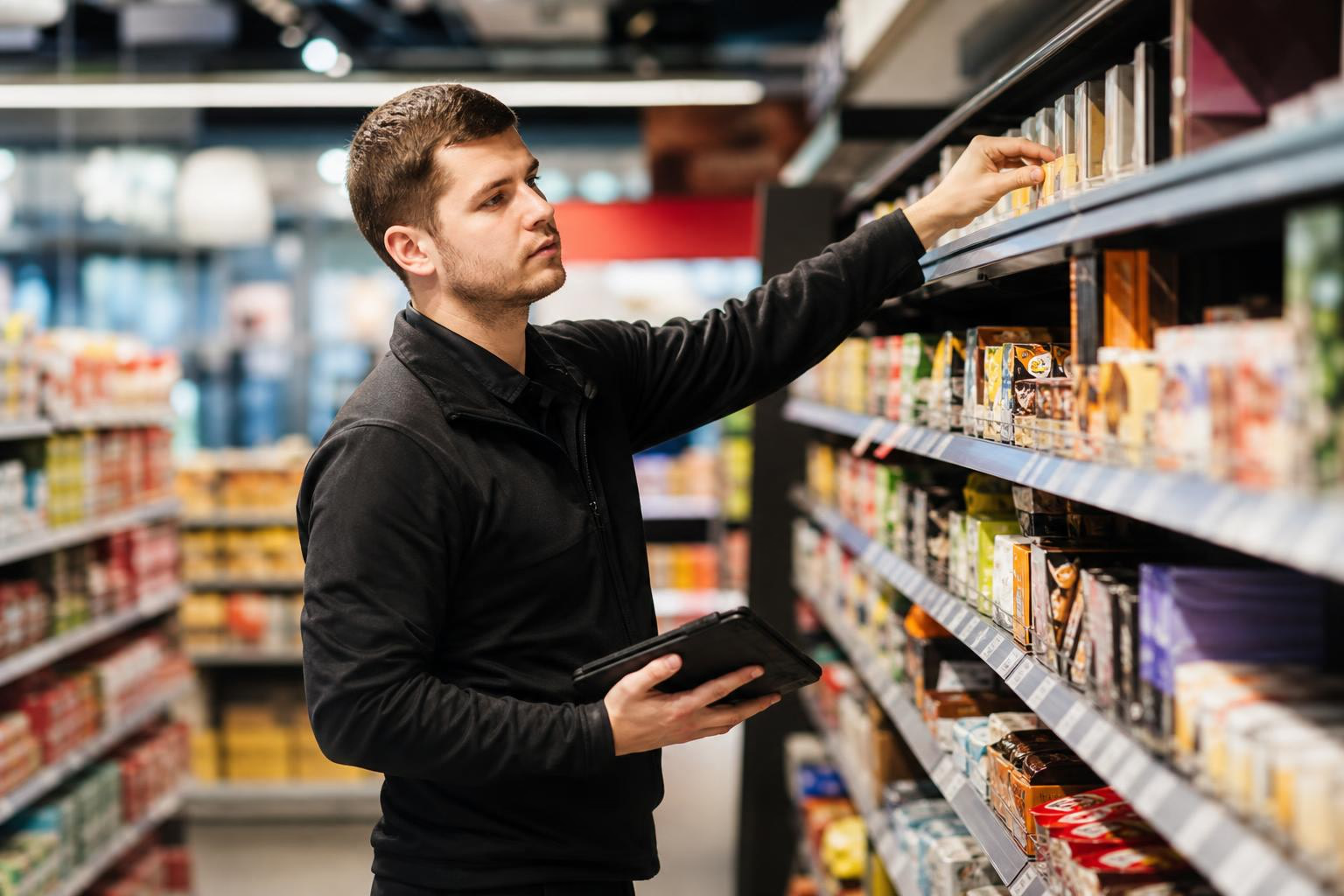
A store-level check verifying whether products, pricing, promotions, POS materials, and shelf layouts match the agreed retail plan. FMCG brands use compliance audits to confirm execution, spot availability gaps, and collect photographic evidence. Without audits, brands are guessing whether their trade investment delivered anything at all.
Explore in-store compliance services →
Digital In-Store Media
Screens, interactive kiosks, and digital shelf-edge labels inside the retail environment. Increasingly part of retailer media networks. The key distinction from traditional POS is that digital media can be updated centrally and measured with impression data, blurring the line between physical and digital activation.
End-of-Aisle Display
Also called a gondola end. One of the most valuable pieces of real estate in a grocery store. End-of-aisle displays generate significantly higher visibility than standard shelf positions. Under HFSS placement restrictions (in force since October 2022), products classified as high in fat, salt, or sugar cannot be placed in these prominent positions in stores with 50 or more employees.
Experiential Activation
Immersive brand experiences inside (or adjacent to) the retail environment. Think cooking demonstrations, VR tastings, or interactive product stations. Research suggests 85% of consumers are more likely to buy from a brand after attending a live marketing event, and 70% become repeat customers afterward. Experiential activation typically requires a larger budget than standard POS, but the trial-to-purchase conversion rates can justify the premium.
Field Marketing
The discipline of deploying people into retail environments to execute brand plans. This includes merchandising, sampling, auditing, and relationship-building with store staff. Field marketing is the human infrastructure behind most in-store activation strategy in the UK. The trend is shifting toward crowdsourced models, where geo-indexed shopper networks handle tasks that traditional field teams once performed exclusively.
In-Store Sampling and Demos
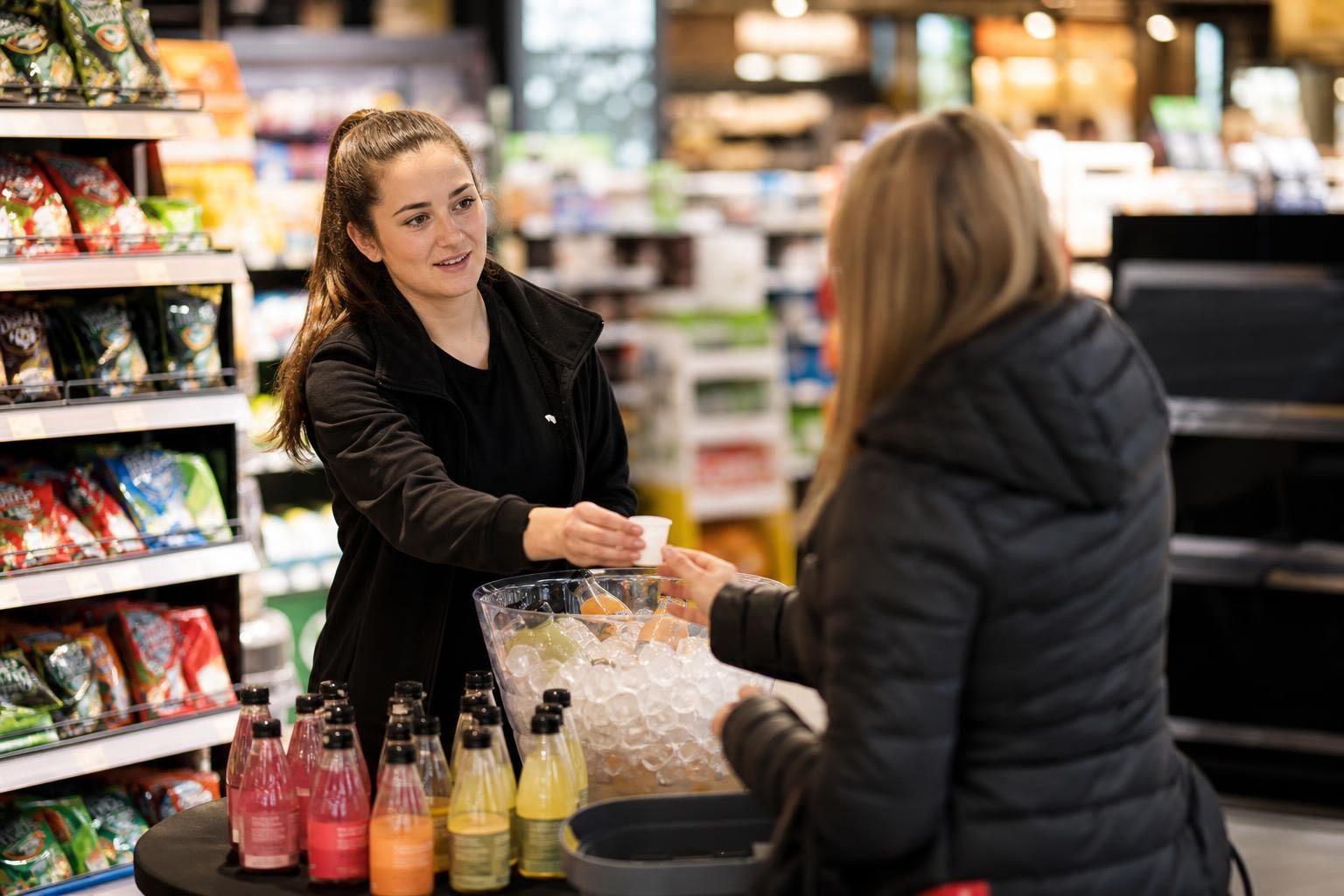
Allowing shoppers to try products before buying. Sampling remains one of the most effective activation formats because it collapses the consideration phase. Well-executed pop-ups and sampling events can deliver 30 to 60% trial-to-purchase conversion among engaged shoppers. In a post-HFSS world where volume promotions are restricted for certain categories, sampling becomes even more important as a non-price trial mechanic.
For a deeper look at running these campaigns, see our guide on product trial campaigns.
Loyalty Mechanic
Any activation tied to a retailer’s loyalty programme: bonus points, personalised offers, or tiered rewards for repeat purchase. Loyalty mechanics sit at the intersection of in-store and digital activation, since redemption data flows through retailer platforms.
POS / POSM (Point of Sale Material)
Physical marketing materials placed at or near the point of purchase: shelf wobblers, dump bins, counter displays, hanging signs, and barkers. POSM compliance audits verify that the materials brands pay for actually make it onto the shop floor. The gap between what is agreed and what is deployed is one of the most persistent problems in UK FMCG execution. Our POS compliance audit guide covers what to measure and how.
Pop-Up Activation
Temporary, often high-impact installations inside or outside a retail store. Pop-ups work well for NPD launches and seasonal campaigns. They generate foot traffic and social content simultaneously. The challenge is scalability, since a pop-up in one Waitrose branch does nothing for the other 300.
Promotional Display
Any temporary fixture or secondary placement designed to draw attention to a promoted product. Promotional displays include stackers, clip strips, pallet wraps, and free-standing display units (FSDUs). The critical question is always whether the display was actually installed. Studies show that while brands perceive their promotional compliance at 70% or higher, actual rates are closer to 40%.
Retailtainment
A blend of retail and entertainment. Retailtainment describes any activation that prioritises experience over transaction: in-store events, themed displays, or gamified shopping mechanics. It works well for brands trying to highlight their mission and values, but it typically requires a bigger budget and is harder to scale across hundreds of stores.
Secondary Placement
Any product location beyond the primary shelf position. Secondary placements include cross-merchandising (placing pasta sauce next to dried pasta), promotional bays, and checkout-area displays. HFSS rules have directly reduced available secondary placement options for affected categories.
Shelf Talker
A small sign or card attached to the shelf edge, drawing attention to a product. Shelf talkers are cheap, quick to deploy, and effective when the message is clear. They are also frequently missing, damaged, or placed next to the wrong product, which makes them a reliable indicator of overall execution quality.
In-Store Execution and Compliance Terms
This section covers the operational vocabulary that sits behind every in-store activation strategy UK brand teams build. If the activation formats above are the “what,” these terms describe the “how well.”
Compliance Rate
The percentage of stores where execution matches the agreed plan. In large, well-managed UK grocery chains, compliance rates of 70 to 85% are typical. That sounds reasonable until you consider that even at 80% compliance, one in five stores is not executing your plan. For a brand listed in 2,000 stores, that is 400 outlets where your trade spend is partially or fully wasted.
Numeric Distribution
The percentage of target stores that stock a given SKU. A brand might have secured national listings but find that only 75% of stores actually have the product on shelf. Numeric distribution is the foundation, since nothing else in your in-store activation strategy matters if the product is not physically present.
On-Shelf Availability (OSA)
Whether your product is findable on the shelf at the moment a shopper looks for it. Out-of-stocks average around 8% across FMCG categories and rise to 10% for promoted lines. The consequences are severe: shoppers switch brands 70% of the time when their product is missing. For a detailed look at how to audit and improve this, read our stock availability audit guide.
Out-of-Stock (OOS)
When a product is completely unavailable to the shopper. Harvard Business Review research found that 72% of out-of-stocks are caused by faulty in-store ordering and replenishment practices, not supply chain failures. This is important because it means the problem is often fixable at store level, through better activation and field team engagement.
Phantom Out-of-Stock
When the product is in the store but not on the shelf. It might be sitting in the stockroom, misplaced in the wrong aisle, or buried behind other products. Phantom OOS is harder to detect than a true out-of-stock because the retailer’s inventory system shows the item as available. It is one of the most common execution failures and one of the hardest to catch without physical store visits.
Perfect Store Framework
The most widely used framework by FMCG brands for defining and measuring in-store execution standards. Originally popularised by Unilever and P&G, it covers five core dimensions: distribution and availability, shelf placement, planogram compliance, share of shelf, and pricing accuracy. Each dimension receives a weighted score, and the aggregate becomes the Perfect Store Score.
Perfect Store Score
The composite metric generated by the Perfect Store framework. Most FMCG brands target 80 to 90% as a healthy score across covered outlets. Scores below 70% usually signal significant execution gaps. The score is useful for tracking performance over time and comparing outlets, regions, or retail partners.
Planogram Compliance
Whether products are placed on the shelf according to the agreed planogram. Planogram compliance is one component of in-store execution, not the whole picture. A store can be fully compliant with its planogram and still have poor execution if products are out of stock, promotional displays are missing, or pricing is incorrect. Our shelf compliance guide covers the relationship between planogram adherence and broader execution quality.
Share of Shelf
The brand’s physical shelf space compared to total category space. A brand with 20% market share but only 10% share of shelf has a visibility problem. Share of shelf influences ease of shopping, rate of sale, and long-term category positioning. It is also a negotiation tool, since brands use share of shelf data to argue for more space during JBP discussions.
In-Store Activation Measurement Terms
Activation without measurement is just spending. These are the metrics UK FMCG teams use to evaluate whether their in-store activation strategy is working.
Basket Uplift
The increase in average basket value attributable to an activation. Measured by comparing baskets containing the activated product (or category) against a control period or control stores. Basket uplift captures whether the activation drove incremental spend, not just brand switching within the category.
Conversion Rate (In-Store)
The percentage of shoppers exposed to an activation who make a purchase. For in-store sampling, conversion rates of 30 to 60% are achievable among engaged shoppers. For passive activations like POSM or shelf talkers, conversion is harder to isolate and typically measured through rate-of-sale changes.
Dwell Time
How long a shopper spends in a specific zone or in front of a display. Longer dwell time correlates with higher purchase probability. Measured via in-store cameras, sensors, or observation studies. Useful for evaluating the engagement quality of experiential activations.
Incremental Sales
Sales generated above the baseline that can be attributed to the activation. This is the metric that matters most in JBP conversations. It requires clean baseline data and ideally a control group (matched stores without the activation) to isolate the effect.
Promotional ROI
The return on investment for a specific promotional activation. Historical Nielsen data suggests 59 to 60% of trade promotions do not break even. Common causes include poor in-store execution with compliance rates as low as 40%, cannibalisation of non-promoted SKUs, and deep post-promotion dips. Experiential campaigns, by contrast, can deliver 3:1 to 5:1 returns on spend, with high performers reaching 10:1.
For more on measuring promotional performance, see our promotional compliance measurement guide.
Rate of Sale
Units sold per store per week. Rate of sale is the most granular performance metric for in-store activation. A successful activation should produce a measurable lift in rate of sale during and (ideally) after the campaign period.
Trial-to-Purchase Conversion
The percentage of shoppers who try a product through sampling or demo and then make a purchase, either immediately or within a defined period. This metric directly connects activation spend to revenue.
UK Regulatory Terms That Shape In-Store Activation
No in-store activation strategy in the UK can be built without understanding HFSS. These regulations have fundamentally changed what is possible inside a British supermarket.
HFSS (High in Fat, Salt, or Sugar)
A classification applied to food and drink products that exceed nutrient profiling thresholds set by the UK government. The classification determines whether a product faces restrictions on placement, promotion, and advertising. Products are scored using the Department of Health’s nutrient profiling model, and those exceeding the threshold are classified as HFSS.
Placement Restrictions (October 2022)
In-store placement restrictions came into force in October 2022, banning HFSS products from checkout areas, store entrances, and end-of-aisle displays in England. These restrictions apply to retailers with 50 or more employees. This single regulation eliminated some of the most valuable secondary placement locations for affected brands and forced a rethink of in-store activation strategy for entire categories.
Volume Promotion Restrictions (October 2025)
HFSS volume promotion restrictions in England came into effect on 1 October 2025. These ban volume-priced promotions such as “buy one get one free,” “3 for 2,” and other multi-buy deals for HFSS products. Temporary price reductions (straight price cuts) are still permitted. This restriction pushes affected brands toward non-price activation tactics: sampling, experiential events, review campaigns, and compliance-led strategies that protect availability and visibility rather than relying on promotional mechanics.
Our promotional campaign checklist covers how to plan within these constraints.
Advertising Restrictions (January 2026)
New restrictions on advertising of HFSS products came into force on 5 January 2026, limiting paid advertising across certain channels. While this primarily affects above-the-line and digital advertising rather than in-store activation directly, it increases the importance of the physical store as a brand-building environment. If you cannot advertise widely, the shelf and the in-store experience carry more weight.
Devolved Nations Timeline
HFSS regulation is not uniform across the UK. England led with placement restrictions in 2022 and volume promotion restrictions in 2025. Wales entered into force on 26 March 2026. Scotland confirmed regulations to be implemented on 1 October 2026. Northern Ireland has not yet confirmed equivalent legislation. For brands operating nationally, this creates a patchwork of compliance requirements that must be managed store by store.
Crowdsourced vs. Traditional Field Activation Models
The infrastructure behind in-store activation strategy in the UK is changing. For decades, brands relied on dedicated field teams: employed merchandisers and reps visiting stores on fixed schedules. That model works, but it is expensive and slow.
The trend has moved firmly toward crowdsourced models. Multiple providers now use geo-indexed shopper networks rather than dedicated field teams. The logic is straightforward: shoppers are already in the stores. Activating them as auditors removes the travel cost and scheduling lag that slow down traditional field operations.
Here is how the two models compare:
| Factor | Traditional Field Team | Crowdsourced Shopper Network |
|---|---|---|
| Speed to deploy | Days to weeks | Hours to days |
| Cost per visit | Higher (travel, salary, management) | Lower (no travel overhead) |
| Geographic reach | Limited by team size and territory | National coverage from existing shoppers |
| Relationship depth | Strong (reps know store staff) | Variable (task-based, less continuity) |
| Data quality | Consistent if well-managed | High volume, needs quality controls |
| Scalability | Constrained | Highly scalable |
Hybrid models are increasingly common. Brands use dedicated field teams for key accounts and strategic relationships, while deploying crowdsourced shoppers for nationwide audits, compliance checks, and ad-hoc tasks. For a detailed comparison, our guide on field team vs crowdsourced retail audits breaks down when to use each.
A model gaining traction combines auditing with genuine purchase behaviour. Store visits that include checking availability, asking store staff about the product, and then purchasing it create real sales signals at store level. This goes beyond observation, since the visit itself generates data that influences replenishment decisions.
How In-Store Activation Connects to the Digital Shelf
Most guides on in-store activation strategy treat the physical store as an island. It is not. What happens on the shelf has direct consequences for a brand’s performance online, and the connection runs both ways.
The Review Gap
The average grocery review rate on UK retailer websites sits at roughly 0.1 to 0.3%, compared to 2 to 5% on Amazon. This gap exists partly because grocery shoppers rarely think to review products they bought in a physical store. Products with reviews can see up to 120% higher conversion rates on retailer PDPs, which means the brands winning online are often those generating reviews through offline trial.
This is where in-store activation and the digital shelf converge. When shoppers try a product through a sampling campaign or promotional trial and then post a review on Tesco.co.uk or Sainsbury’s, that review improves the product’s visibility in retailer search, lifts PDP conversion, and strengthens the brand’s position in range reviews.
Our guide on retailer product reviews explains this connection in detail.
On-Shelf Availability and Online Visibility
If a product is consistently out of stock in physical stores, its rate of sale drops. Lower rate of sale weakens the brand’s negotiating position with the retailer, which can affect online visibility through reduced retailer media support and lower algorithmic ranking. The physical and digital shelves are not separate P&Ls. They are part of the same system.
Why the Best Strategies Cover Both
The most effective in-store activation strategies generate physical trial that feeds digital proof. A sampling campaign that produces 200 verified reviews on a retailer website is not just an in-store activation, it is a digital shelf investment. Brands that recognise this connection get more value from every activation pound spent.
See how review campaigns support activation →
The Retail Media Tension
One dynamic worth naming: the explosion of interest in retail media is quietly drawing attention and budget away from physical in-store activation. As practitioners have noted, the problem is not that in-store activation does not work. The problem is that it is too often done inconsistently, too hard to measure, and too easy to underfund once comparisons start being made with retail media’s cleaner attribution story.
Retail media and in-store activation are complementary, not competing. A sponsored product listing on a retailer app drives awareness, but if the shopper walks into the store and the product is not on the shelf, or the promotional display is missing, that digital spend is wasted. At scale, even a 1 to 2% improvement in execution compliance can generate millions in incremental sales.
Vague activation briefs produce inconsistent execution. Specific, outlet-level standards (right product, right position, right POS, right price) give reps something to aim at and managers something to measure against.
Frequently Asked Questions
What is the difference between in-store activation and brand activation?
Brand activation is the umbrella term for any activity that builds awareness and engagement, whether that happens online, at an event, or in a store. In-store activation is a subset that happens specifically inside physical retail environments. All in-store activation is brand activation, but not all brand activation is in-store.
What does a typical in-store activation cost in the UK?
Costs vary enormously depending on format and scale. A simple shelf talker campaign across 500 stores might cost a few thousand pounds. A staffed sampling campaign in 50 stores for a week could run to £15,000 to £40,000. Experiential activations with bespoke installations can exceed £100,000. The relevant question is not what it costs, but what return it generates.
How do you measure in-store activation success?
The core metrics are incremental sales, rate of sale uplift, compliance rate, and trial-to-purchase conversion. For experiential formats, dwell time and basket uplift add context. The most rigorous approach uses matched control stores (outlets without the activation) to isolate the effect. Experiential campaigns deliver 3:1 to 5:1 returns on spend when well executed.
Do HFSS restrictions affect in-store sampling?
The current HFSS regulations focus on placement (where products can be displayed), volume promotions (multi-buy deals), and advertising. In-store sampling of HFSS products is not explicitly banned, but the placement restrictions limit where sampling stations can be located. Brands should check specific retailer policies, since some supermarkets apply stricter interpretations than the legislation requires.
What is a Perfect Store score?
A composite metric that measures how well a store executes against agreed standards across distribution, shelf placement, pricing, and promotion. Most FMCG brands target 80 to 90% as a healthy score. Scores below 70% typically indicate significant execution gaps. The framework was originally developed by Unilever and P&G and is now used across the industry.
Why is UK in-store activation strategy different from other markets?
Three factors make the UK unique: HFSS regulations (the most advanced in Europe), a highly consolidated grocery market dominated by a small number of major retailers, and a mature promotional culture where 35% of branded FMCG sales happen on promotion. These conditions demand a more compliance-aware, regulation-literate approach than what works in the US or Asia.
What is the biggest mistake brands make with in-store activation?
Treating it as a creative exercise rather than an execution discipline. The data is clear: in-store activations earn their place as the last-mile nudge that turns browsers into buyers, but getting it right is less about creativity and more about consistency. The same planogram, the same price, the same POSM, across every outlet. When brands nail consistency, the results follow.