
TLDR
A receipt verified sampling campaign is a product trial mechanic where shoppers buy a qualifying product, submit proof of purchase, and only then receive cashback, a review request, or another reward. The receipt confirms the right SKU was purchased from the right retailer during the campaign window. It turns sampling from a giveaway into measurable retail evidence, but it only works when distribution is strong, instructions are clear, reimbursement is fast, and any review collection is honestly disclosed.
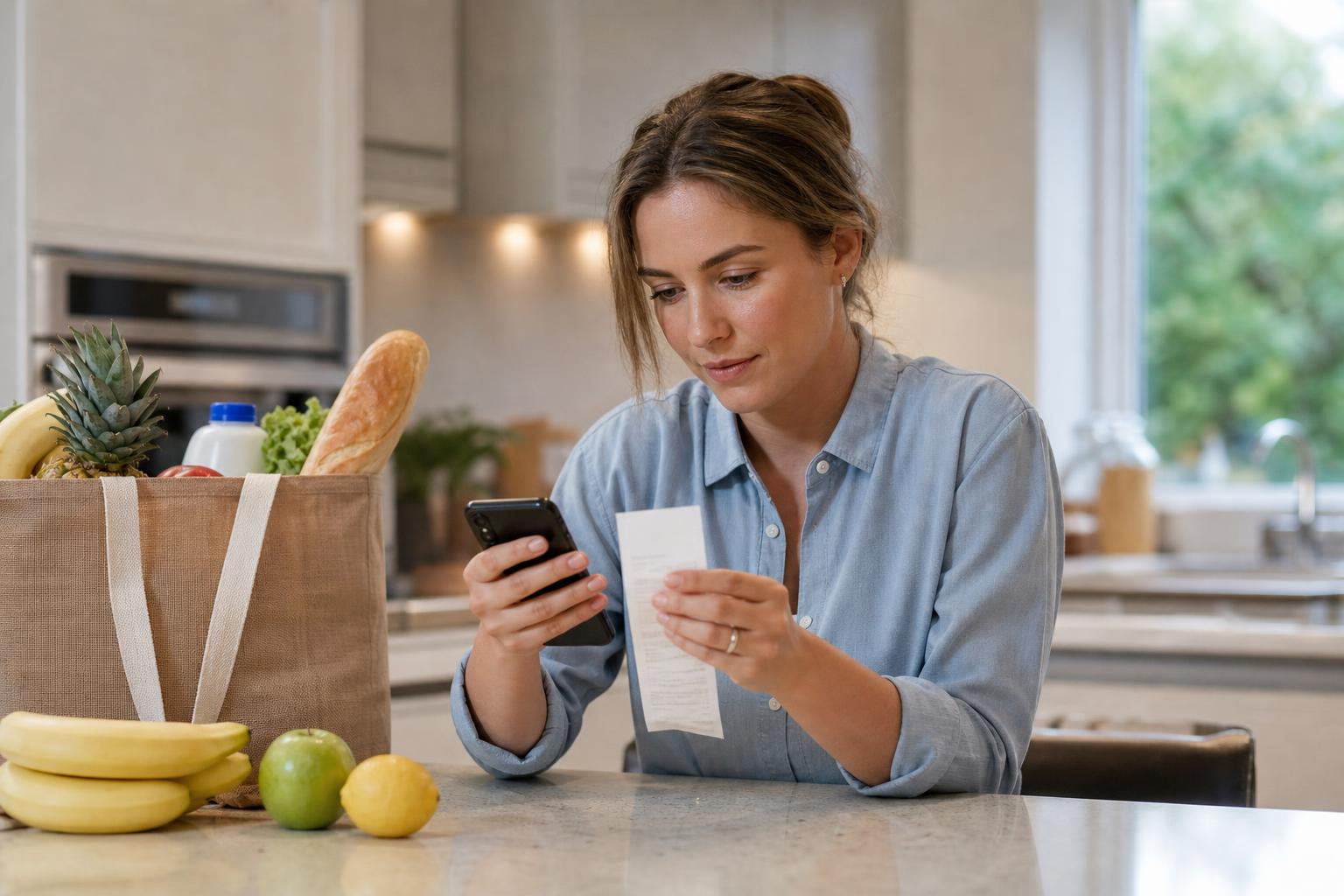
A receipt verified sampling campaign is a product trial campaign where the brand only counts or rewards the trial after the shopper proves they bought the product. The shopper buys a qualifying SKU, submits a receipt, and the campaign checks the product, retailer, date, and other rules before cashback, review collection, survey follow-up, or reporting continues.
For FMCG brands, the attraction is straightforward: it turns sampling from a giveaway into a measurable retail action. Instead of reporting how many samples were handed out, the brand can report how many real shoppers bought the product, where they bought it, whether they reviewed it, and what the campaign cost per verified action.
If the goal is generating verified product reviews on UK retailer websites, receipt verification adds a proof layer that connects purchase to feedback.
Receipt Verified Sampling Campaign: The Core Definition
A receipt verified sampling campaign asks shoppers to buy a qualifying product from a specified retailer, then submit proof of purchase before receiving any incentive or follow-up task. The receipt is the proof layer. It confirms that the trial came from a real purchase of the right SKU, at the right retailer, within the campaign window.
In UK FMCG, this often means a brand wants shoppers to buy a full-size product from Tesco, Sainsbury’s, Asda, Morrisons, Boots, Ocado, Waitrose, or another retailer, then prove the purchase before cashback, review collection, or campaign reporting begins.
The mechanic differs from traditional product sampling, where a free sample is handed out or posted and the brand may never know whether the recipient later bought the full-size product. BeeLiked’s sampling framework makes this point directly: sample distribution alone does not prove later purchase. Receipt verification closes that gap.
How a Receipt Verified Sampling Campaign Works
The process follows a consistent pattern across most platforms and services.
1. Define the commercial goal
The campaign starts with a clear objective. Common goals include driving NPD trial, building retailer PDP review volume, proving media-to-store conversion, comparing channels by cost per verified purchase, or building a consented first-party audience for future marketing.
2. Recruit the right shoppers
The audience matters as much as the receipt. Sampling to freebie hunters creates weak insight and low repeat value. The best campaigns recruit shoppers who already buy the category or live near stocked stores.
For a deeper look at structuring trial campaigns, see the guide on running product trial campaigns in UK FMCG.
3. Give shoppers exact buying instructions
This step is more important than most brands realise. Instructions should include product name, pack size, barcode if available, eligible retailers, campaign dates, maximum reimbursement, whether online or e-receipts count, and what to do if the product is out of stock.
Practitioners on Reddit report that participant frustration with receipt-based campaigns often comes from unclear rules. Influenster users describe campaigns where receipts stayed “under review” for extended periods, were rejected without a clear reason, or required repeated support contact before cashback was paid. MoneySavingExpert forum users discussing UK receipt apps mention similar issues: rejected receipts, slow cashout, and product availability problems in rural areas.
4. Shopper buys the product
This is the key difference from classic sampling. The shopper experiences a real shelf or online retail purchase. That matters because it creates a retail sales signal and forces the shopper to interact with the actual product page, shelf price, range, availability, and delivery experience.
5. Receipt is verified
The receipt goes through validation checks. SeeGap describes its flow as checking SKU, retailer, date, and price before paying cashback. Steve’s receipt validation guidance adds further checks: matching line items to promoted SKUs, confirming merchant participation, checking purchase date, verifying totals, detecting duplicate receipts, and enforcing participant limits.
6. Reward, reimbursement, or next task
Depending on the campaign design, the shopper may receive full or partial cashback, a gift card, points, a review request, a survey, a UGC task, or a repeat purchase offer. If a review or social post is requested, the incentive must be disclosed.
7. Report the results
The brand receives verified purchase data: approved receipts, retailer split, redemption rate, review completion rate, cost per verified purchase, and other campaign metrics. This is the reporting advantage over traditional sampling, where the brand can only report distribution numbers.
What the Receipt Verifies
Receipt validation typically checks several data points:
- Product or SKU match. Does the receipt show the correct product and variant?
- Pack size. Is it the right size, not a different variant?
- Quantity. Did the shopper buy the required number of units?
- Retailer. Was the purchase made at an eligible store?
- Purchase date. Does the transaction fall within the campaign window?
- Purchase price. Is the price consistent with the product?
- Duplicate receipt detection. Has this receipt been submitted before, on the same or a different account?
- Participant limits. Has this shopper already claimed the maximum number of times?
- Editing or tampering. Are the totals arithmetic consistent? Does the image show signs of manipulation?
For brands running promotional campaigns alongside receipt verification, the retail promotion verification guide covers the compliance side of validation in more detail.
How Receipt Verified Sampling Differs From Similar Mechanics
These terms overlap but they are not interchangeable.
| Mechanic | What happens | Key difference from receipt verified sampling |
|---|---|---|
| Traditional product sampling | Brand gives away a free sample by post, in-store, or at an event | Trial happens before purchase. No proof of later full-size purchase. |
| Receipt verified sampling | Shopper buys the product, then proves purchase with a receipt | Trial is tied to a verified retail transaction. |
| Cashback campaign | Shopper buys product, receives money back after proof of purchase | Cashback is one possible incentive. Receipt verified sampling is the broader campaign structure. |
| Coupon or money-off promotion | Discount is applied before or at purchase | Receipt verified sampling normally rewards after purchase, so the shelf price is not reduced. |
| Verified purchase review | A review is labelled as coming from a confirmed buyer | Receipt verified sampling may generate verified reviews, but also covers cashback, survey insight, and channel attribution. |
| Review seeding | Brand recruits shoppers to try a product and leave reviews | If receipt verified, review seeding includes a proof-of-purchase layer before the review task is counted. |
Receipt verified sampling is not just cashback. Cashback may be the reward, but the campaign is the wider structure: target shopper, purchase, proof, trial, review or feedback, and reporting.
For brands considering shopper promotion campaigns in UK retail, receipt verification adds the proof layer that standard promotions often lack.
Why FMCG Brands Use Receipt Verified Sampling
It gives sampling a proof layer
Traditional sampling can create trial but often leaves the brand guessing what happened after the product was handed out. Sampl’s positioning makes this argument directly: samples can go to the wrong people, and brands may not know what happens after someone tries the product.
It links marketing spend to retail action
Receipt verified sampling can connect paid social, creator campaigns, QR codes, email, or shopper communities to a verified in-store or online purchase. Each channel can receive its own activation link, so the brand compares channels by verified purchases rather than impressions or clicks.
It can generate reviews from real product users
Bazaarvoice defines product sampling as asking customers to try a product in exchange for honest feedback, often a review or social post. In its own sampling example, roughly 45 reviews returned for every 50 samples sent. When receipt verification is added, those reviews come from confirmed buyers.
Research from Northwestern University’s Spiegel Research Center found that products with five reviews had a purchase likelihood 270% greater than products with no reviews. The same research found that purchase likelihood tends to peak around ratings of 4.0 to 4.7, then decline as ratings approach a perfect 5.0. For brands working toward the first 30 product reviews on retailer PDPs, receipt verified sampling provides a structured path to get there with real buyers.
It supports retail launch and range review conversations
If the brand can show verified purchase counts, review growth, retailer-specific performance, and buyer feedback, it has more concrete evidence than impressions, clicks, or sample distribution counts.
It preserves shelf price better than blanket discounting
In receipt verified cashback, the shopper buys at full shelf price and receives cashback after validation. This is different from a coupon because the shelf price is not cut and the reward is paid after a full-price purchase.
A practitioner on LinkedIn noted that cashback sampling connects trial, retail sell-through, and ratings/reviews, but it is not a pre-launch review programme. Products must be widely available and reviews should be disclosed as incentivised. This is an important distinction: receipt verified sampling campaigns work best after distribution is live, not before.
UK Compliance: What Brands Must Get Right
This is not optional. UK consumer protection law changed in April 2025, creating a banned practice around fake reviews and concealed incentivised reviews. The CMA can now issue fines and directions directly, with penalties potentially reaching up to 10% of global turnover.
The rules are clear
If a shopper receives money, cashback, a free product, a gift card, loyalty points, or any other benefit connected to a review, the incentive must be made clear. Concealed incentivised reviews are reviews that hide that they were written in exchange for money or benefits, such as a freebie. The CMA’s short guide says publishers must take reasonable and proportionate steps to prevent and remove fake reviews, concealed incentivised reviews, and misleading review information.
What this means for receipt verified sampling campaigns
- Never ask for positive reviews only. Allow honest negative feedback.
- Never suppress reviews because of sentiment.
- Do not hide the commercial relationship between the brand and the reviewer.
- Bazaarvoice’s Authenticity Policy requires that incentivised content reflects honest opinions, the endorser is a bona fide user, incentivisation is transparently disclosed, and sentiment is not influenced by the incentive.
- Platforms like Bazaarvoice provide incentivised badges or text labels so shoppers can see which reviews came from a promotion.
A YouGov 2025 study found that 60% of UK adults rated verified purchaser reviews as an important trust signal. Disclosure protects that trust. Hiding it destroys it.
For a full breakdown of the legal requirements, see the guide on UK CMA and ASA review compliance rules.
Metrics to Track
The right KPIs depend on whether the campaign is focused on trial, reviews, channel attribution, or all three.
| Metric | Formula | Why it matters |
|---|---|---|
| Invite-to-claim rate | Claims / invited shoppers | Shows offer appeal and audience quality. |
| Purchase verification rate | Approved receipts / submitted receipts | Shows whether shoppers are buying the right product and whether instructions are clear. |
| Receipt rejection rate | Rejected receipts / submitted receipts | High rejection suggests SKU confusion, poor image quality, fraud, or overly complex rules. |
| Review completion rate | Live reviews / approved purchases | Shows whether verified buyers convert into usable reviews. |
| Cost per verified purchase | Total campaign cost / approved purchases | Core ROI measure for trial. |
| Cost per live review | Total campaign cost / live approved reviews | Core measure for review-led campaigns. |
| Time to purchase | Purchase date minus invite date | Shows urgency and stock accessibility. |
| Time to reimbursement | Payment time minus receipt approval time | Critical for shopper trust. |
| Retailer split | Approved purchases by retailer | Useful for retail conversations. |
| Star rating distribution | Reviews by rating band | More useful than average rating alone. |
For brands connecting receipt verified sampling to review ROI, see how to calculate product review ROI with formulas and benchmarks.
Common Problems and How to Avoid Them
This is where most vendor pages stop. Community discussions tell the rest of the story.
Shoppers buy the wrong SKU
Pack sizes and variants look similar on shelves. A shopper grabs the 150g pack instead of the 200g pack, and the receipt shows the wrong barcode. Prevention: give the exact barcode, include a pack image, provide the exact product title, and link to the retailer PDP.
Receipts are rejected without explanation
Practitioners on Reddit describe this as one of the biggest sources of frustration. Influenster users report campaigns where receipts sat in “under review” status for weeks, then were rejected with no useful feedback. Prevention: give photo examples of acceptable receipts, run instant image-quality checks at upload, and provide clear rejection reasons with a resubmission path.
Cashback is delayed
Manual review queues and unclear approval workflows create bottlenecks. A shopper who uploads a receipt and hears nothing for three days is unlikely to participate in the next campaign. Prevention: set a payout SLA and update the shopper’s status at every stage.
The product is out of stock
This is a major hidden friction point. MoneySavingExpert users note that receipt app offers are often limited to products that are not available locally, especially outside major cities. A receipt verified sampling campaign should not be launched for a product with weak distribution.
Prevention: recruit only shoppers near confirmed distribution areas, and consider pairing campaigns with in-store compliance checks to verify stock before launch.
Reviews look biased
Reddit communities (particularly beauty and consumer forums) show scepticism about incentivised reviews, especially when products appear to have inflated five-star ratings from people who received products for free. Compliance is not just a legal issue. It is a trust issue. Prevention: require honest feedback, disclose the incentive, and never filter by sentiment.
Freebie hunters dominate
If the offer is too broad and not category-targeted, cashback hunters will stack offers and optimise around terms. UK beermoney subreddits discuss strategies for “double or triple dip” stacking across receipt apps. Prevention: screen for category buyers, use household limits, and employ duplicate detection. But do not treat all savvy cashback users as bad actors. Some are genuine category buyers who understand the mechanic.
Retailer moderation rejects reviews
If a review violates the retailer’s content guidelines or the disclosure is missing, the retailer may reject it. Prevention: train shoppers on retailer review rules and neutral review language before they submit.
When to Use Receipt Verified Sampling
Receipt verified sampling campaigns are strongest when:
- The product is already listed and findable at target retailers
- The brand needs its first 20 to 30 retailer reviews
- NPD has low review coverage on retail PDPs
- The product is too heavy, chilled, fragile, or regulated to post as a sample
- The brand wants full-size trial instead of a sachet or sample pack
- Retail media or paid social needs store-purchase proof
- The brand needs retailer-specific evidence for range reviews
- A shopper community can be geo-targeted near stocked stores
When Not to Use It
A receipt verified sampling campaign is a poor fit when:
- Product distribution is patchy or unverified
- SKU names are inconsistent across retailer receipts
- The product is frequently out of stock
- The brand cannot tolerate honest negative reviews
- Retailer terms do not allow incentivised review collection
- Approval and reimbursement cannot be handled quickly
- Campaign success depends on hiding that the review was incentivised
- The product has not yet launched in stores (a practitioner on LinkedIn explicitly warns that cashback sampling is not a pre-launch review programme)
The Difference Between Proving Purchase and Proving Usage
One important nuance: a receipt proves purchase. It does not automatically prove meaningful product usage. For cashback campaigns, purchase proof may be enough. For review campaigns, the shopper needs enough time to actually try the product before writing about it.
A receipt verified sampling campaign that asks for a review two minutes after receipt approval is not collecting genuine product feedback. A well-designed campaign builds in usage time, then follows up with a review request that encourages honest, experience-based writing.
FAQ
Is receipt verified sampling the same as cashback?
No. Cashback is one possible incentive within a receipt verified sampling campaign. The campaign itself is the broader structure: recruit shopper, purchase product, verify receipt, deliver reward or follow-up task, report results. Cashback is just one version of the reward.
Does receipt verification prove the shopper actually used the product?
No. It proves purchase. Product usage is supported by timing, review quality, surveys, photos, or follow-up tasks. A good campaign builds in usage time before requesting feedback.
Can receipt verified sampling generate verified reviews?
Yes, if the campaign asks verified buyers to leave honest reviews and complies with retailer guidelines and UK disclosure rules. The review should reflect genuine product experience, the incentive must be disclosed, and the shopper should be free to give negative feedback.
Do incentivised reviews need to be labelled?
Yes. UK CMA guidance treats concealed incentivised reviews as a banned practice. Platforms like Bazaarvoice provide incentivised badges or text labels. Brands that hide the commercial relationship risk fines of up to 10% of global turnover.
What should a receipt verification system check?
At minimum: the right SKU, retailer, date, quantity, price, duplicate use, participant limits, and signs of editing. These checks protect the brand from paying for invalid claims.
Why not just send free samples instead?
Free samples can create trial, but they do not prove purchase, retailer availability, or full-size product demand. Receipt verified sampling creates a retail purchase signal and generates data the brand can use in retailer conversations.
What is the biggest risk?
Poor shopper experience. Unclear instructions, product unavailability, slow reimbursement, and unexplained receipt rejection all erode trust. Community discussions on Reddit and MoneySavingExpert consistently highlight these friction points as the main source of participant complaints.
How much does a receipt verified sampling campaign cost?
Costs vary by campaign scale, incentive level, and whether the campaign includes review generation. The primary metric to track is cost per verified purchase or cost per live review, not total spend.
For UK FMCG brands that need verified retailer reviews rather than another one-off sampling spike, Brand Allies helps plan managed shopper advocacy campaigns across priority retailer PDPs, connecting real UK shoppers to real retail purchases and honest product reviews.