
TL;DR
Retail availability monitoring is the systematic tracking of whether a brand’s products are genuinely purchasable, on shelf and online, at the moment a shopper wants to buy. It covers physical stores, e-commerce, and rapid delivery platforms. In the UK, where 60% of consumers decide on brands at the shelf, poor availability costs brands sales, search visibility, and even their place in range reviews. This guide defines the concept, explains how it’s measured, and covers the main approaches brands use to monitor it.
If a product is showing as “in stock” in a retailer’s system but the shelf has been empty since 9am, that product is not available. That gap, the difference between what databases say and what shoppers actually find, is the core problem retail availability monitoring exists to solve.
Talk to us about monitoring availability across UK retail.
What Is Retail Availability Monitoring?
Retail availability monitoring is the practice of systematically tracking whether a brand’s products are purchasable, visible, and accessible to shoppers across every channel where they’re sold. That includes physical store shelves, online retailer pages, marketplace listings, and rapid delivery platforms.
The concept builds on On-Shelf Availability (OSA), which measures the percentage of time a product is physically present on the retail shelf when a customer intends to buy it. The standard formula is straightforward:
OSA (%) = (Number of items available on shelf / Total expected items on shelf) × 100
But retail availability monitoring goes further than shelf counts. It extends into the digital shelf: stock status on retailer websites, Buy Box ownership on marketplaces, search visibility, delivery window availability, and content accuracy on product detail pages.
The critical distinction most people miss is this: “in stock” and “available to buy” are not the same thing. A product can appear in stock in a retailer’s inventory system while the physical shelf sits empty. Online, a product can be technically listed but invisible to shoppers because it has dropped off the first page of search results, lost the Buy Box, or shows a delivery date two weeks out. Retail availability monitoring tracks what shoppers actually experience, not what systems report.
For a deeper look at how on-shelf availability audits work in practice, that guide covers the mechanics step by step.
Why Retail Availability Monitoring Matters
The financial consequences of poor availability are enormous, and the UK data paints a particularly stark picture.
Shoppers don’t wait. They switch.
A 2026 study by TELUS Consumer Goods surveying 3,000 global consumers found that 45% of consumers switch to a different brand when their preferred product is out of stock. For UK brands, the stakes are even higher: 60% of UK consumers decide on brands at the shelf, the highest rate globally. That means the shelf is the moment of truth, and an empty space hands the decision to a competitor.
Research from Retail Insight confirms the problem is widespread. 82% of UK shoppers polled said they had experienced out-of-stocks in-store during the previous 12 months, up 11 percentage points year-on-year. And the consequences go beyond a single lost sale: 27% of shoppers said shelf gaps would make them switch to a competitor supermarket entirely.
A fifth of shoppers (21%) reported that encountering out-of-stocks would make them abandon their shopping mission and leave the store without buying other items in their basket. That’s not just lost revenue on one SKU. It’s basket abandonment.
The global cost is staggering
The retail industry is losing an estimated $1.77 trillion annually to inventory distortion, a phenomenon sometimes called the “Ghost Economy” that encompasses out-of-stocks, overstocks, and preventable returns. Out-of-stocks alone eliminate roughly 4% of total retail revenue each year. Poor shelf execution more broadly costs CPG brands up to 25% in lost sales annually.
For a full breakdown of how UK FMCG brands can approach stock availability auditing, that guide covers the UK-specific challenges in detail.
Availability protects your listing, not just your sales
Out-of-stocks don’t just cost revenue in the moment. On platforms like Amazon, an out-of-stock product stops generating sales velocity, which drops its search ranking, which reduces visibility even after stock returns. On the retailer side, persistent availability problems can lead to delisting during range reviews. Products that maintain strong on-shelf availability and healthy review coverage are far more likely to survive those reviews.
What Retail Availability Monitoring Covers
Physical shelf
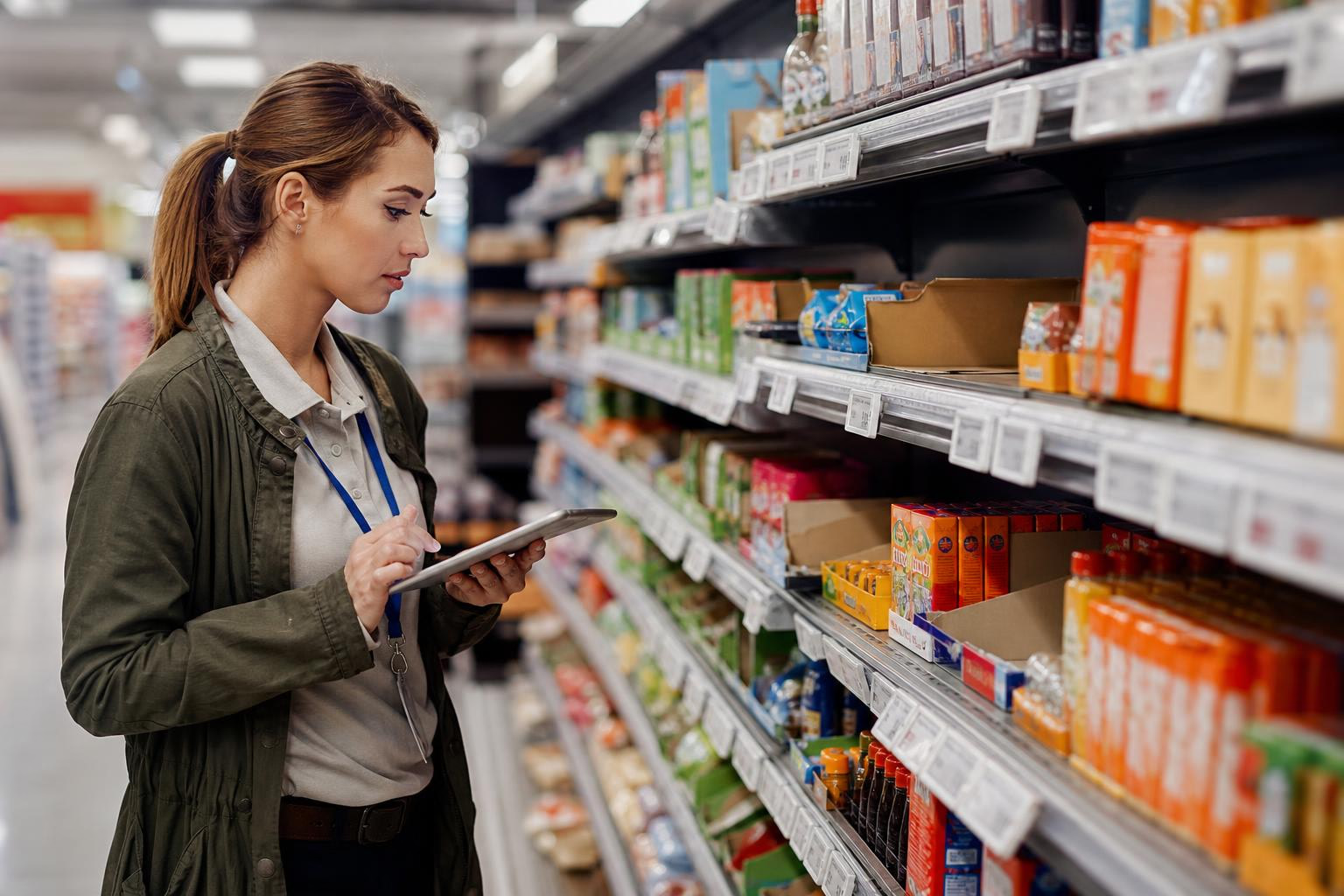
In-store, retail availability monitoring tracks whether the right products are in the right place, in the right quantity. That includes SKU presence, planogram compliance, shelf depth, and whether product is sitting in the backroom while the shelf sits empty.
That last point matters more than most brands realise. Research consistently shows that between 25% and 60% of out-of-stock events happen when the product is already in the store, just not on the shelf. This makes retail availability monitoring fundamentally an in-store execution problem, not purely a supply chain one.
For brands wanting to understand what planogram compliance actually involves, the shelf compliance guide for UK FMCG breaks it down.
Digital shelf
Online, the concept expands to include stock status on retailer websites, Buy Box ownership, search result positioning, content accuracy, ratings and review status, and delivery window availability. A product that shows “in stock” but ships in 14 days is functionally unavailable to most online grocery shoppers.
Since everything is interconnected on the digital shelf, when availability drops, so does share of assortment. Platforms rank products by sales velocity, and a stockout halts that momentum. The compounding effect is brutal: lose the sale, lose the ranking, lose future sales.
Quick commerce
Availability on rapid delivery platforms (Getir, Deliveroo Hop, Gopuff) is both more volatile and more consequential than on standard e-commerce. A 15-minute stockout during a peak period can permanently redirect a consumer to a competitor. Monitoring needs to happen in near real-time to be useful here.
Why omnichannel matters in the UK
Tesco, Sainsbury’s, and Boots all operate tightly integrated physical and digital channels. A shopper might check stock on the Tesco app, order via Click & Collect, or browse in-store and buy online later. This means availability gaps in either channel affect the other. Platforms that can integrate in-store availability data with online shelf data into a single view are increasingly necessary, and the UK market, with its high omnichannel maturity, is where this convergence matters most.
Looking for in-store compliance checks to close the gap between system data and shelf reality?
How Retail Availability Monitoring Is Measured
UK benchmarks
The UK grocery OSA average is 89.7%, according to Retail Economics and DHL data cited by GrowSights. That sounds reasonable until you consider the targets: most FMCG and retail studies suggest a strong OSA rate falls between 95% and 98%. Anything below 95% creates measurable revenue loss.
The global average out-of-stock rate across grocery retail sits at 8.3%. That means for every 13 items on a shopper’s list, roughly one isn’t there.
Meanwhile, CPG companies’ actual OSA scores range wildly, from 40% to 85% depending on the category, retailer, and monitoring approach. The gap between the best and worst performers is enormous.
The phantom inventory trap
This is the hidden problem that makes retail availability monitoring essential even when ERP systems look healthy.
Phantom inventory occurs when a retailer’s digital records show a product is in stock, but the physical shelf is completely empty. With retailers’ average inventory records currently only 60% accurate, phantom inventory blocks replenishment triggers and timely reorders, causing shelf gaps that compound over hours and days.
Analysis suggests phantom inventory causes as much as 80% of out-of-stocks. That’s a remarkable figure. It means the majority of stockouts are not supply chain failures. They’re data failures.
Inventory out-of-stock events are routinely invisible to ERP and POS systems because those systems record transactions, not physical presence. A product can show as “in stock” in your database while the shelf has been empty since the morning.
UK-specific research from GrowSights breaks down avoidable OSA failures as follows: phantom inventory accounts for approximately 35%, replenishment lag 28%, distribution centre order rounding 22%, and shelf-depth or planogram issues 15%. Each of these is detectable through systematic monitoring. None of them are visible from head office without ground-level data.
For brands building a monitoring programme from scratch, the retail distribution audit checklist covers what to check and when.
Approaches to Retail Availability Monitoring
Brands generally choose between four approaches, or combine them.
Software and digital shelf analytics
Automated tools scrape online retailer pages for stock status, pricing, search ranking, and content compliance. Consider the complexity: 50 SKUs across 10 retailers means 500 product pages requiring daily monitoring for availability, content changes, pricing shifts, and search positions. Manual tracking is not feasible at that scale.
These tools are strong for the digital shelf but blind to physical stores. They tell you whether a product page shows “in stock” on Tesco.com, but they can’t tell you whether the product is actually on the shelf in Tesco Brixton.
Traditional field teams
Dedicated reps visit stores on a scheduled rotation, checking availability, planogram compliance, and promotional execution. The advantage is depth of relationship with store managers. The downside is cost, speed, and coverage. A brand auditing 500 stores monthly through a third-party firm spends $10,000 to $25,000 per month for data that often arrives 3 to 4 weeks after collection.
There’s also a reporting bias problem that practitioners frequently raise. Traditional reps are incentivised to make their assigned stores look good, sometimes introducing bias into the data. The stores they can’t reach remain invisible.
Crowdsourced shopper audits
Crowdsourcing uses a distributed network of real shoppers to capture availability data in-store. Instead of a small field team covering a fixed route, hundreds of shoppers across the country can audit stores within days.
Practitioners in the crowdsourced audit space emphasise the “human-in-the-loop” advantage. Platforms like Field Agent argue that human-captured photo validation provides the verified ground truth that even AI models need to function accurately. Crowdsourced auditors are everyday shoppers with no personal relationship to store management, capturing raw, unfiltered reality.
The most competitive FMCG brands, according to analysis from Roamler (a crowdsourced retail intelligence platform), treat retail execution as a data discipline. They monitor continuously rather than auditing periodically, extend coverage beyond what their field teams can reach, and use execution data to trigger real store-level action. As they put it: a gap detected today should generate a corrective visit tomorrow, not show up in a monthly slide deck.
AI and image recognition
Computer vision allows analysis of shelf images to detect gaps, misplacement, and compliance issues. It reduces manual work and provides faster, more scalable visibility. AI-powered shelf monitoring is becoming one of the most cost-effective ways to improve on-shelf availability, particularly when paired with crowdsourced image capture to feed the models.
Comparison at a glance
| Approach | Speed | Cost | Coverage | Accuracy |
|---|---|---|---|---|
| Digital shelf software | Real-time | Medium (SaaS fee) | Online only | High for digital, zero for physical |
| Traditional field team | Slow (3-4 week lag) | High ($10K-25K/month for 500 stores) | Limited to routes | Subject to reporting bias |
| Crowdsourced audits | Fast (days) | Lower per store | Nationwide, flexible | High (photo-verified, unbiased) |
| AI/image recognition | Fast (once images captured) | Medium-high (setup + training) | Depends on image source | High for trained categories |
| Hybrid (crowdsourced + AI + digital) | Fastest | Varies | Both channels | Highest |
For a comparison of field team vs. crowdsourced audit models, that piece covers the trade-offs in more detail.
Key Terms You’ll Hear
OSA (On-Shelf Availability): The percentage of time a product is present on the shelf when a customer wants to buy it.
OOS (Out of Stock): When a product is completely unavailable at a location, either physically or online.
Phantom inventory: A discrepancy where retail systems show stock that doesn’t physically exist on the shelf. The biggest hidden cause of stockouts.
Planogram compliance: Whether products are placed in the locations, positions, and quantities defined by the agreed shelf layout.
Void: An empty space on a shelf where a product should be. Sometimes called a “gap.”
Share of shelf: The proportion of physical shelf space (or digital search results) a brand occupies relative to the category.
Purchasability: Whether a product can actually be bought at that moment, not just whether it technically exists in the system.
How Availability Connects to Search Ranking and Reviews
This connection is underappreciated but powerful, and it’s where retail availability monitoring intersects directly with commercial performance online.
When a product goes out of stock on a retailer website, it stops generating purchases. When purchases stop, sales velocity drops. Retailer search algorithms (on Tesco, Sainsbury’s, Amazon, and others) rank products partly by sales velocity. So a stockout doesn’t just cost the immediate sale. It pushes the product down in search results, reducing visibility for days or weeks after stock returns.
There’s a secondary effect on reviews. A product that can’t be purchased can’t generate new reviews. Review recency matters, because a steady flow of fresh reviews outperforms a one-time spike. When availability drops, review velocity drops with it, which further reduces the product’s retailer search ranking.
UK-focused practitioners at GrowSights have argued that OSA meets every test for a meaningful KPI: it’s measurable, financially material, responsive to execution quality, and directly affects the retailer relationship. Brands that can present strong availability data during buyer meetings and range reviews are in a fundamentally stronger negotiating position.
Store visits that combine availability checks with actual purchases create real sales signals at store level. That combination of monitoring plus purchasing is one of the more effective ways to flag availability problems to store systems while simultaneously supporting the product’s sales data.
Want to build review coverage alongside availability to protect your listings?
Frequently Asked Questions
What is the difference between on-shelf availability and retail availability monitoring?
On-shelf availability (OSA) specifically measures whether a product is physically present on the shelf in a store. Retail availability monitoring is the broader discipline that includes OSA but also covers online stock status, search visibility, Buy Box ownership, delivery window availability, and rapid delivery platform stock. It tracks purchasability across every channel, not just the physical shelf.
What is a good OSA score for UK grocery?
The UK grocery average is 89.7%. However, most industry benchmarks suggest that a strong OSA rate falls between 95% and 98%. Anything below 95% begins creating measurable revenue loss. The gap between the average and the target represents significant unrealised revenue for most brands.
What is phantom inventory and why does it matter?
Phantom inventory is when a retailer’s system shows a product as in stock, but the physical shelf is empty. It matters because it prevents automatic replenishment from being triggered. With average retail inventory records only 60% accurate, phantom inventory is estimated to cause up to 80% of out-of-stocks. It’s the single biggest reason brands need physical monitoring rather than relying solely on system data.
How much does retail availability monitoring cost?
Costs vary significantly by approach. A standard third-party shelf audit runs $20 to $50 per store visit. A brand auditing 500 stores monthly through a traditional firm spends $10,000 to $25,000 per month. Crowdsourced models tend to be cheaper per store with wider coverage, while digital shelf analytics tools charge monthly SaaS fees that vary by the number of SKUs and retailers monitored.
What happens when a product goes out of stock online?
The brand loses the immediate sale, and then the product’s search ranking drops because retailer algorithms factor in sales velocity. Both Amazon and major UK grocers rank products partly by recent sales performance, so a stockout creates a visibility penalty that persists even after stock returns. Review generation also halts, compounding the problem.
Can availability monitoring help during range reviews?
Yes. Range reviews assess which products deserve continued shelf space. Brands that can demonstrate consistent on-shelf availability, strong sales velocity, and healthy review coverage are better positioned to retain their listings. Conversely, persistent out-of-stocks can accelerate delisting because the retailer sees the SKU as underperforming, even when poor availability was the root cause.
Why do out-of-stocks happen even when product is in the store?
Between 25% and 60% of out-of-stock events occur when product is already in the store but sitting in the backroom. Common causes include phantom inventory masking the gap, replenishment lag between delivery and shelving, planogram confusion, and staff shortages during peak hours. This is why availability monitoring is as much an execution problem as a supply chain one.
Ready to close the gap between what your systems say and what shoppers actually find? Get in touch to discuss how availability monitoring works in practice across UK retail.