
TL;DR
Retailer SEO for brands is the practice of improving how products appear, rank, and convert on third-party retailer websites like Tesco, Sainsbury’s, Ocado, and Boots. It is not Google SEO. The core levers are product titles, category placement, review coverage, star ratings, imagery, stock availability, and sales momentum. For UK FMCG brands, getting this right means winning visibility in the places where shoppers actually search, browse, and buy.
What Is Retailer SEO for Brands?
Retailer SEO for brands is the process of improving a product’s visibility and conversion performance on retailer websites and apps. It covers search ranking, category visibility, product detail page (PDP) content, product titles, images, reviews, ratings, stock availability, and other signals that help both retailer algorithms and shoppers choose the product.
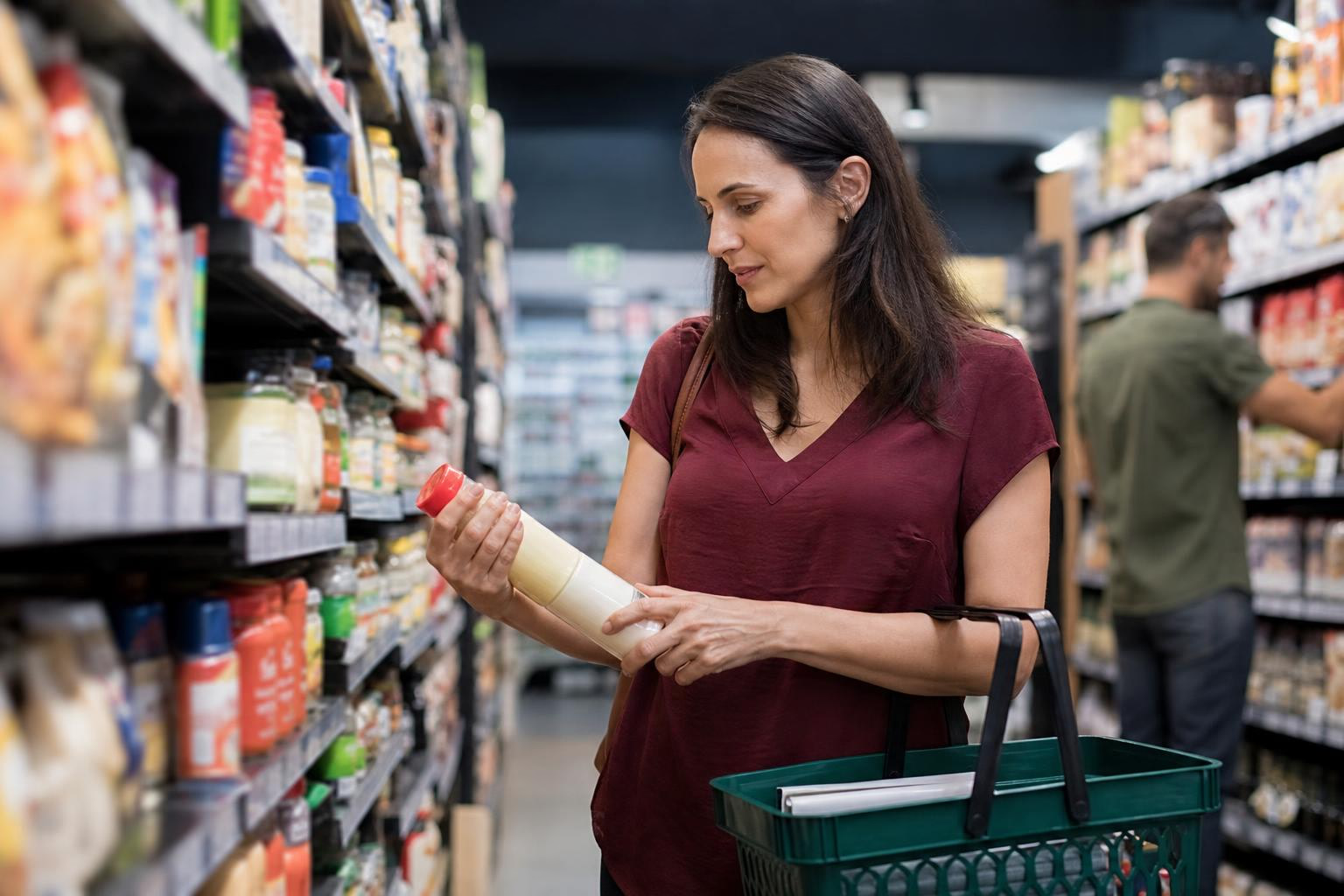
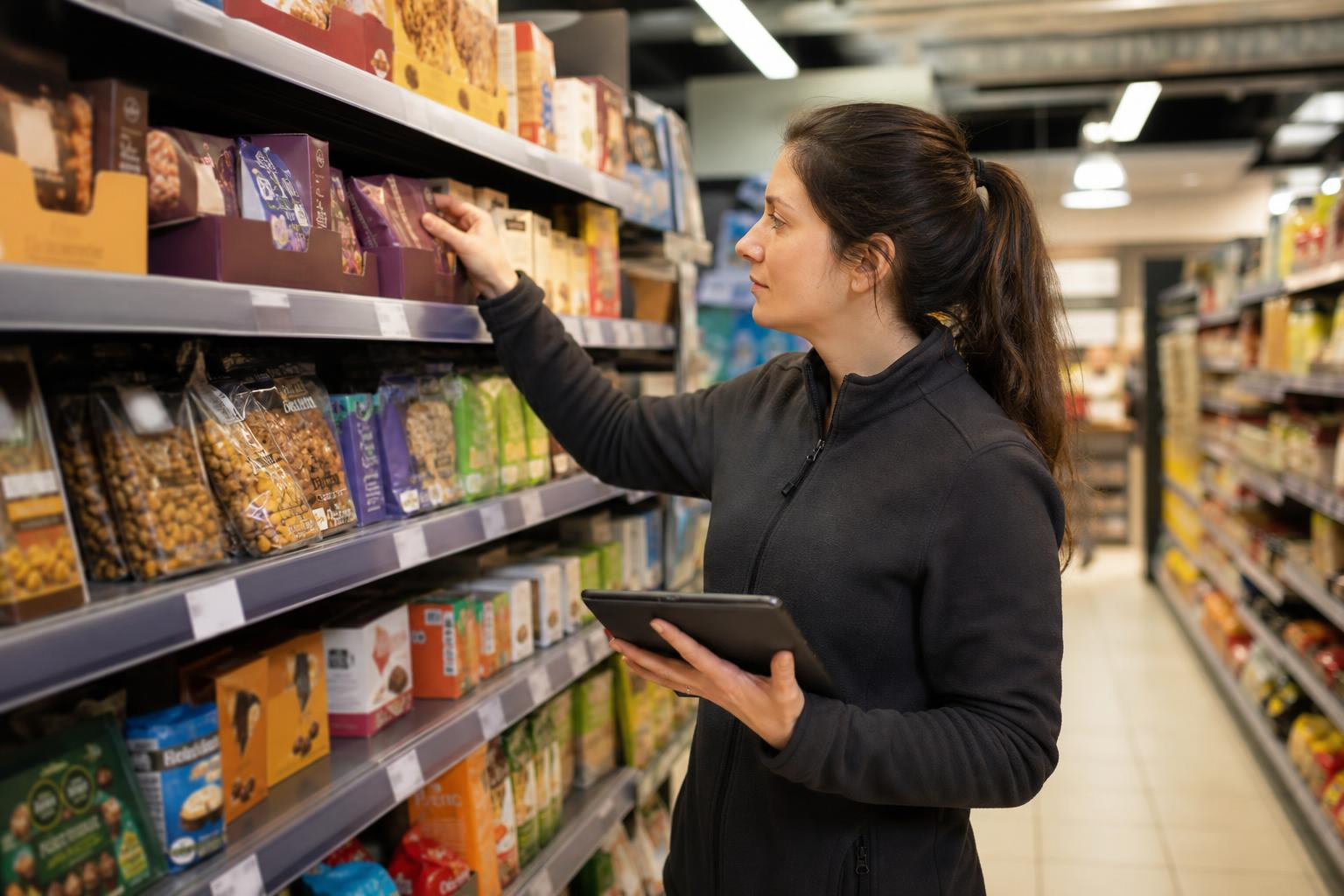
In FMCG, this matters because most shoppers search and add to basket directly inside supermarket, health, beauty, and marketplace apps rather than visiting a brand’s own website first. If someone searches “protein yoghurt” on Tesco or “vitamin C serum” on Boots, retailer SEO is the work that helps the right SKU appear higher, look more credible, and convert better once clicked.
This is not Google SEO. There are no backlinks, no domain authority scores, no crawled meta tags. The retailer controls the environment. What a brand can influence are the inputs: product titles, content completeness, review coverage, ratings, stock status, and the commercial signals that retailer algorithms use to decide what gets surfaced.
Explore verified review campaigns for UK FMCG brands.
Why Retailer SEO Matters for FMCG Brands
Retailer search is a high-intent environment. The shopper is not browsing for inspiration. They are looking for something to buy, often with a basket already open.
Ranking higher in that context has a direct sales impact. Profitero’s analysis found that products moving organically from page 2 to page 1 saw a 37% average sales increase, and products reaching the top five positions doubled sales on average. These are not vanity metrics. They are commercial outcomes tied directly to where a product appears in retailer search results.
Very few shoppers browse past the first page. If a product sits on page 3, it is functionally invisible.
Beyond search position, the discipline affects several other business outcomes. NPD launches struggle without reviews, imagery, and proper titles. Range reviews go better when a product has strong digital shelf performance to support its case. Retail media spend gets wasted if the underlying PDP has two reviews and a blurry image. And conversion rates drop when shoppers cannot find enough information to trust the product.
How Retailer SEO Works: The Four-Part Flywheel
Retailer algorithms want to show products that are relevant, available, likely to sell, and likely to satisfy shoppers. Brands cannot control those algorithms directly, but they can improve the inputs. Think of this as four connected stages: findability, eligibility, confidence, and momentum.
Findability
Can the shopper find the product when they search or browse?
The most important findability signals are product titles, category placement, and attribute completeness. Blue Array’s supermarket search analysis identified titles and categories as two of the four main visibility factors, alongside sponsored products and stock levels. Products are more likely to rank for searches where the search term appears in the product title.
Practical findability levers include:
- Writing titles that contain the shopper’s most likely search terms
- Ensuring the product sits in the correct category and subcategory
- Completing all available attributes, filters, and variant names
- Checking that brand and product identifiers are accurate
For a deeper breakdown, see retailer search ranking factors for UK FMCG.
Eligibility
Is the product eligible to appear and available to buy?
This is where the work becomes an operations problem, not just a content problem. Out-of-stock products are often pushed below in-stock items in supermarket search results. A perfectly optimised PDP cannot sell anything if the product is unavailable.
Eligibility levers include in-stock status (online and in-store), correct retailer listing and active SKU, accurate price and promotion data, and complete product data covering allergens, ingredients, nutrition, and pack size.
Practitioners on Reddit consistently highlight availability as a pain point for online grocery shoppers. In AskUK threads about why people avoid online grocery delivery, heavily upvoted comments cite poor substitutions, missing items, and short-dated products. For brands, this means optimising retailer search visibility cannot be isolated from supply chain execution.
Monitoring gaps is critical. Learn more about running a stock availability audit for UK FMCG.
Check in-store compliance services for UK FMCG brands.
Confidence
Does the PDP give shoppers enough trust to add the product to basket?
A product can rank well in retailer search but still fail to convert if the page feels thin or untrustworthy. This is where reviews, ratings, imagery, and content quality do their work.
Review count makes a measurable difference. Spiegel Research Center found that purchase likelihood for a product with five reviews was 270% greater than for a product with no reviews. The jump from zero to a handful of reviews is the most important threshold to cross.
Star ratings build trust at a glance. Profitero’s UK grocery analysis includes star ratings and review count among the product attributes correlated with search performance across seven major UK grocery websites.
Imagery is equally important. Retailers vary in what they allow: Ocado accepts up to 10 images per product, while Tesco, Sainsbury’s, and Morrisons allow up to six. University of Cambridge research found that Unilever’s Magnum brand saw a 24% sales increase in an eight-week A/B test after adopting mobile-ready hero images. Brands using only one or two photos are leaving conversion on the table.
Building early review momentum is especially important for new SKUs. A guide to getting the first 30 product reviews on retailer PDPs covers this in more detail.
Momentum
Is the product generating the behavioural signals that retailers care about?
Retailers have a commercial incentive to surface products that sell. Sales velocity, conversion rate, repeat purchase, and promotional performance all feed back into the system. Profitero notes that price, promotions, availability, and sales history may contribute to search performance beyond content factors alone.
Momentum levers include promotional support, retail media, PDP conversion rate, strong in-store execution, low substitution risk, and repeat purchase patterns.
Retailer SEO works when the product is findable, eligible, credible, and already generating enough commercial activity for the retailer to keep surfacing it.
Ranking and Conversion Factors
Not every factor carries the same weight on every retailer. Profitero’s UK grocery SEO study analysed seven major UK grocery websites and found that the relationship between product content and search performance differs by retailer. A Tesco optimisation plan is not an Ocado optimisation plan.
That said, these factors come up most consistently:
| Factor | Why it matters | What brands can do |
|---|---|---|
| Product title | Often the strongest relevance signal for retailer search | Include the core shopper search term naturally; follow retailer naming conventions |
| Category and taxonomy | Products appear for category browsing even without exact keyword matches | Verify category placement, filters, attributes, and variants |
| Stock availability | Out-of-stock products get pushed below available products | Monitor online and in-store availability; fix gaps fast |
| Reviews | Review count and star rating influence search performance and shopper confidence | Build authentic, recent, disclosed, verified reviews |
| Star rating | Higher ratings improve trust and may correlate with stronger search placement | Monitor rating trends; fix product issues causing low scores |
| Images | Main and secondary images improve readability and conversion | Use mobile-ready hero images, lifestyle shots, back-of-pack photos |
| Product description | May not always be a direct search factor, but helps conversion and completeness | Write benefit-led copy with key terms, usage, allergens, ingredients |
| Promotions and retail media | Sponsored and promoted products affect visibility | Separate paid rank from organic rank in reporting |
| Sales velocity | Retailers want to surface products that sell | Improve PDP conversion, review quality, availability, and support |
Descriptions deserve a note. Blue Array’s analysis found that descriptions in supermarket search behaved more like meta descriptions than ranking factors: not always a direct search signal, but important for helping shoppers decide. The takeaway: do not ignore descriptions just because titles carry more search weight.
The Role of Product Reviews
Reviews sit at the intersection of retailer SEO and conversion. They are not just social proof for the shopper. In some retailer contexts, review count and star rating correlate with higher search placement.
Profitero’s UK grocery analysis benchmarks review-count thresholds that vary by retailer and category, from 11+ reviews to over 1,400 for the strongest performers. Review goals should be set by retailer, category, and competitive set, not by a single universal number.
The first reviews on a PDP matter disproportionately. Moving from zero to even a handful changes the product from “unproven” to “worth considering.”
Review recency matters too. A burst of 40 reviews in January 2023 followed by silence is weaker than 30 reviews spread across the last six months. For more on this, see what review velocity means for UK FMCG.
But volume alone is not the goal. Shoppers are getting better at spotting manufactured review profiles. In Sephora-related Reddit threads, users describe filtering for non-incentivised reviews, reading lower-star reviews first, or dismissing products where every positive comment comes from a free-product programme. In a Sainsbury’s discussion, one shopper said they felt misled by high ratings that appeared to come entirely from promotional reviews.
The goal is not just “more reviews.” It is a believable review profile: recent, specific, balanced, disclosed where incentivised, and based on real product use.
Compliance: What Brands Must Not Get Wrong
UK review compliance changed significantly in April 2025. Under the Digital Markets, Competition and Consumers Act framework, fake reviews and concealed incentivised reviews are now banned practices. The CMA can directly issue fines and directions for breaches.
ASA/CAP guidance adds further detail: marketing communications must not contain fake consumer reviews, must make clear where reviews have been incentivised, must not incentivise only positive reviews, and must not give greater prominence to positive reviews over negatives.
Individual retailers enforce their own policies on top of the law. Tesco allows incentivised ratings and reviews only if the incentive is clearly and prominently disclosed and not tied to a positive rating. Ocado’s policy states that only Ocado-provided incentivised review activity is permitted, and third-party compensated reviews are not allowed.
For brands running retailer SEO programmes that include review generation, the practical rules are clear:
- Incentivised reviews must be genuine, unbiased, and clearly disclosed
- Incentives must never be conditional on a positive review
- Negative reviews must not be suppressed or filtered out
- Review activity must comply with each specific retailer’s policy
- Sentiment-neutral moderation is the only safe approach
Retailer policies vary. Campaigns must be designed around each retailer’s rules. For a fuller guide, see UK product review compliance for FMCG.
Retailer SEO vs Retail Media
Retail media is the paid advertising layer on retailer websites: sponsored product placements, display ads, and promoted positions within search results and category pages.
Retailer SEO is the broader discipline of improving the organic signals underneath: relevance, content quality, reviews, availability, and conversion performance.
The two interact. Paid placements can drive short-term traffic to a PDP, but weak reviews, poor images, missing information, or stock issues will waste that traffic. Strong organic foundations make retail media spend more efficient because the product converts better once a shopper lands on it.
A common measurement mistake makes this worse. Profitero reports that only 24% of surveyed brands measured share of display ads on page 1 separately from paid and organic search results. If a brand counts a sponsored position as an organic ranking improvement, it is measuring the wrong thing. Track organic rank, sponsored rank, share of search, and page-one real estate separately.
See shopper activation and promotions for UK FMCG brands.
How to Improve Retailer SEO: A Practical Checklist
-
Choose target retailers and priority SKUs. Not every product on every retailer needs equal attention. Focus on high-value SKUs and retailers where search visibility gaps are biggest.
-
Build a keyword map. Use shopper language, retailer category structures, competitor listings, and search-volume proxies to identify the terms shoppers actually use.
-
Benchmark current performance. Track share of search, rank, PDP content completeness, reviews, ratings, price, promotion status, and availability for each target SKU.
-
Fix titles, categories, and attributes. Make sure the product title includes the most relevant search phrase naturally, the product sits in the right category, and all attributes and filters are complete.
-
Upgrade PDP content. Write benefit-led descriptions. Add mobile-ready hero images, lifestyle imagery, back-of-pack information, and video where the retailer supports it. Tesco allows up to 2,150 characters for product descriptions. Ocado allows up to 10 images.
-
Build review coverage compliantly. Generate authentic, verified reviews through real shoppers. Disclose incentives. Do not filter for positive sentiment.
-
Monitor review recency and rating issues. Reviews age. Set up ongoing review activity rather than one-off bursts.
-
Track out-of-stocks and substitutions. Availability is both a ranking factor and a shopper trust factor.
-
Separate organic rank from sponsored placement. Know what visibility you are earning versus buying.
-
Review results regularly. This work is continuous. Competitor content, stock levels, prices, promotions, and review profiles change constantly.
KPIs to Track
The right measurement framework separates vanity from value. These are the KPIs that matter most for retailer SEO:
- Share of search by retailer and keyword
- Highest organic rank and average organic rank
- Page-one keyword coverage
- Paid vs organic placement split
- PDP conversion rate and add-to-basket rate
- Review count, average star rating, and review recency
- Rating distribution (not just the average)
- Percentage of SKUs below your credibility threshold (often 20 to 30 reviews)
- In-stock rate and out-of-stock frequency
- Content completeness score
- Image count and mobile image compliance
- Sales velocity
Gartner defines digital shelf analytics as applications that provide brands with data from third-party retail channels where products are sold. Retailer SEO sits as one operational area within that broader digital shelf picture. For a wider view, see retailer visibility for FMCG brands.
Common Mistakes
Treating this like Google SEO. There are no backlinks, no domain authority, no owned SERP. The retailer controls the environment, and the brand influences inputs within that system.
Using the same content across all retailers. Profitero’s UK analysis found retailer-specific differences in what correlates with higher ranking. What works on Tesco may not work on Ocado or Boots.
Optimising titles only. Titles matter, but availability, reviews, ratings, images, price, promotions, and sales history all affect outcomes. Retailer SEO is multi-signal work.
Chasing review volume without credibility. An avalanche of generic five-star praise from incentivised reviewers can backfire. Shoppers on Reddit report filtering for non-incentivised reviews or reading negatives first when they suspect a manufactured profile. The goal is a believable mix, not a high number.
Ignoring out-of-stocks. A beautifully optimised product listing that is unavailable will not rank and will not sell.
Counting sponsored rank as organic improvement. Paid placement and organic visibility are different things. Measure them separately or risk drawing wrong conclusions from your data.
Related Terms
| Term | What it means | How it differs |
|---|---|---|
| Google SEO | Optimising web pages to rank in Google or Bing | Different signals: crawlability, links, content authority, technical SEO |
| Amazon SEO | Optimising listings for Amazon search | Useful analogy but not identical to Tesco, Sainsbury’s, or Boots |
| Digital shelf optimisation | Managing a product’s full online retail presence | Broader umbrella; retailer SEO is one part of it |
| Retail media | Paid advertising on retailer websites and apps | Paid visibility layer; does not replace organic relevance |
| PDP optimisation | Improving product detail pages for conversion | A key component, not the whole discipline |
| Review generation | Collecting customer reviews for products | A major lever, but must be genuine, disclosed, and compliant |
| Review syndication | Sharing reviews from one site to other sites | A distribution mechanism, not the same as earning retailer-specific verified reviews |
A Note on the Future
Practitioner discussion on LinkedIn increasingly frames this discipline as “being understood by algorithms,” not just being seen by shoppers. One CPG/retail practitioner argued that products now need to be machine-readable, context-aware, and comparable because AI assistants and marketplace algorithms may increasingly mediate product choice.
This is not a distant concern. Structured product data, clear attributes, genuine review signals, and consistent product identity across retail platforms are already good practice. They also happen to be exactly what AI-driven search and recommendation systems need to work with.
FAQs
What is retailer SEO for brands?
Retailer SEO for brands is the process of improving how products appear and perform inside retailer websites and apps. It covers product titles, search visibility, category placement, PDP content, reviews, ratings, stock availability, and other digital shelf signals that influence whether shoppers find and buy a product.
Is retailer SEO the same as Google SEO?
No. Google SEO focuses on ranking web pages in search engines using signals like backlinks and domain authority. Retailer SEO focuses on ranking and converting products inside retailer-owned environments like Tesco, Sainsbury’s, Ocado, and Boots. The signals, systems, and level of brand control are all different.
What factors affect retailer search ranking?
Common factors include product title relevance, category placement, stock availability, review count, star ratings, image count, price, promotions, retail media, and sales velocity. The exact mix varies by retailer, which is why generic optimisation templates tend to underperform.
Do product reviews affect retailer search performance?
They can. Profitero’s UK grocery research includes review count and average star rating among the product attributes correlated with search performance. Reviews also directly affect shopper confidence and conversion rate, creating a feedback loop with sales momentum.
Are incentivised product reviews allowed in the UK?
Incentivised reviews are not banned outright, but they must be genuine, unbiased, and clearly disclosed. Since April 2025, fake reviews and concealed incentivised reviews are banned practices under UK law. Each retailer also enforces its own review policy that brands must follow.
How is retailer SEO different from retail media?
Retail media is the paid advertising layer on retailer sites. Retailer SEO is the broader discipline of improving organic visibility, content quality, reviews, availability, and conversion. Paid placements buy short-term visibility; strong organic foundations make both paid and organic traffic more valuable.
How should FMCG brands measure retailer SEO performance?
Track share of search, organic rank, page-one keyword coverage, paid versus organic visibility, review count, star rating, review recency, PDP content completeness, image quality, in-stock rate, and sales velocity. Measure by retailer, not as a single blended number.
Retailer SEO for brands is not a one-off project. It is a continuous discipline that connects content, reviews, availability, and commercial execution across every retailer where your products are sold. The brands that treat it as an operating system, not a keyword tactic, are the ones that build lasting visibility.
Book a Brand Allies demo to review opportunities across reviews, visibility, and store execution.