

TL;DR
AI referral traffic to retail sites grew 393% year over year in Q1 2026, and ChatGPT now limits product recommendations to just 3-4 brands per response. FMCG brands need dedicated AI visibility tools to track whether their products appear in these shortlists. This guide evaluates 9 tools through an FMCG lens, covering pricing, features, and limitations. The critical insight: every tool on this list monitors your visibility, but none of them fix the underlying inputs (reviews, retailer listings, UGC) that determine whether AI recommends your products in the first place.
Why FMCG Brands Need a Dedicated AI Visibility Tool for Product Recommendations
The numbers tell a clear story. According to Adobe Digital Insights, AI-referred traffic to US retail sites grew 393% year over year in Q1 2026. That same traffic now converts 42% better than non-AI traffic. Just twelve months earlier, it converted 38% worse, an approximately 80 percentage point swing in a single year.
Consumers are paying attention. A BCG survey of 9,000 consumers across nine countries found that over 60% express high trust in generative AI shopping results. Gartner projects that traditional search engine volume will drop 25% by 2026 as buyers shift to AI chatbots and virtual agents.
Yet only 22% of marketers currently track AI visibility, according to Graph Digital. For FMCG brands, that gap represents both a risk and an opportunity.
Explore how verified reviews drive the signals AI uses to recommend products.
What Makes FMCG Different From Generic Brand Monitoring
Generic AI visibility tools track whether your brand name appears in AI answers. FMCG brands need something more specific: product-level and SKU-level tracking across multiple retailers.
Here’s why the requirements differ:
Retailer AI shopping agents are new discovery layers. Amazon Rufus, Walmart Sparky, and Alexa for Shopping are now recommending products directly to consumers. A shopper asking Rufus “what’s the best plant-based protein bar under £3” gets a shortlist pulled from Amazon’s catalogue, reviews, and product data. If your brand isn’t tracked on these platforms, you’re flying blind.
Reviews and UGC are a top-3 input signal. Azoma’s analysis of millions of shopping agent citations found that ChatGPT’s source mix breaks down as 41% earned media, 37% retailer listings, and 19% UGC. Reviews are the third most important input to AI product recommendations. Brands with thin retailer review coverage will struggle to appear in AI answers regardless of which monitoring tool they buy.
The 3-4 brand shortlist creates winner-take-all dynamics. When a shopper asks an AI assistant for the best product in a category, the response typically includes three to five brands. Established market leaders can lose ground to smaller competitors who understand these new rules. For challenger FMCG brands, this is actually encouraging, but only if you know where you stand.
Physical availability matters too. AI shopping agents that reference retailer data can’t recommend products that are out of stock. Brands running in-store compliance audits alongside AI visibility monitoring are better positioned to ensure the products AI recommends are actually available on shelf.
Quick Comparison Table
| Tool | Best For | Starting Price | AI Engines Covered | Product/SKU-Level? | FMCG-Specific Features | Free Trial? |
|---|---|---|---|---|---|---|
| Azoma | Enterprise FMCG | Custom (enterprise) | 7 incl. Rufus, Sparky | Yes | Shopping agents, CPG focus | No |
| Stackline | CPG on Amazon/Walmart | Custom (enterprise) | ChatGPT, Rufus, Alexa, Gemini | Yes | Shopper analytics integration | No |
| Profound | Mid-large FMCG brands | $99/mo | 1-3 (tier-dependent) | Partial (Shopping) | Prompt volume data | 7-day (Growth) |
| Scrunch AI | E-commerce teams wanting GA4 | $250/mo | 4-9 (tier-dependent) | Yes (Shopping feature) | Site audits, traffic attribution | 7-day |
| Semrush | Existing Semrush users | $99/mo per domain | 4-5 | No | Prompt research with volume | No |
| Ahrefs Brand Radar | Free exploration | Free | 6 | No | Reddit/YouTube tracking | Yes (free) |
| Otterly.AI | Budget entry | $29/mo | 4 core | No | None | Yes |
| Peec AI | Multi-market brands | $80/mo | 3 per tier | No | Sentiment, 115+ languages | 7-day |
| Tesseract by AdLift | FMCG-marketed option | Demo-gated | ChatGPT, Gemini, Perplexity, AIOs | No | FMCG landing page | Demo only |
1. Azoma
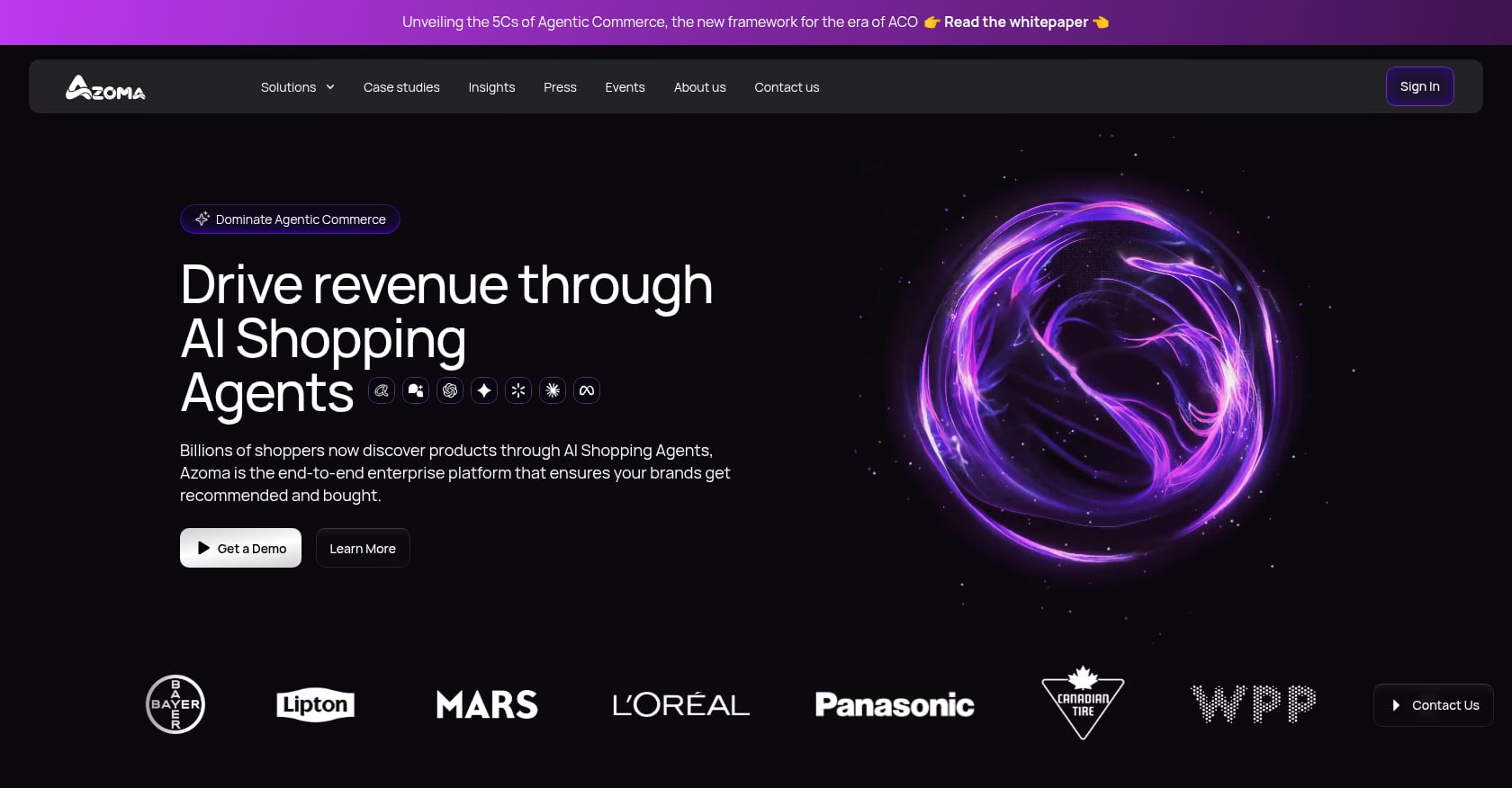
Best for: Enterprise FMCG brands selling across multiple retailers and marketplaces
Azoma is the most FMCG-specific AI visibility tool on the market. The platform was built for high-volume retailers and manufacturers of physical goods, with a primary focus on CPG and FMCG sectors.
Pricing: Custom/enterprise only. Pricing scales with number of SKUs tracked, AI platforms monitored, and markets covered. No public pricing.
Key features:
- Covers 7 AI platforms including ChatGPT, Gemini, Google AI Overviews, Perplexity, Amazon Rufus, Alexa for Shopping, and Walmart Sparky
- Only tool that tracks retail-specific AI shopping agents (Rufus, Sparky, Alexa)
- Product-level and SKU-level visibility tracking
- Source attribution showing which content types drive AI citations
- Trusted by L’Oréal, Unilever, Mars, Beiersdorf, and Reckitt
FMCG fit: Excellent. Azoma’s coverage of retail AI shopping agents is unmatched. Their citation source analysis (showing the 41% earned media, 37% retailer, 19% UGC breakdown) is the most useful framework available for understanding what drives AI product recommendations.
Result claim: Azoma has reported being “instrumental in boosting top-of-funnel visibility among consumers searching for healthier energy drink alternatives on ChatGPT and Perplexity, contributing to +532% year-over-year revenue growth” for one client.
Limitations:
- Enterprise-only pricing puts it out of reach for mid-market FMCG brands
- No published pricing makes budgeting difficult before the sales conversation
- Overkill for brands selling through fewer than three or four retailers
Verdict: If your brand sells through Amazon, Walmart, and major grocers, Azoma is the gold standard AI visibility tool for FMCG product recommendations. The retail shopping agent coverage alone justifies the investment for enterprise CPG companies.
2. Stackline AI Visibility
Best for: CPG brands already using Stackline’s retail analytics for Amazon, Walmart, or Target
Stackline’s AI Visibility module sits within its broader Shopper Analytics platform, giving consumer brands insight into how shoppers discover and interact with products through conversational and agentic shopping platforms.
Pricing: Enterprise/custom only. Stackline has raised $180 million in total funding, which signals long-term commitment to the product.
Key features:
- Tracks real shopping questions asked across ChatGPT, Amazon Alexa, Google Gemini, and other agentic commerce experiences
- Question-level volume analysis showing what shoppers actually ask AI assistants
- Impression volume for every product and brand with share of visibility metrics
- Brands can review answers generated by each platform and see which products are recommended
FMCG fit: Strong for US-focused CPG brands. The question-level volume data is particularly valuable because it shows which product attributes and use cases shoppers are asking about, not just whether your brand appears.
Limitations:
- US-centric (Amazon, Walmart, Target focus), less relevant for UK-only FMCG brands
- Not a standalone tool, it’s part of the broader Stackline analytics suite
- Enterprise pricing means smaller CPG brands won’t qualify
- Limited coverage outside major US retailers
Verdict: Best suited for large CPG brands already invested in Stackline’s ecosystem. The shopper question data adds genuine strategic value, but the US-centric retail focus limits its appeal for brands selling primarily through UK grocers.
3. Profound
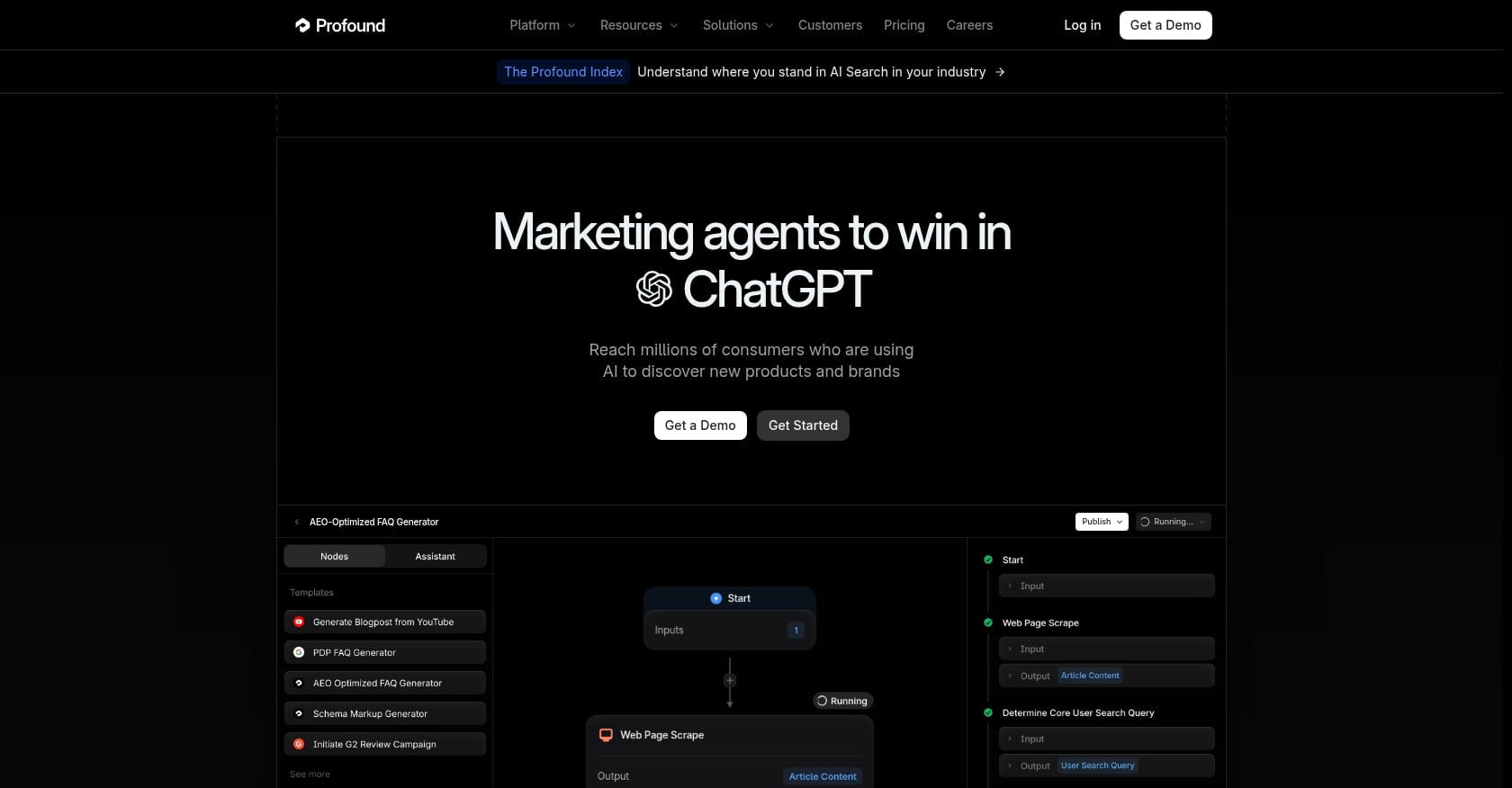
Best for: Mid-to-large FMCG brands starting their AI visibility journey with budget for $399+/month
Profound is an enterprise AI visibility and answer-engine-optimisation platform that tracks how a brand appears across AI assistants, measures citations, sentiment, and share of voice against competitors.
Pricing:
- Starter: $99/month (covers only ChatGPT)
- Growth: $399/month (adds Perplexity and Google AI Overviews, caps prompts at 100, includes 400 Agent credits)
- Enterprise: custom
- A team comparing Profound against other tools should treat $399 as the real entry price, not $99
Key features:
- Estimates how often people ask AI questions in the first place (prompt volume data)
- Enterprise plans include ChatGPT Shopping visibility
- Citation tracking with sentiment analysis
- Share of voice benchmarking against competitors
FMCG fit: The prompt volume estimation is genuinely useful for FMCG category managers. Knowing that 15,000 people per month ask ChatGPT about “best oat milk” versus 3,000 asking about “best almond milk” turns AI visibility from a vanity score into a content strategy input.
Funding/credibility: $155M raised with a $1B valuation and Fortune 500 clients.
User perspective: A G2 reviewer noted: “The main thing is that it is more expensive than the competition, but ultimately you get what you pay for.”
Limitations:
- Starter plan is too narrow for any serious FMCG use (single AI engine, limited prompts)
- No free tier to test before committing
- No retail shopping agent tracking (Rufus, Sparky)
- Higher cost than most competitors at the Growth tier
Verdict: Profound’s prompt volume data sets it apart for FMCG brands that want to prioritise which categories and product types to optimise first. Just skip the Starter plan entirely.
4. Scrunch AI
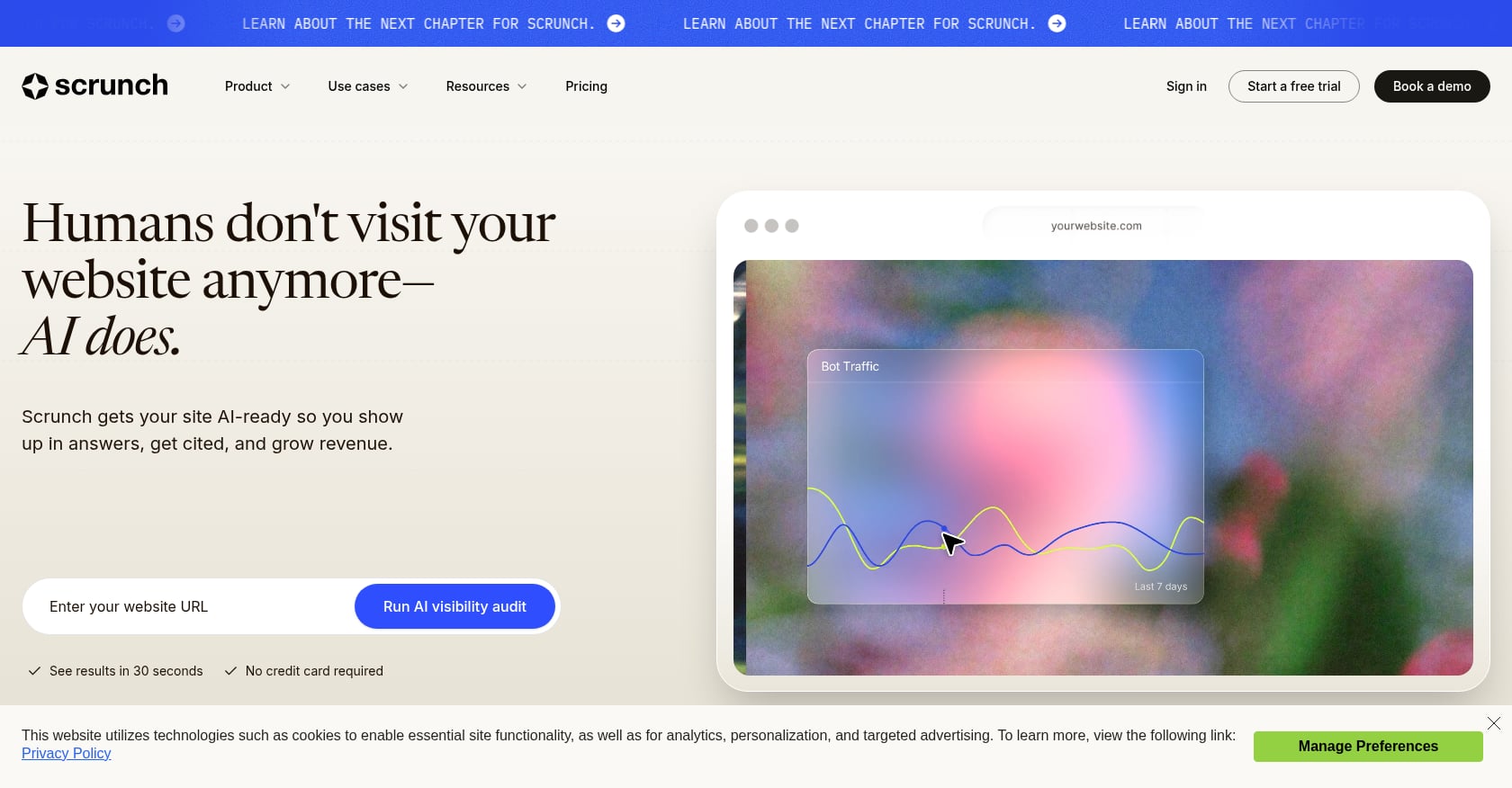
Best for: FMCG e-commerce teams that want to connect AI visibility tracking to actual GA4 traffic data
Scrunch AI is an advanced GEO/AEO monitoring platform tracking brand visibility across 7+ AI engines, with a standout Google Analytics integration.
Pricing:
- Core: $250/month (125 unique tracked prompts, 5 site audits per month, 1 brand workspace, 5 user licences, monitoring across 4 LLMs)
- 7-day free trial available
Key features:
- Google Analytics integration analyses how AI crawlers use your site and attributes traffic to AI referrals
- Shopping feature allows AI search performance tracking at the product level
- Site audit functionality showing how AI-readable your content is
- Traffic attribution connecting AI visibility to actual website visits
FMCG fit: The GA4 integration is the killer feature here. For FMCG e-commerce managers who need to prove ROI to finance teams, being able to say “AI-referred traffic drove X sessions and Y revenue last month” is far more persuasive than abstract visibility scores.
User perspective: Practitioners on review sites consistently note that Scrunch is priced like an enterprise-grade tool. For early-stage startups or businesses with simple needs, the monthly cost can feel hard to justify.
Limitations:
- $250/month for 125 prompts is steep if you only need a monthly snapshot
- No MCP server, so you can’t hand data to AI assistants natively
- The per-prompt cost is among the highest in the category
- Limited value unless you have meaningful direct-to-consumer traffic to measure
Verdict: If your FMCG brand sells direct or drives significant traffic to retailer sites and needs to prove AI visibility ROI, Scrunch’s GA4 integration is worth the premium. Less useful for brands that sell entirely through third-party retailers.
5. Semrush AI Visibility Toolkit

Best for: FMCG brand teams that already have a Semrush subscription and want to add AI visibility without onboarding a new vendor
The Semrush AI Visibility Toolkit shows how brands appear in AI-generated answers, adding a new layer of visibility tracking to the existing SEO platform millions of marketers already use.
Pricing:
- $99/month per domain (billed annually)
- Includes 1 licensed user, 25 custom prompts with daily rankings, 300 daily AI reports, 1,000 daily Prompt Research queries
- Additional 50 prompts: $60/month
- Additional domain: $99/month
Key features:
- Daily prompt tracking (several rivals refresh only weekly)
- Prompt research with volume and intent data, which is genuinely rare at this price point
- Deep integration with existing Semrush SEO suite
- Covers 4-5 AI engines
FMCG fit: Decent for brand-level monitoring but limited for product-level tracking. The daily refresh rate is useful for FMCG brands running time-sensitive campaigns or new product launches where visibility can shift quickly.
Limitations:
- No product/SKU-level tracking
- Per-domain pricing adds up fast if you monitor multiple brand sites
- No free trial for the AI Visibility Toolkit specifically
- The tool sits inside Semrush’s broader (and sometimes cluttered) interface
- No retail shopping agent coverage
Verdict: A sensible add-on for existing Semrush users. Not worth switching to Semrush for, and not sufficient on its own as an AI visibility tool for FMCG product recommendations at the SKU level.
6. Ahrefs Brand Radar
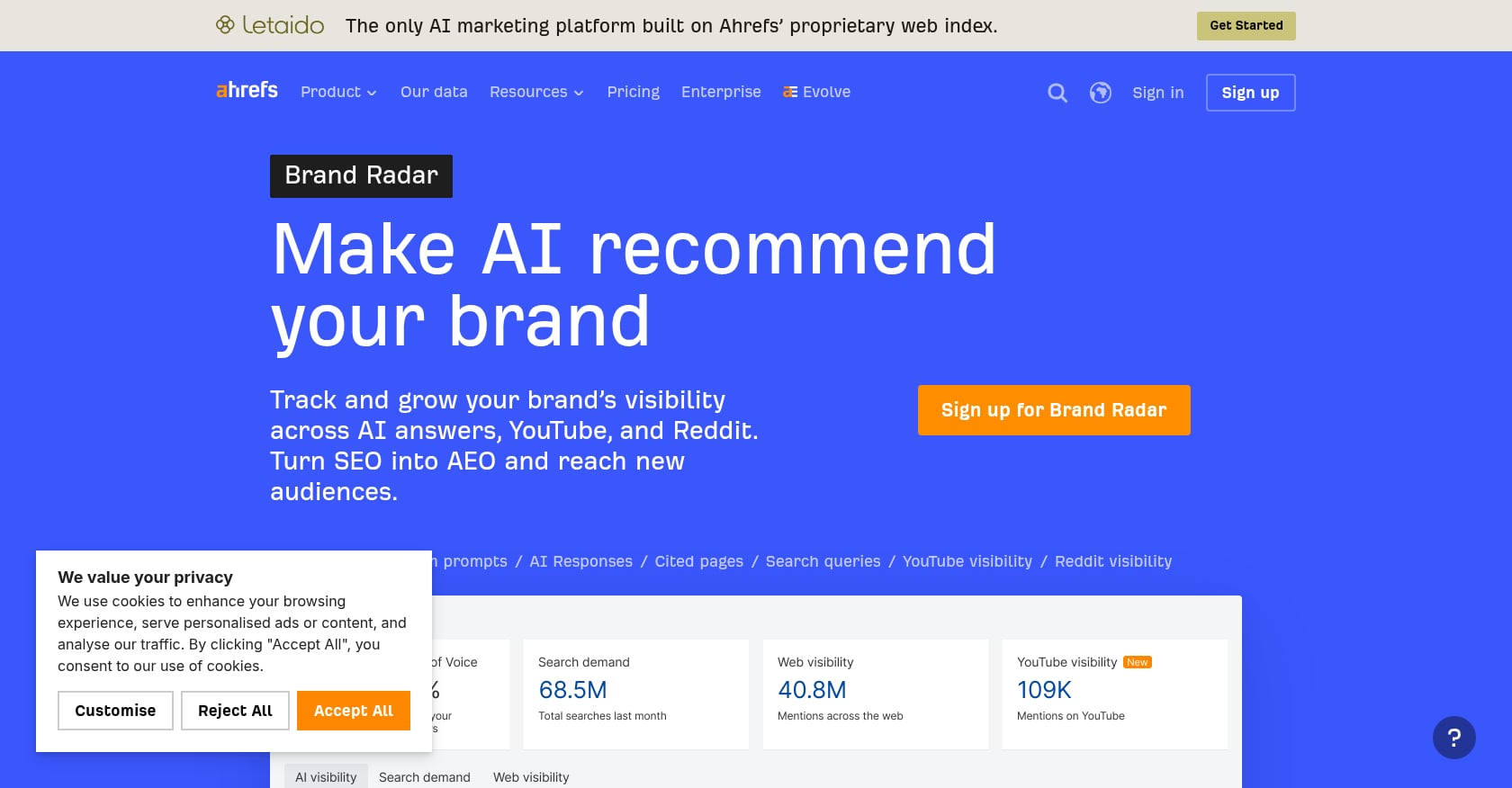
Best for: FMCG brand managers who want a zero-cost way to check AI visibility before investing in a paid tool
Ahrefs Brand Radar monitors any brand’s visibility across AI answers, YouTube, and Reddit, making it the most accessible entry point in this list.
Pricing: Free for all Ahrefs users (including free accounts). YouTube, TikTok, and Reddit tracking currently free during beta.
Key features:
- 356M+ total monthly prompts tracked across AI Overviews, AI Mode, ChatGPT, Copilot, Gemini, and Perplexity
- Powered by search-backed prompts (real queries, not synthetic ones)
- Tracks YouTube, TikTok, and Reddit mentions, which are key surfaces influencing product discovery
- Brand-level visibility scores with competitor benchmarking
FMCG fit: Limited but useful as a starting point. The Reddit and YouTube tracking is particularly relevant given that LLMs heavily cite Reddit as a source. Practitioners on marketing forums regularly confirm that “LLMs trust UGC more,” and Reddit threads about product recommendations directly feed into AI training data and retrieval systems.
Limitations:
- No product-level or SKU tracking
- No shopping agent coverage (no Rufus, Sparky, or Alexa)
- More of a directional “where do we stand” tool than a workflow platform
- Can’t track competitor products at the SKU level
- No GA4 or analytics integration
Verdict: Start here. Before spending £200+ per month on a paid AI visibility tool, use Brand Radar to confirm whether the problem exists for your brand. If you see competitors appearing in AI recommendations and your brand is absent, you have the business case for a paid tool.
7. Otterly.AI
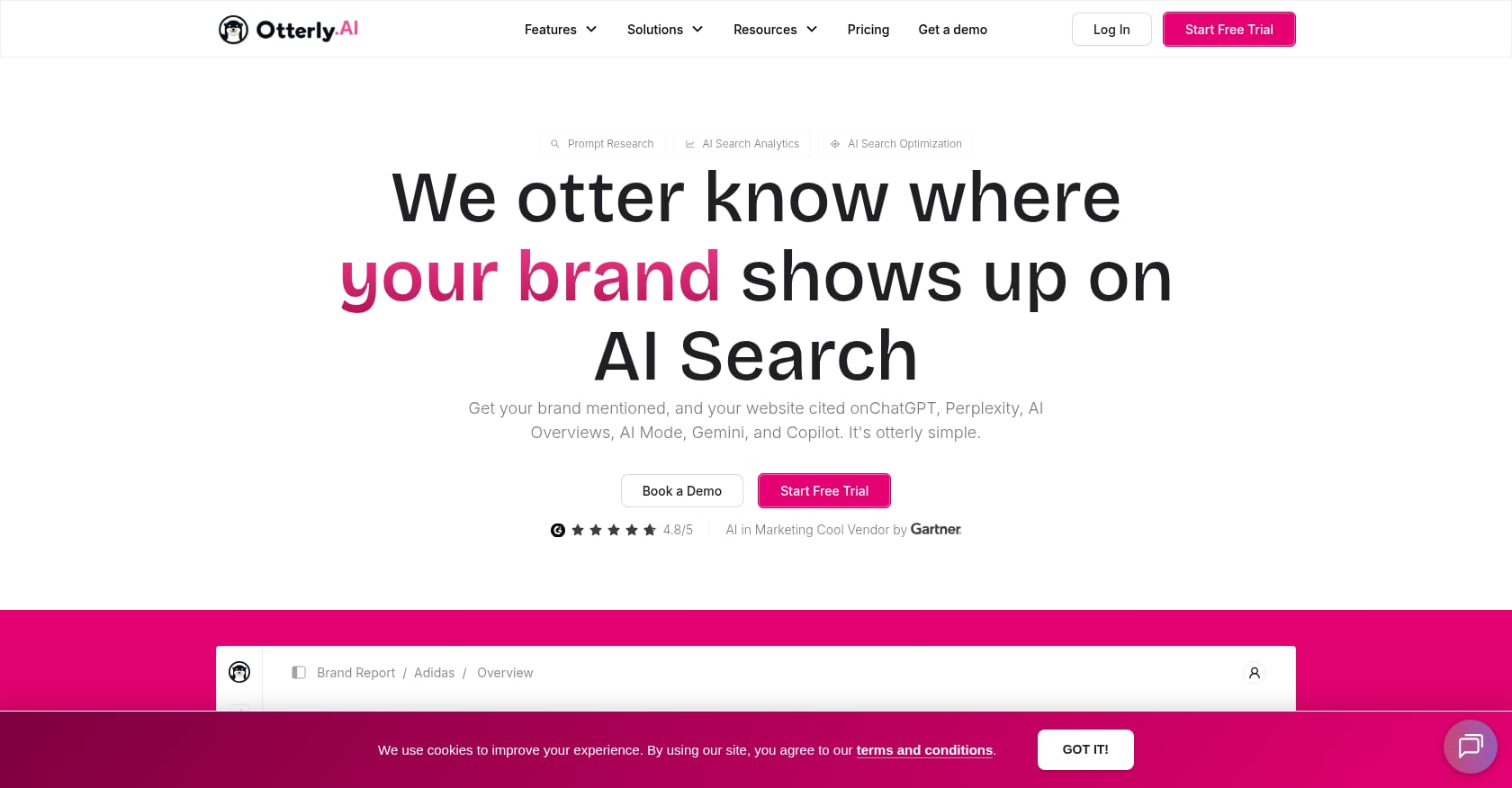
Best for: Challenger FMCG brands spending under £200/month who need a proof-of-concept before investing heavily
Otterly is a clean, self-serve AI search visibility tool built for marketers and agencies who want to start measuring mentions, citations, and GEO performance fast.
Pricing:
- Lite: $29/month (15 prompts, 4 AI engines)
- Standard: $189/month (100 prompts)
- Premium: $489/month (400 prompts)
- Gemini, Google AI Mode, and Claude are paid add-ons on lower tiers
Awards: Gartner Cool Vendor nod in 2025.
FMCG fit: Minimal FMCG-specific features, but the low entry price makes it ideal for challenger brands testing whether AI visibility matters for their category before committing to enterprise tooling.
User perspective: The prevailing view among practitioners is straightforward: before you spend $500 or $1,000/month on AI visibility monitoring, spend $29 first to confirm the problem is real. That argument holds up. Otterly is the cheapest credible entry point in the category.
Limitations:
- Lite plan’s 15 prompts are quickly outgrown, and the next step is a sizeable jump to $189
- No product-level or SKU tracking
- No FMCG-specific features whatsoever
- No retail shopping agent coverage
- Limited competitive intelligence at lower tiers
Verdict: A good budget entry point for proof-of-concept. Once you confirm AI visibility is a real gap for your brand, you’ll likely outgrow Otterly and need to upgrade to something with product-level tracking.
8. Peec AI
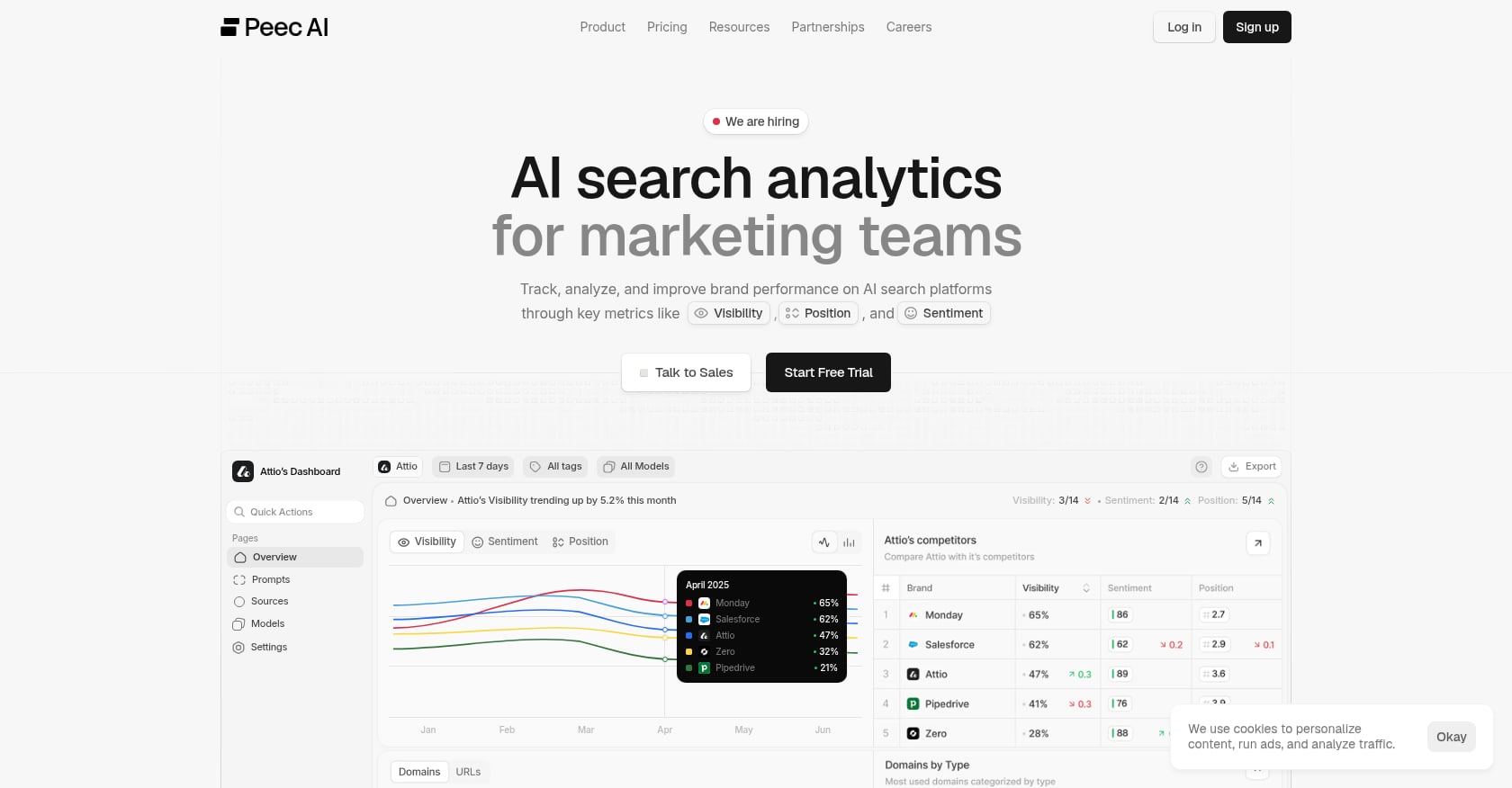
Best for: Multi-market FMCG brands selling across European or international markets that need sentiment analysis across languages
Peec AI goes beyond logging whether a brand appeared in an answer. It scores how the brand was characterised and tracks that sentiment over time against competitors.
Pricing:
- Starter: $80/month (billed annually)
- Pro: $205/month
- Advanced: $420/month
- Each tier tracks 3 AI models by default; a fourth model is a paid add-on
Key features:
- Sentiment analysis showing how AI describes your brand (positive, neutral, negative)
- Regional benchmarking across markets
- UI scraping methodology for accurate answer capture
- Supports 115+ languages
FMCG fit: Strong for international FMCG brands. If you sell the same product across the UK, France, Germany, and Spain, Peec can show whether AI recommends your product differently in each market and in each language. That kind of regional intelligence is hard to get elsewhere.
User perspective: The tool’s G2 profile shows a 4.8/5 rating across 18 reviews as of August 2026.
Limitations:
- It’s a measurement tool, not an optimisation one. Brands expecting it to fix citation gaps will need other tools and services alongside it
- Every tier caps at 3 of 7 engines, and Claude is Enterprise-only
- No product/SKU-level tracking
- No retail shopping agent coverage
Verdict: The best option for multi-market FMCG brands that need to understand how AI characterises their products across languages and regions. Pair it with a product-level tool like Azoma for complete coverage.
9. Tesseract by AdLift
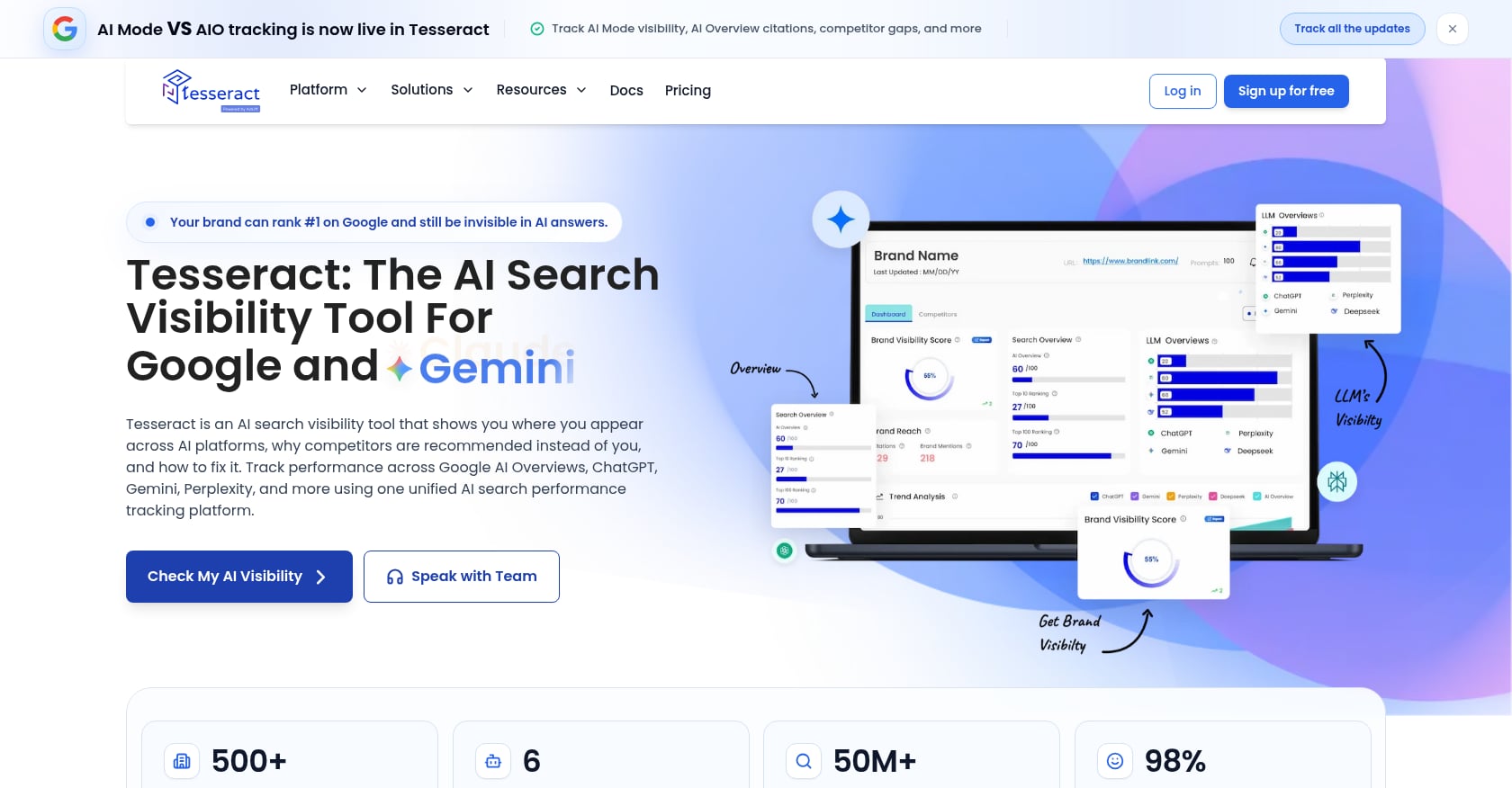
Best for: FMCG brands open to an agency relationship alongside AI visibility tooling
Tesseract is an AI-powered tool built by digital agency AdLift that helps brands track their presence across LLM-based platforms like ChatGPT, Google’s AI Overviews, and Perplexity.
Pricing: Not publicly disclosed. Demo-gated with multiple planned tiers (Basic, Pro, Enterprise).
Key features:
- Dedicated FMCG landing page with sector-specific messaging
- Coverage of ChatGPT, Gemini, Perplexity, and AI Overviews
- Being rolled out with interest from retail, healthcare, hospitality, and FMCG sectors
- Agency support alongside the tool
FMCG fit: Tesseract has the most FMCG-specific marketing of any tool on this list. However, marketing and product capability are different things.
Limitations:
- No independent reviews on G2, Capterra, or any review platform
- Built by an agency (AdLift/Liqvd Asia), not a dedicated product company
- No product/SKU-level tracking confirmed
- Unclear how the tool differs from competitors beyond the FMCG positioning
- Demo-gated pricing prevents comparison shopping
Verdict: Worth a demo if you value having an agency partner guide your AI visibility strategy. But approach with caution until independent reviews validate the product’s capabilities.
What AI Visibility Tools Can’t Do (And What Fills the Gap)
This is the most important section of this article.
Every tool listed above is a monitoring layer. They tell you whether your products appear in AI-generated recommendations. They do not fix why you’re absent.
The data on what drives AI product recommendations is clear. Azoma’s citation source analysis shows that ChatGPT pulls from earned media (41%), retailer listings (37%), and UGC/reviews (19%). Brand.com content accounts for just 3%. Authoritative third-party listicle mentions outweigh online reviews, awards, and social sentiment by at least 2:1 as a signal for generative AI chatbots.
Reviews Are the New AI Fuel
AI engines use customer reviews to validate product claims and extract semantic attributes. Detailed, descriptive reviews from real buyers help AI match products to specific long-tail queries. When a shopper asks ChatGPT for “the best gentle face wash for sensitive skin under £10,” the AI isn’t guessing. It’s synthesising review language, product descriptions, and editorial coverage to build its shortlist.
Bazaarvoice’s December 2025 research of over 2,600 users shows that 62% of shoppers trust recommendations most when backed by reviews and photos from real, verified purchasers. AI systems mirror this preference. Review recency and volume matter more than fractional rating differences: a product with many recent, detailed reviews is a “safer” recommendation for the model than one with a 4.9 rating from three reviews posted two years ago.
For FMCG brands, this creates a specific problem. The average grocery review rate sits at only 0.1% to 0.3%, compared to 2-5% on Amazon. Products listed on Tesco, Sainsbury’s, or Boots often have negligible review coverage. An AI visibility tool will show you the gap clearly, but it won’t generate the reviews needed to close it.
Book a demo to see how authentic shopper reviews on retailer sites power AI product recommendations.
Retailer Listings Need to Be Machine-Readable
Adobe’s AI readability analysis found that retail PDPs scored only 66% on their AI readability checker. Structured data, complete product descriptions, and consistent attribute tagging all influence whether AI can accurately parse and recommend your product. Brands investing in retailer SEO are building the foundation that AI visibility tools measure.
The Three-Legged Stool
Think of AI product visibility as a three-legged stool:
- Earned media and editorial coverage. Getting featured in buying guides, comparison articles, and expert roundups is the single strongest signal.
- Retailer listing quality. Complete, structured, and available product pages on the retailers where shoppers buy.
- Reviews and UGC. Fresh, detailed, and diverse reviews from real purchasers, posted on the retailer sites where AI agents are looking.
A monitoring tool gives you a score. These three inputs determine the score. Brands that invest in monitoring without addressing the inputs will see the problem clearly and still have no lever to pull. Building a product sampling programme that generates authentic retailer reviews is one of the most direct ways to improve the UGC signal that AI systems rely on.
How to Choose the Right AI Visibility Tool for Your FMCG Brand
The right tool depends on your brand’s size, budget, and where you sell.
Enterprise FMCG with Rufus/Sparky needs: Start with Azoma or Stackline. These are the only tools tracking retail AI shopping agents, and if your products sell through Amazon, Walmart, or major UK grocers, that coverage is non-negotiable.
Already on Semrush or Ahrefs: Use their AI visibility features first. Ahrefs Brand Radar is free, and Semrush’s toolkit costs $99/month per domain. Neither offers product-level tracking, but both will confirm whether AI visibility is a meaningful gap for your brand before you invest further.
Budget-conscious challenger brand: Start with Otterly’s $29/month Lite plan or Ahrefs Brand Radar (free). Prove the problem exists, then build the business case for a more capable tool.
Multi-market FMCG brand: Peec AI’s 115+ language support and regional benchmarking make it the clear choice for brands selling across multiple European markets.
Any FMCG brand with thin retailer reviews: Fix the inputs first. The most sophisticated AI visibility tool in the world won’t help if your products have five reviews on Tesco and your competitor has 150. Investing in advocacy marketing and building authentic review volume on retailer sites is the foundational work that makes monitoring data actionable.
Get started with Brand Allies to build the review coverage and shopper advocacy that AI visibility depends on.
Frequently Asked Questions
What is an AI visibility tool for FMCG product recommendations?
An AI visibility tool tracks whether your products appear when consumers ask AI assistants (ChatGPT, Perplexity, Google AI Overviews, Amazon Rufus) for product recommendations in your category. For FMCG brands specifically, this means monitoring product-level visibility across both general-purpose AI chatbots and retail-specific shopping agents.
How does ChatGPT decide which FMCG products to recommend?
Based on Azoma’s analysis, ChatGPT’s citation sources break down as 41% earned media, 37% retailer listings, and 19% user-generated content (reviews and community discussions). Products with strong editorial coverage, complete retailer listings, and fresh, detailed reviews are far more likely to appear in AI recommendations than products with thin coverage.
Can small FMCG brands afford AI visibility monitoring?
Yes. Ahrefs Brand Radar is free and covers 6 AI engines at the brand level. Otterly’s Lite plan starts at $29/month. These won’t give you product-level or SKU-level tracking, but they’ll confirm whether AI visibility is a gap worth investing in.
Do AI visibility tools track Amazon Rufus and Walmart Sparky?
Only two tools currently cover retail-specific AI shopping agents: Azoma (tracks Rufus, Sparky, and Alexa for Shopping) and Stackline (tracks Rufus, Alexa, and Gemini in a retail context). All other tools on this list focus on general-purpose AI engines like ChatGPT and Perplexity.
Why do reviews matter for AI product recommendations?
AI engines use customer reviews to validate product claims and extract semantic attributes. Fresh, detailed, and diverse reviews help AI match products to specific user queries. A product with 200 recent reviews describing taste, texture, and value gives the AI far more to work with than a product with a handful of generic “great product” reviews.
Is monitoring AI visibility enough, or do I need to take action on the inputs?
Monitoring alone won’t improve your visibility. AI visibility tools show the gap; they don’t close it. The three inputs that drive AI recommendations are earned media coverage, retailer listing quality, and review volume/recency. Brands need to invest in all three to move the needle.
How often should FMCG brands check their AI visibility?
It depends on your competitive landscape and campaign activity. Semrush offers daily tracking, while most tools refresh weekly. For FMCG brands running seasonal campaigns or new product launches, weekly monitoring is a reasonable minimum. For ongoing category tracking, monthly reviews may suffice at the brand level.
Will AI visibility tools replace traditional SEO tools for FMCG brands?
No. AI visibility tools complement traditional SEO, they don’t replace it. Retailer search ranking, on-site conversion optimisation, and organic search traffic still matter. AI visibility is an additional layer of discovery that FMCG brands need to track alongside their existing digital shelf metrics.