TLDR
A sampling campaign follow-up strategy is the planned sequence of actions a brand takes after giving shoppers a product sample, covering everything from usage confirmation to honest review requests, purchase prompts, and performance reporting. Without it, sampling is just product distribution. The follow-up phase is where reviews, shopper insight, first purchases, and retailer-ready evidence actually get created. This guide walks through the full workflow, timing, compliance rules, metrics, and common mistakes for UK FMCG teams.
What Is a Sampling Campaign Follow-Up Strategy?
A sampling campaign follow-up strategy is the post-sample plan that turns product trial into measurable results. It defines when and how to contact samplers, what action to ask for next, how to collect honest feedback or retailer reviews, how to disclose incentives compliantly, and how to measure whether sampling led to sales, review volume, repeat purchase, or shopper insight.
Put simply: sampling strategy decides who gets the product and where. Follow-up strategy decides what happens after they try it.
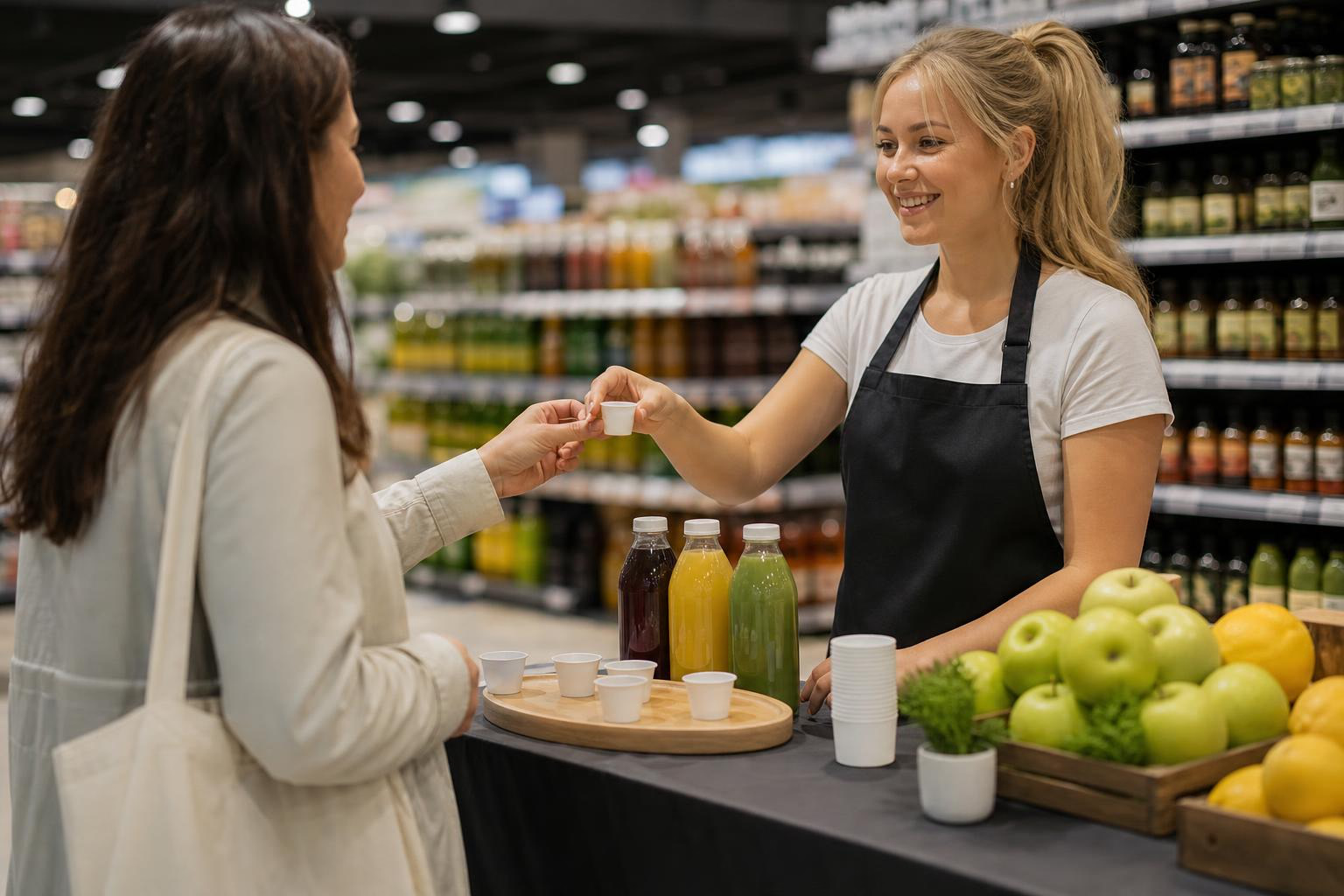
Here is a quick example. A soft drink brand sends 2,000 targeted shoppers a sample. The follow-up strategy confirms the sample was received, asks for taste feedback after three days, directs shoppers to leave an honest disclosed review on their retailer’s product page, sends a first-purchase prompt with a coupon, and tracks review approvals, redemption rates, and repeat intent over the next 90 days.
That sequence is the difference between “we gave out 2,000 samples” and “we generated 340 approved retailer reviews, a 4.3 average star rating, and a 22% first-purchase conversion.”
If your sampling campaigns need to generate verified retailer reviews alongside feedback and purchase data, the follow-up plan is where that outcome gets built.
Why Follow-Up Matters More Than Sample Distribution
Sampling is attractive because it reduces purchase risk. But in FMCG, the sample itself rarely proves ROI unless the brand captures what happens afterwards.
A field study of in-store food sampling found that 73% of exposed shoppers took the sample, with earlier industry figures suggesting 37% will buy once sampled. Those numbers sound impressive, but they only describe the moment of trial. They say nothing about whether the shopper remembered the product a week later, left a review, told a friend, or repurchased.
EventTrack research found that among consumers interested in a promoted product, 78% said participating made them more inclined to purchase, with 43% buying on-site and 30% purchasing within four weeks. The gap between 43% and 30% matters. It means a meaningful share of purchase happens days or weeks later, not at the sampling stand.
A University of South Florida study followed 1,630 households for 18 months after they received a new oral-hygiene sample through in-store, direct mail, or online request channels. All three channels drove similar first purchases, but direct mail generated the strongest repeat purchasing, while online-request samples were most cost-effective. The takeaway is clear: follow-up strategy should vary by sampling channel, not be one-size-fits-all.
Without a structured follow-up, brands count distribution rather than outcomes. The commercial value appears after the sample: when the shopper tries it, remembers it, reviews it, buys it, or gives the brand usable feedback.
The TRIAL Loop: A Framework for Post-Sampling Follow-Up
Most sampling follow-up advice boils down to “send a survey.” That is not a strategy. The TRIAL Loop is a five-step framework that turns sampling follow-up into a repeatable system.
T, Trigger the follow-up from real trial
The first follow-up should be based on when the shopper likely used the product, not when the campaign manager closed the sampling day.
Timing examples:
- In-store wet sampling: same day or next day
- At-home snack or drink sample: 2 to 4 days after delivery
- Beauty and personal care: 7 to 14 days
- Vitamins, supplements, or functional products: longer window, with extra care around claims
- Household cleaning: after a realistic use occasion
Practitioners on Reddit report that some platforms send emails urging people to review products less than 24 hours after receiving them, creating a perception that reviews are rushed and less trustworthy. One user said they no longer read the platform’s reviews because incentivised reviews appeared prioritised. Timing is part of trust.
R, Request the right action
Not every sampler should receive the same ask. Match the request to the campaign objective:
- Leave an honest retailer review
- Complete a short product survey
- Scan a QR code for a first-purchase offer
- Upload a receipt
- Report stock availability or shelf issues
- Share user-generated content with disclosure
I, Incentivise transparently
If there is any benefit (sample, refund, discount, prize draw, or payment), disclose it clearly. Make the incentive independent of sentiment.
Correct framing: “Please leave an honest review based on your experience. Your feedback can be positive, neutral, or negative.”
Wrong framing: “Leave us a 5-star review to receive your reward.”
A, Attribute outcomes
Connect each sample to an outcome where possible: review submitted, review approved, survey completed, coupon redeemed, purchase made, repeat purchase made, stock issue reported. Where direct attribution is impossible, use holdouts, matched stores, or pre/post comparisons.
L, Learn and loop
Use the results to improve the next wave. Which shopper segments reviewed at higher rates? Which retailers approved reviews fastest? Which product claims appeared most in authentic reviews? Which follow-up timing produced the best review quality?
For brands planning their sampling campaign brief, building these loop questions into the initial design prevents the common scramble of trying to extract insight after the campaign has already ended.
What to Plan Before the First Sample Goes Out
The sampling campaign follow-up strategy must be designed before the first sample is handed out. Retrofitting a follow-up plan after distribution is always worse.
Set the campaign objective. Is this about review generation, new product trial, first purchase, repeat purchase, retailer sell-in proof, product feedback, UGC, CRM growth, or in-store availability validation? Pick one primary objective. Secondary objectives are fine, but the follow-up sequence should prioritise the main one.
Define the target action. “Submit an honest Tesco review.” “Complete a 5-question taste survey.” “Redeem a first-purchase offer within 14 days.” Specific beats vague.
Build the data capture. Track sample ID, shopper segment, region, retailer, SKU/variant, delivery date, review link, disclosure copy, consent status, and review/purchase status. Without this, attribution is guesswork.
Prepare the compliance copy. Free sample disclosure, honest review requirement, no positive-review condition, platform-specific rules, and privacy/consent language. More on this in the compliance section below.
Check product availability first. A follow-up campaign asking shoppers to buy or review a product will fail if the SKU is not live, out of stock, or missing from the relevant retailer product page. Retail availability monitoring should happen before and during the follow-up window, not after someone reports a problem.
Post-Sample Follow-Up Timeline
This timeline is designed for UK FMCG products. Adjust the windows based on product type, trial complexity, and whether the sample was received in-store or at home.
Day 0: Sample delivered or sampled
Confirm the experience and keep the product memorable. Send a delivery confirmation, a simple “look out for your sample” message, a usage tip or serving suggestion, and a support route for damaged or missing samples.
Do not ask for a detailed review at this stage. The shopper has not had time to use the product.
Day 1 to 3: Usage nudge
Best for products with quick trial cycles: snacks, drinks, sauces, confectionery, ready-to-eat grocery.
Send a “Have you tried it yet?” message, a one-click taste or usage feedback prompt, and a retailer availability link. Keep it light.
Day 3 to 10: Feedback request
Capture honest feedback while the experience is fresh. Ask whether they tried the product, what they liked most, what would stop them buying it again, whether the pack size and price felt right, and which retailer they would buy it from.
Keep the survey short. For FMCG, most samplers will not complete a long research questionnaire unless the incentive is strong. Five questions is a good ceiling.
Day 5 to 14: Honest review request
This is the window for converting trial into compliant retailer review content.
Send shoppers to the exact retailer product page. Ask for honest feedback, not positive feedback. Include disclosure wording. Give clear instructions on photos, purchase verification, and moderation rules. Warn your internal team that some submitted reviews may be rejected by retailer moderation.
An important distinction: survey feedback is private and diagnostic. Retailer reviews are public-facing, honest, disclosed, and platform-compliant. These are two different follow-up actions.
Brands working on a new SKU review strategy should treat this review window as one of the highest-value moments in the entire launch plan.
Day 10 to 30: First or repeat purchase prompt
Turn the trial into a commercial signal. Options include a retailer-specific “buy now” link, a coupon or discount, recipe or use-case content, a reminder when the product is on promotion, or a subscribe/replenishment prompt where relevant.
For FMCG, this phase should connect to real retailer availability. If the product is not stocked in the shopper’s local area, the call to action falls flat.
Shoppers on Reddit discussing Costco samples describe how free samples can lead to purchase immediately, later when on sale, or months later when they remember they liked it. “Did they buy today?” is too narrow a measurement window.
Day 30 to 90: Repeat, recency, and retailer evidence
Track repeat purchase intent, second purchase, review recency, product page review count, star rating distribution, recurring feedback themes, store availability, and sales velocity during and after sampling.
This longer window is where the brand can start using follow-up data in retailer conversations, demonstrating that sampling created lasting commercial signals rather than a one-day spike.
Follow-Up Actions by Campaign Objective
Different objectives need different follow-up asks. Here is a practical mapping:
| Objective | Follow-up ask |
|---|---|
| Generate retailer reviews | Honest disclosed product page review |
| Understand product-market fit | Short survey (5 questions or fewer) |
| Drive first purchase | Retailer link or coupon |
| Drive repeat purchase | Reminder, replenishment prompt, recipe |
| Build retailer proof | Review count, sentiment, purchase signal |
| Check execution | Store visit, stock check, photo task |
| Create UGC | Photo or video with disclosure |
A single sampling campaign can aim for multiple outcomes. But the follow-up sequence should prioritise. Asking a shopper to complete a survey, write a review, upload a photo, post on social media, and redeem a coupon in the same week is a recipe for zero completion.
Brands using shopper activation campaigns to drive trial should decide upfront whether the primary follow-up goal is reviews, purchase data, or product insight, then build the sequence around that priority.
How to Collect Reviews Compliantly After Sampling
This is one of the most important parts of any sampling campaign follow-up strategy for UK brands. Getting it wrong creates legal risk, platform bans, and trust damage.
The UK rules
New legislation came into force in April 2025 that includes a banned practice relating to fake reviews and concealed incentivised reviews. Reviews must be genuine and accurate, and endorsements must be clearly disclosed.
The ASA and CAP say marketing communications must not contain fake consumer reviews, must make clear where reviews have been incentivised, and must not suppress negative reviews or give positive reviews greater prominence. Directly incentivising consumers to leave positive reviews is specifically flagged as problematic.
For a deeper breakdown, read this guide to UK product review compliance.
Platform-specific rules
Amazon prohibits accepting free products or compensation directly from sellers or brands in exchange for reviews, except through its own Vine programme. This means Amazon follow-up is not the same as grocery retailer review follow-up.
Bazaarvoice’s authenticity policy requires disclosure of contextual information such as samples, paid influencers, or other remuneration, and says sentiment must not be influenced by the incentive. It also prohibits rejecting content solely because of star rating. Incentivised reviews without standard disclosure will not be syndicated through their network.
Compliance checklist
A compliant sampling campaign follow-up strategy should follow these principles:
- Ask for honest feedback, not “a good review”
- Do not offer extra rewards for 5-star reviews
- Do not ask samplers to change or remove negative reviews
- Disclose the free sample, reimbursement, or incentive clearly
- Check each retailer and platform’s rules before directing shoppers to review there
- Keep records of consent, sampling method, incentive, and review request copy
- Expect moderation: not every submitted review will be approved
- Separate product feedback surveys from public review requests if the shopper had a poor or unresolved experience
The safest rule is simple: ask for honest feedback, disclose the incentive, and never make rewards depend on a positive review.
Why Reviews Are the Central Follow-Up Action for FMCG
For UK FMCG brands, the review request is not a side task bolted onto the end of sampling. It can be the most commercially valuable follow-up action because reviews directly influence retailer product page trust, search ranking, conversion, and retailer confidence.
Research from the Medill Spiegel Research Center found that purchase likelihood for a product with five reviews is 270% greater than for a product with no reviews, and that purchase likelihood peaks at a star rating of 4.0 to 4.7, not a perfect 5.0.
PowerReviews found that 97% of consumers consider review recency important, with 64% saying they would rather buy a product with fewer recent reviews than one with more reviews older than three months. Their conversion data shows that even 1 to 10 reviews generate a 52.2% lift compared with no reviews, scaling to 251.2% at 101 or more reviews.
In grocery specifically, PowerReviews reported that 58% of in-store shoppers are more likely to buy a grocery item they have not tried before if they can read reviews. Yet many grocery categories still average around 32 reviews per product. The review gap is real, and sampling follow-up is one of the fastest ways to close it.
Bazaarvoice’s 2025 global report found that 40% of consumers feel confident with 11 to 50 reviews and 79% say higher total review count is important when choosing between products.
The point is straightforward. A single review spike from one sampling burst is weaker than a steady flow of recent, authentic reviews. The follow-up strategy should plan for recency, not just volume.
Metrics to Track After a Sampling Campaign
“Samples distributed” is not a success metric on its own. Here is what a proper sampling campaign follow-up strategy should measure.
Delivery metrics
Samples allocated, samples delivered, delivery failure rate, cost per delivered sample, target segment match rate, retailer and region coverage.
Engagement metrics
Email or SMS open and click rate, QR scan rate, survey completion rate, opt-in rate, review request click-through rate.
Review metrics
Reviews submitted, reviews approved and published, review rejection rate, cost per approved review, average star rating, review count by retailer, review recency, photo and video review rate, sentiment themes, and “helpful” votes where available.
Commercial metrics
Coupon redemption, product page visits, first purchase, repeat purchase, sales uplift, retail velocity, and retailer search position movement where measurable.
Insight metrics
Top positive themes, top objections, price and value feedback, packaging issues, usage barriers, flavour or variant preference, and shelf availability issues.
A note on attribution
Do not assume every sampling campaign can be perfectly attributed to sales. In-store sampling, limited retailer data access, and multi-retailer FMCG journeys make clean attribution difficult. Use a practical hierarchy:
- Directly attributable: review submitted, coupon redeemed, receipt uploaded
- Strong directional: product page traffic, survey intent, QR scan, CRM opt-in
- Incremental proof: matched control stores, holdout audiences, pre/post velocity
- Qualitative proof: recurring shopper feedback, product objections, retailer execution issues
For brands trying to quantify the financial case, this guide to product trial campaign costs covers the input side of the equation.
Common Mistakes That Kill Sampling Follow-Up
These are not theoretical. Several come directly from practitioner communities where real samplers and marketers share their experiences.
1. Asking for reviews too early. As noted above, practitioners on Reddit report that platforms sending review requests within 24 hours of delivery create rushed, low-quality content that erodes trust.
2. Hiding extra tasks until after opt-in. A 2026 Reddit thread about sampling campaigns complained that some campaigns appear to be review-only at first, then later reveal extra requirements like Instagram or TikTok posting. Users viewed this as deceptive. A good follow-up strategy states all obligations upfront.
3. Making cashback or reimbursement unclear. Multiple Reddit threads describe cashback campaigns where receipts take weeks to verify, products do not match campaign requirements, or users never receive reimbursement. If the follow-up depends on shopper purchase and reimbursement, ambiguous SKUs and slow receipt approval will depress participation. Brands running receipt-verified campaigns need fast, transparent verification processes.
4. Asking for positive reviews. This is a compliance risk, not just a trust problem. UK law and platform policies prohibit filtering for positive-only feedback.
5. Sending shoppers to a dead or out-of-stock product page. A follow-up email linking to a product page where the item cannot be found or purchased wastes the entire trial investment.
6. Tracking only samples handed out. Distribution is an input, not an outcome.
7. Ignoring negative feedback. Negative survey responses contain the product insight that makes the next launch better.
8. Treating all products as having the same usage window. A snack gets tried in minutes. A skincare product needs a week. A supplement might need a month. The follow-up timing should reflect reality.
9. Running one review spike then letting recency decay. A burst of 50 reviews in week one that goes stale by month three is worth less than 10 fresh reviews per month for five months.
10. Forgetting retailer and platform rules. Each retailer has its own review submission and moderation process. What works on Tesco’s product page may not work on Boots or Ocado.
Example: UK FMCG Sampling Follow-Up Workflow
Here is how a sampling campaign follow-up strategy might work for a new snack SKU launching into UK grocery.
Before sampling: The brand confirms the product is live on Tesco and Sainsbury’s product pages. Review links are tested. Disclosure copy is approved. The survey is built. A coupon is created. The in-store compliance check confirms shelf placement in target stores.
Day 0: 1,500 targeted shoppers receive samples at home. A confirmation email includes a serving suggestion and a support route for missing samples.
Day 3: A short usage nudge asks “Have you tried it yet?” with a one-click taste rating.
Day 7: A feedback survey collects taste preference, value perception, purchase intent, and retailer preference. Five questions, two minutes.
Day 10: An honest review request directs shoppers to the Tesco or Sainsbury’s product page, with disclosure wording and clear instructions. No positive-review condition.
Day 14: A first-purchase coupon is sent with a retailer-specific link.
Day 30: A repeat purchase prompt includes a recipe idea and a reminder that the product is on promotion this week.
Day 60: The brand reports to the commercial team: 280 approved retailer reviews, a 4.2 average star rating, 18% coupon redemption, top positive theme is “great for lunchboxes,” top objection is “wish it came in a bigger pack,” and three stores flagged out-of-stock issues that were resolved within a week.
That report is the kind of evidence that supports range review conversations and gives the buyer confidence that the product will keep moving.
How Brand Allies Supports Sampling Follow-Up
Brand Allies helps UK FMCG brands turn shopper trial into retailer-ready evidence. Using a UK-resident shopper community powered by redwigwam, Brand Allies can support online product reviews across major retailer websites, in-store activations, compliance checks, and shopper-led product tasks. Its pay-per-verified-review model is designed for brands that want outcomes rather than software licences.
For sampling follow-up specifically, Brand Allies can activate UK shoppers to buy, try, and review products on Tesco, Sainsbury’s, Morrisons, Waitrose, Ocado, Boots, Iceland, Holland & Barrett, Amazon, and TikTok Shop. It also supports field audits for promo compliance, POS checks, and distribution checks, providing the store-level proof that connects sampling to retail execution.
Book a demo to discuss how your sampling campaigns can generate verified reviews and shopper evidence.
Frequently Asked Questions
When should you follow up after a sampling campaign?
It depends on the product. Snacks and drinks can be followed up within 2 to 4 days. Beauty and personal care products need 7 to 14 days. Supplements or household products may need even longer. The principle is to wait until the shopper has had a realistic chance to use the product before asking for feedback or a review.
Can you ask samplers to leave a review?
Yes, but it must be honest, based on real product experience, and disclosed where required. UK law since April 2025 treats concealed incentivised reviews as a banned practice. Ask for honest feedback. Never make the review conditional on a positive rating.
What is the difference between a sampling follow-up survey and a product review?
A survey is private feedback that goes back to the brand for product development, pricing insight, or market understanding. A product review is public content posted on a retailer or platform, subject to moderation rules, disclosure requirements, and consumer trust expectations. They serve different purposes and should often be separate follow-up actions.
What is a good review rate after sampling?
There is no universal rate because it depends on sampling channel, incentive structure, product type, task complexity, and retailer moderation. Rather than chasing a percentage, use “cost per approved review” as the primary efficiency metric. This accounts for moderation rejections and gives a true picture of review-generation economics.
How do you measure ROI from sampling follow-up?
Use review approvals, coupon redemption, first and repeat purchase data, product page conversion indicators, sentiment analysis, and control groups where possible. Recognise that clean attribution is difficult in multi-retailer FMCG. A practical hierarchy moves from directly attributable outcomes (reviews, coupons) through directional indicators (survey intent, QR scans) to incremental proof (control stores, holdout audiences).
Why do sampling campaign reviews get rejected?
Common reasons include platform moderation rules, wrong product reviewed, unsubstantiated claims, duplicate content, missing purchase proof, inappropriate language, undisclosed incentive, or the review not appearing to be based on genuine product experience. Build a rejection rate into your planning so the team is not surprised.
Should the follow-up be automated?
Automation is valuable for timing and reminders, but it should not be blind. The timing and ask should match the product type, trial window, and compliance requirements. A fully automated sequence that sends a review request 12 hours after dispatch, regardless of product type, will produce worse results than a thoughtfully timed plan.
What is the biggest mistake brands make with sampling follow-up?
Treating follow-up as an afterthought rather than a core part of campaign design. The most common symptom is a team that can report exactly how many samples were distributed but has no data on how many shoppers tried the product, what they thought, or whether trial led to purchase. The sampling campaign follow-up strategy should be built before the first sample ships, not scrambled together after the samples are gone.