
Sampling Campaign Compliance UK: Definition, Rules and Practical Checklist
TL;DR
Sampling campaign compliance in the UK means running a product sampling campaign in line with advertising rules (ASA/CAP), consumer review rules (CMA/DMCCA), data protection law (UK GDPR/PECR), product safety regulations, and retailer platform policies. Since April 2025, hidden incentivised reviews are explicitly banned under UK law. Compliance is not one rule but six overlapping sets of obligations, and getting any of them wrong can result in review removal, retailer relationship damage, or penalties up to 10% of worldwide turnover.
What Is Sampling Campaign Compliance?
Sampling campaign compliance is the process of making sure a UK product sampling campaign is fair, transparent, safe, and properly disclosed. It applies whenever a brand gives consumers a free product, refund, cashback, coupon, sample, gift, or other incentive to create trial, feedback, reviews, user-generated content, or data capture.
This is not a single regulation. It is a stack of overlapping rulebooks that together determine whether a campaign is sound. In practice, sampling compliance in the UK usually covers six areas:
- Advertising and promotional marketing rules from the ASA and CAP Code.
- Consumer review and endorsement rules from the CMA and the Digital Markets, Competition and Consumers Act 2024 (DMCCA).
- Data and marketing consent rules under UK GDPR and PECR, enforced by the ICO.
- Product safety and sector rules covering food allergens, cosmetics, medicines, alcohol, and general product safety.
- Prize draw and competition rules where the Gambling Act 2005 and CAP Code set boundaries.
- Retailer and platform rules from Tesco, Amazon, Boots, Sainsbury’s, Ocado, and others that often go beyond legal minimums.
Put simply: do not mislead people, do not hide incentives, do not pressure positive reviews, do not collect data without proper notice and consent, do not sample unsafe products, and do not break the retailer’s review rules.
Brand Allies helps FMCG brands structure managed review campaigns around verified purchase, real shopper experience, and clear brief controls across UK retailers.
Why Sampling Campaign Compliance Matters for UK FMCG Brands
Reviews drive purchasing decisions at scale. The UK government noted that reviews were used by 90% of consumers and contributed to £217 billion spent in online retail markets in 2023. For FMCG brands selling through grocery retailers, review volume and quality directly affect product page conversion, retailer search ranking, and range review survival.
That commercial importance makes sampling campaign compliance more than a legal checkbox. Non-compliant sampling can lead to:
- Review removal by retailer moderation teams, wiping out weeks of campaign effort.
- ASA complaints against promotional materials.
- CMA scrutiny under the new fake review provisions, with monetary penalties up to the higher of £300,000 or 10% of worldwide turnover.
- Consumer distrust that damages brand credibility on retailer product pages.
- Retailer relationship damage when a brand’s campaign breaks platform rules.
The CMA has already acted. Its April 2026 enforcement update reported that fake reviews were one of three focus areas under direct consumer enforcement, with advisory letters sent to 54 firms and five investigations opened.
Sampling works commercially. But only when brands separate genuine trial from manipulation, make incentives visible, keep reviews honest, and document the campaign.
The UK Rules That Affect Sampling Campaigns
ASA and CAP: Promotional Marketing
The CAP Code is the rulebook for non-broadcast advertising, direct marketing, and promotional marketing in the UK. It defines promotional marketing as temporary incentives that make a product more attractive, including money-off offers, competitions, prize draws, and free samples.
Key principles from CAP Code Section 8:
- Promoters are responsible for all aspects and stages of promotions. This includes offer wording, shopper eligibility, stock availability, product safety, and evidence retention.
- Promotions must be conducted fairly and avoid unnecessary disappointment. “Subject to availability” does not remove the obligation to take reasonable steps to meet likely demand.
- Product samples must be safe, with accompanying literature including necessary warnings and safety advice.
- Significant conditions must be clear before participation, including how to participate, proof-of-purchase requirements, closing dates, restrictions, availability, and the promoter’s identity.
The word “free” is also regulated. ASA guidance says marketers must avoid using “free” where the customer is actually paying through the package price or where the free element is not genuinely additional. For sampling campaigns, this matters when describing mechanics like “free sample” (the product must be genuinely free), “product reimbursed after purchase” (costs must be clear), or “cashback” (claim terms must be upfront).
CMA and DMCCA: Reviews and Endorsements
This is the area that changed most dramatically in 2025. The DMCCA fake review provisions came into force on 6 April 2025, creating a specific banned practice covering fake reviews, concealed incentivised reviews, and misleading consumer review information.
The CMA’s short guide for businesses publishing consumer reviews is direct. Concealed incentivised reviews include reviews that hide the fact they were written in exchange for money or benefits such as a free product. Review information covers not just individual reviews but aggregated ratings, review summaries, review counts, and rankings. Publishers of reviews must take reasonable and proportionate steps to prevent and remove fake reviews, concealed incentivised reviews, and false or misleading review information.
The ASA’s updated guidance reinforces this. It says marketing communications must not contain fake consumer reviews and must make clear where reviews have been incentivised. Crucially, it adds that incentivising genuine, unbiased reviews may be acceptable, but directly incentivising positive reviews is likely to be problematic.
For a deeper breakdown of these rules, see our guide to product review compliance in the UK.
ICO: Data, Email, SMS, and Profiling
Sampling campaigns collect personal data. Sign-up forms, email addresses, purchase receipts, delivery addresses, and shopper profiles all fall under UK GDPR and the Privacy and Electronic Communications Regulations (PECR).
The ICO’s guidance covers several points that trip up sampling campaigns:
- Privacy information must be clear at the point of collection, explaining how data will be used.
- Consent should not normally be bundled as a condition of a service unless the processing is necessary. Making newsletter consent a requirement for receiving a sample is risky. ICO guidance says people must be able to refuse or withdraw consent without detriment.
- Pre-ticked boxes do not give valid consent under UK GDPR.
- PECR covers electronic marketing by email, text, calls, and other electronic mail. Consent must be clear, specific, knowingly and freely given, with records showing what a person consented to, when, and how.
A sampling sign-up form should separate sample fulfilment data from marketing email opt-in, review reminder communications, retailer account verification, profiling, and any data sharing with partner brands or agencies.
Product Safety and Category Rules
A product does not stop being a product because it is labelled “sample.” General product safety regulations require producers to ensure products are safe, provide relevant risk information, enable traceability, and monitor risks. This applies to sample-size items just as it does to full-size products sold in store.
Category-specific rules add further requirements, covered in detail in the special rules section below.
Prize Draws and Competitions
When a sampling campaign includes “review to enter,” “buy to win,” “share to win,” or any prize element, the Gambling Act 2005 boundaries apply. The Gambling Commission says free draws and prize competitions can be used to promote products, but organisers must understand the rules. No licence is needed only if the draw or competition meets the Act’s requirements. If not, it may be an illegal lottery.
CAP rules then require significant conditions for prize promotions to be clear, including how to participate, closing dates, prizes, restrictions, and the promoter’s name and address.
Retailer and Platform Rules
This is where many campaigns quietly fail. A sampling campaign can be fully legal under UK rules and still get reviews rejected because the retailer’s own policy is stricter.
Tesco allows incentivised ratings and reviews, but only if the incentive is clearly and prominently disclosed and not contingent on a positive rating or review. Reviews that fail those requirements will be removed.
Amazon takes a harder line. An Amazon representative stated in the Seller Forums that reviews for products received free “for an honest review” outside Amazon Vine are not legitimate under Amazon policy. The only legitimate route for free-product reviews on Amazon is through the Vine programme, with reviews clearly marked as Vine reviews.
The practical lesson: UK legal compliance and retailer acceptance are separate questions. Brands need to check both before launching a campaign.
What Types of Sampling Campaigns Need Compliance Checks?
Almost all of them. Here is how the compliance focus shifts depending on the campaign mechanic:
| Campaign type | Primary compliance focus |
|---|---|
| Free sample (direct) | “Free” wording, availability, safety warnings |
| Cashback or rebate sampling | Claim terms, proof of purchase, refund timing, data use |
| Receipt-verified sampling | Receipt handling, privacy notice, data minimisation |
| Review seeding | Incentive disclosure, genuine experience, no positive-review pressure |
| Influencer gifting | Ad/gift disclosure, genuine claims, no hidden sponsorship |
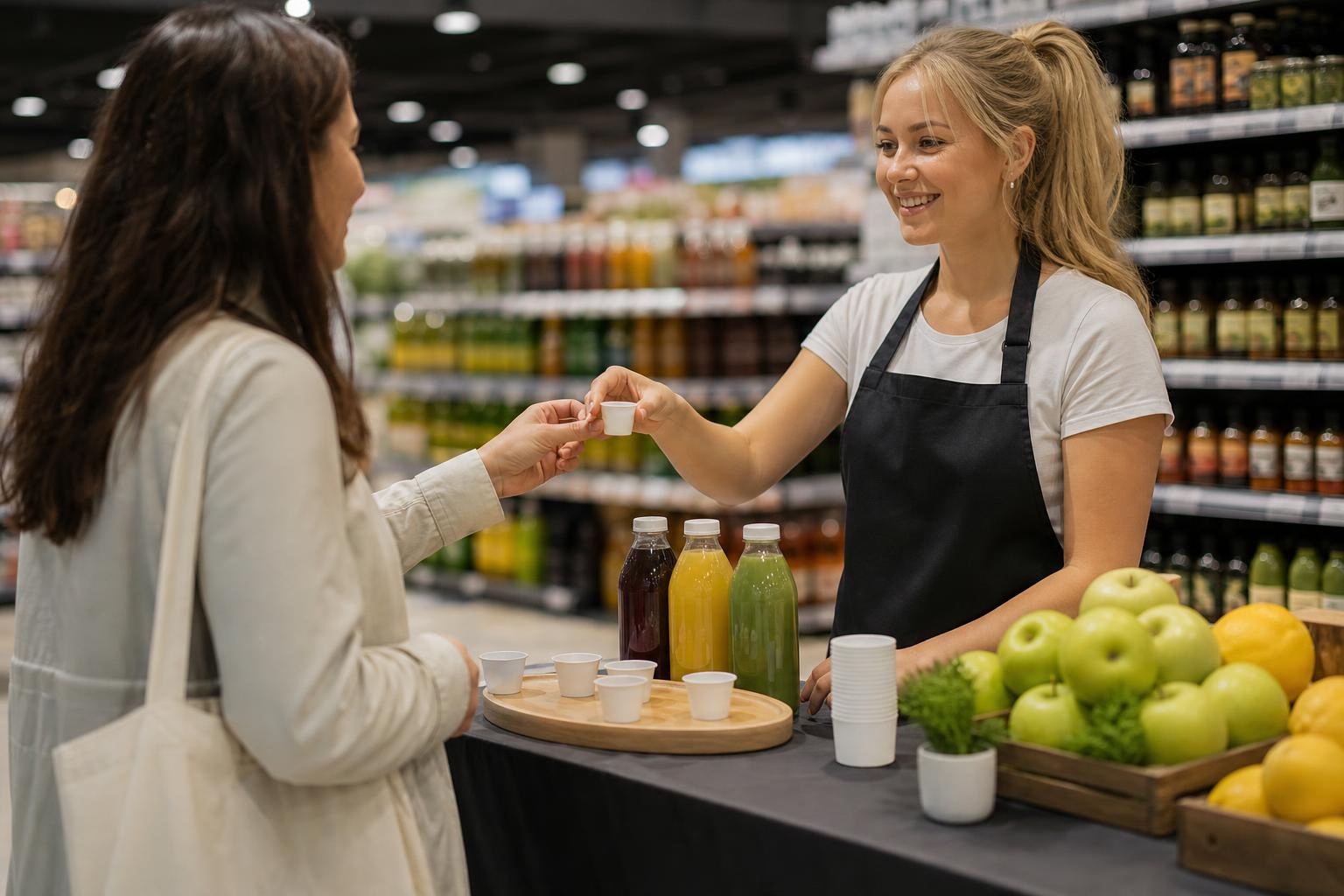
| In-store sampling | Allergen info, staff training, age checks, product safety |
| Prize-led sampling | CAP terms, Gambling Act boundary, free-entry route |
| Retailer PDP review campaign | Retailer policy, moderation rules, verified purchase, incentive label |
| Alcohol sampling | Age-gating, under-18 audience limits, no excessive consumption messaging |
| Beauty/cosmetics sampling | Responsible Person, safety assessment, labelling requirements |
For a practical comparison of how cashback, rebate, and sampling mechanics each affect compliance obligations, we have a separate glossary entry.
For brands running shopper promotions alongside sampling, Brand Allies offers managed retail promotions with in-store activation and verification across UK grocers.
What Makes a Sampling Campaign Non-Compliant?
Not every risk is obvious. Some of the most common compliance failures look harmless from inside a brand team.
Risky or non-compliant behaviours include:
- Asking only for positive reviews or conditioning a refund on a favourable rating.
- Hiding “received free product” disclosure in reviews or social content.
- Providing pre-written review copy or required claims.
- Suppressing negative reviews while publishing positive ones.
- Using fake accounts or employees posing as shoppers.
- Calling something “free” when consumers pay hidden costs.
- Failing to state limits, claim dates, or proof-of-purchase requirements.
- Collecting marketing consent through a pre-ticked box.
- Sampling food without allergen information.
- Sending age-restricted products to under-18s without verification.
- Using shopper data for retargeting without telling people.
- Running “buy to win” mechanics without proper prize terms.
- Ignoring retailer rules even where UK law disclosure is present.
The consumer trust dimension
Practitioners on Reddit report real-world consequences beyond regulatory action. In a thread on r/Sainsburys, a user complained that products with mostly incentivised, positive, free-trial reviews had destroyed their trust in the app’s rating system, and they stopped using Sainsbury’s reviews as a buying guide. A similar discussion on r/SkincareAddictionUK said Boots product reviews felt unreliable when many came from free-product review programmes, with the poster saying negative reviews were needed to “level the playing field.”
A thread on r/Sephora showed users distrusting products where all reviews were incentivised, reasoning that recipients may be less critical when they received a product for free or want future products.
These reactions show that compliance is not just about avoiding regulatory penalties. Even disclosed incentivised reviews can undermine consumer trust if they dominate a product page with uniformly positive ratings. A compliant campaign should aim for a balanced review profile, not a wall of identical five-star entries.
Compliant Review Sampling: What Good Looks Like
Review-based sampling is not dead. The old model of “free product for a nice review” is high-risk, but structured sampling for reviews remains viable.
Eight principles for compliant review sampling
- Real shopper experience. The reviewer must actually buy, use, or try the product.
- Verified participation. Keep evidence of purchase, receipt, delivery, or trial.
- Neutral incentive. The reward is not dependent on rating, sentiment, or specific wording.
- Clear disclosure. The review must clearly state any free product, cashback, payment, or other benefit received.
- No scripting. Brands can explain what to review (taste, texture, packaging) but should not tell shoppers what opinion to express.
- No suppression. Negative reviews must not be discouraged, filtered, or removed because they are negative.
- Retailer fit. Follow the retailer’s own review policy and moderation standards.
- Record keeping. Archive the campaign brief, shopper instructions, eligibility rules, claim records, proof of purchase, and disclosure wording.
Example: compliant shopper instruction
“You are receiving this product so you can try it and, if you choose, leave an honest review based on your genuine experience. Your review can be positive, negative, or neutral. Your incentive is not dependent on the rating you give. If the review platform asks whether you received an incentive or free product, you must disclose this clearly.”
Example: risky instruction
“Leave a five-star review and send us a screenshot to claim your refund.”
The difference is stark. The first instruction preserves reviewer independence. The second conditions payment on a positive rating, creating exactly the kind of concealed incentivised review that the DMCCA bans.
Discussions in the Amazon Vine UK subreddit reinforce this from the reviewer side. Reviewers are aware that undisclosed incentivised reviews are illegal in the UK and that sellers offering free products outside official systems put reviewers at risk of account bans and policy breaches. Reviewers are not blank media inventory. They worry about their accounts and need clear, honest instructions.
For brands looking to build receipt-verified sampling campaigns with proper evidence chains, structuring the proof-of-purchase step correctly is essential.
The CLEAR Sampling Compliance Framework
Product sampling compliance in the UK is easier to manage when broken into five practical areas:
C, Clarity. Make the offer, incentive, eligibility, dates, limits, costs, proof requirements, and claim process clear before participation. A shopper should understand exactly what they are signing up for before they commit.
L, Lawful data use. Explain how shopper data will be used. Separate marketing opt-ins from sample fulfilment. Keep consent records where required, and never use pre-ticked boxes.
E, Evidence. Keep proof of product trial, purchase, disclosure wording, campaign terms, shopper instructions, safety checks, and review outcomes. This is the documentation layer that proves the campaign was run properly. For more on building evidence trails, see our guide to retail campaign verification.
A, Authenticity. Reviews and endorsements must be based on genuine experience. No fake accounts, no scripts, no positive-review pressure, and no suppression of fair negative feedback.
R, Retailer readiness. Check the review, sampling, cashback, and user-generated content rules for each retailer or platform before launch. Legal compliance and retailer acceptance are separate hurdles, and the stricter one wins.
Sampling Campaign Compliance Checklist
Before launch
- Define the campaign mechanic: free sample, cashback, review, prize, influencer gift, store audit, or hybrid.
- Identify all incentives: product, payment, refund, coupon, prize entry, loyalty points, discounts.
- Check product category risks: food, alcohol, cosmetics, medicine, household, supplement.
- Write significant terms: eligibility, start and end date, claim process, proof of purchase, limits, availability, promoter identity.
- Prepare disclosure wording for reviews and social posts.
- Separate marketing consent from fulfilment consent.
- Confirm retailer and platform rules for each channel.
- Prepare shopper instructions that ask for honest experience only.
- Confirm stock availability and retailer listings.
- Create campaign ID and tracking process.
For a ready-to-use sampling campaign brief template, we have a separate planning guide that walks through each element.
During campaign
- Monitor stock levels, failed purchases, rejected reviews, and shopper questions.
- Do not correct a shopper’s opinion or ask them to change negative reviews.
- Do not suppress negative reviews.
- Log retailer moderation rejections and reasons.
- Keep evidence of disclosures and campaign communications.
Brands running in-store sampling alongside online campaigns should also verify store-level execution, since up to 30% of products can be missing or incorrectly merchandised at any given time.
Brand Allies offers in-store compliance checks across UK retailers, using real shoppers to verify availability, POS placement, and promotional execution.
After campaign
- Audit review acceptance rate by retailer.
- Check whether disclosure appeared correctly on published reviews.
- Analyse rejected reviews by reason (moderation, policy, content quality).
- Archive campaign terms, briefs, shopper records, opt-in logs, proof-of-purchase records, and sample safety documents.
- Report performance using verified metrics, not just claimed purchase intent.
A LinkedIn practitioner noted that a survey of 100 FMCG marketers found 75% could not prove sampling leads to sales and 62% received no direct sales data. This is partly a compliance problem. Campaigns that track verified purchase, review publication, review recency, and retailer PDP coverage produce evidence that is useful for both compliance and ROI reporting.
Compliant vs Risky: A Quick Comparison
| Campaign action | Lower-risk compliant approach | Higher-risk approach |
|---|---|---|
| Free product for review | “Received product free in exchange for an honest review”; no rating requirement | “Leave us a 5-star review and get reimbursed” |
| Cashback sampling | State cashback value, dates, purchase requirements, claim process, and limits | Hide fees, stock limits, or claim deadlines |
| Review instructions | Ask for genuine experience, pros and cons, no script | Provide pre-written review text or required claims |
| Influencer gifting | Clear upfront ad/gift disclosure, visible before “see more” | Brand tag only, disclosure hidden or absent |
| Product page reviews | Follow retailer policy and disclose incentives | Off-platform review manipulation or undisclosed freebie |
| Data capture | Separate sample fulfilment from marketing opt-in | Make newsletter consent mandatory for the sample |
| Negative reviews | Allow and accept without penalty | Filter out, discourage, or remove because they are negative |
Special Rules for Food, Beauty, Alcohol, and Medicines
Not all FMCG samples carry the same risk. A cereal sample, skincare sachet, alcohol miniature, and OTC medicine each trigger different compliance requirements.
| Category | Extra compliance requirements |
|---|---|
| Food and drink | Allergen information (FSA guidance), storage and shelf life, chilled chain integrity, nutrition and health claims, HFSS media restrictions from January 2026 |
| Alcohol | Age-gating, under-18 audience limits (alcohol promotions should not appear where 25%+ of the audience is under 18), no excessive consumption messaging |
| Cosmetics | Responsible Person required, Product Information File, safety assessment before distribution, OPSS notification, sample labelling |
| Medicines | Must be licensed, prescription-only medicines cannot be advertised to the public, free medicine samples may not be provided as promotion (MHRA rules) |
| Cleaning and household | Safety warnings, child safety, product traceability, hazard information |
| Supplements | Food law applies, nutrition and health claims must be accurate, allergen and ingredient accuracy |
UK cosmetics guidance explicitly applies to products given away free, including samples. Many brands overlook this, assuming that “it’s just a sachet” exempts them from safety assessment and labelling requirements. It does not.
For brands planning free sample campaigns across grocery retailers, these category-specific checks should be part of the campaign brief from day one.
Why Disclosure Alone Is Not Enough
There is a gap between legal compliance and consumer trust.
On Mumsnet, UK shoppers discussed searching supermarket apps for sample items, mentioning Tesco online-only samples and Ocado “star reviewer” items received in return for reviews. These shoppers see samples as freebies and deals, and they form opinions about review credibility based on patterns they notice.
The practical implication: even properly disclosed incentivised reviews can erode trust if they dominate a product page. Compliant sampling campaigns should aim for a balanced review profile, mixing organic reviews with incentivised ones, ensuring review recency, and never replacing a natural review ecosystem with a spike of near-identical five-star entries.
Wording matters. Telling reviewers “your review must be honest, you can leave a negative, neutral, or positive review, and your reward is not dependent on the rating” is not just a compliance safeguard. It is what produces reviews that other shoppers actually find useful and credible.
How Brand Allies Supports Sampling Campaign Evidence
Brand Allies is a UK managed-service shopper advocacy platform for FMCG brands. It uses a UK shopper community to support buy, try, and review activity on retailer websites, alongside in-store audits and compliance checks.
For brands concerned about sampling campaign compliance, the value is not about bypassing rules. It is about structured execution: verified shopper activity, campaign briefs with clear instructions, neutral review guidance, proof of purchase, and evidence that can be used to understand review coverage, digital shelf performance, and store-level execution.
Brand Allies operates a pay-per-verified-review model across retailers including Tesco, Sainsbury’s, Ocado, Boots, and others. Every campaign uses real shoppers making real purchases, with review tracking built around genuine product experience.
This page is a practical glossary, not legal advice. Brands should seek qualified legal counsel for campaign-specific questions.
Planning a sampling, review, or retail activation campaign? Visit Brand Allies FAQs for common questions about campaign structure, shopper community, and review delivery.
FAQ
What is sampling campaign compliance?
Sampling campaign compliance is the process of making sure a product sampling campaign follows UK advertising rules (ASA/CAP), consumer review rules (CMA/DMCCA), data protection rules (UK GDPR/PECR), product safety law, category-specific regulation, and retailer platform policies. It means clearly explaining the offer, disclosing incentives, collecting data lawfully, keeping products safe, avoiding fake or pressured reviews, and keeping records that prove the campaign was run fairly.
Are free product reviews legal in the UK?
Yes, UK brands can run review-based sampling campaigns. But the review must be genuine, the incentive must be clearly disclosed, the reward must not depend on a positive rating, and the retailer or platform must allow the mechanic. Hidden incentivised reviews and fake reviews are prohibited under the DMCCA, which came into force on 6 April 2025.
Can a brand ask for a five-star review?
No. Directly incentivising positive reviews or testimonials is likely to be problematic under ASA guidance. Conditioning a refund, payment, or future benefit on a specific star rating crosses the line from genuine review into manipulated endorsement.
Do incentivised reviews need to be disclosed?
Yes. Both CMA and ASA rules require clear disclosure when a review was written in exchange for money, a free product, a refund, or any other benefit. The disclosure must be prominent, not hidden behind a “see more” button or buried in small print.
What data protection rules apply to sample sign-ups?
UK GDPR and PECR apply. Brands must provide clear privacy information at the point of collection, separate marketing consent from sample fulfilment, avoid pre-ticked consent boxes, and keep records of what each person consented to. Marketing emails require specific opt-in consent under PECR.
Are retailer review rules different from UK law?
Often, yes. Retailers can set stricter policies than general UK law requires. Tesco allows incentivised reviews only with prominent disclosure and no positive-rating condition. Amazon restricts free-product reviews to its own Vine programme. A review can be legally compliant and still get rejected by a retailer’s moderation team.
Do food samples need allergen information?
Yes. FSA guidance requires food businesses to provide allergen information and follow best practice for allergen handling. This applies to food samples distributed in-store, through the post, or at events, regardless of pack size.
What records should a sampling campaign keep?
At minimum: campaign terms and conditions, shopper instructions, eligibility criteria, disclosure wording, proof of purchase or trial, consent records for data collection, product safety documentation, review outcomes by retailer, moderation rejection logs, and stock availability evidence.