TL;DR: New buyer acquisition sampling is the practice of getting free or subsidised product trials into the hands of people who have never bought your brand, with the explicit goal of converting them into first-time purchasers. It is the most evidence-backed growth tactic in FMCG because brands grow primarily through gaining new buyers, not squeezing more from existing ones. Modern sampling programmes go further by capturing first-party data and generating product reviews that compound the acquisition effect over time.
Interested in running a sampling-to-reviews programme on UK retailer sites? Explore the reviews service to see how it works.
What “New Buyer Acquisition Sampling” Actually Means
New buyer acquisition sampling is a specific type of product sampling where the primary objective is converting non-buyers into first-time purchasers. It sounds obvious, but the distinction matters. Plenty of sampling activity ends up reaching people who already buy the brand. That might reinforce loyalty, but it does nothing for growth.
In an FMCG context, acquisition sampling targets shoppers who either buy from a competing brand in the same category or who don’t participate in the category at all. The sample is the mechanism that removes the risk of trying something new. The purchase that follows is the metric that counts.
This separates acquisition sampling from three related but different activities:
- Awareness sampling, where the goal is impressions and brand recall, not purchase.
- Loyalty sampling, where existing customers receive samples of line extensions or new variants.
- Product seeding, where samples go to influencers or media for coverage rather than direct consumer trial.
The reason this term is gaining traction among UK brand teams comes down to two uncomfortable truths. First, customer acquisition costs across ecommerce and FMCG have surged roughly 40% between 2023 and 2025. Second, NielsenIQ found that only 17% of FMCG launches achieve both strong trial and strong repeat purchase. Most launches fail because they never acquire enough new buyers fast enough to hold shelf space.
Why Sampling Is the Primary Acquisition Lever in FMCG
The Ehrenberg-Bass Penetration Principle
The Ehrenberg-Bass Institute at the University of South Australia has spent decades proving a single point: brands grow by gaining more buyers, not by increasing purchase frequency among existing ones. Byron Sharp’s How Brands Grow made this accessible to marketers, but the underlying data is far older and covers hundreds of categories across dozens of countries.
The practical implication is stark. If you want to grow a biscuit brand, a laundry detergent, or a plant-based milk, your budget should skew heavily toward reaching and converting non-buyers. Ehrenberg-Bass researchers recommend allocating roughly 60 to 70% of budget to new buyer acquisition and 30 to 40% to retention.
The Double Jeopardy Law
Smaller brands suffer twice: they have fewer buyers, and those buyers purchase slightly less often. This is not a strategy failure. It is a statistical regularity observed across virtually every consumer goods category. The only escape is growing penetration, which automatically lifts purchase frequency as a side effect.
Light Buyers Drive Most Revenue
This is the part that surprises brand managers focused on “loyal superfans.” Light buyers, those purchasing a brand just once or twice a year, typically generate 70 to 80% of a brand’s revenue. A Bain & Company analysis of over 4,000 brands in 2024 confirmed that penetration growth accounts for most revenue growth, while purchase frequency stays remarkably stable.
Sampling is the most direct way to turn a non-buyer into a light buyer. And light buyers are the engine room of FMCG growth.
Key Sampling Methods for New Buyer Acquisition
Not all sampling formats are equally suited to acquiring new buyers. Here is how the main methods compare when the goal is first-time purchase rather than just awareness.
In-Store Sampling
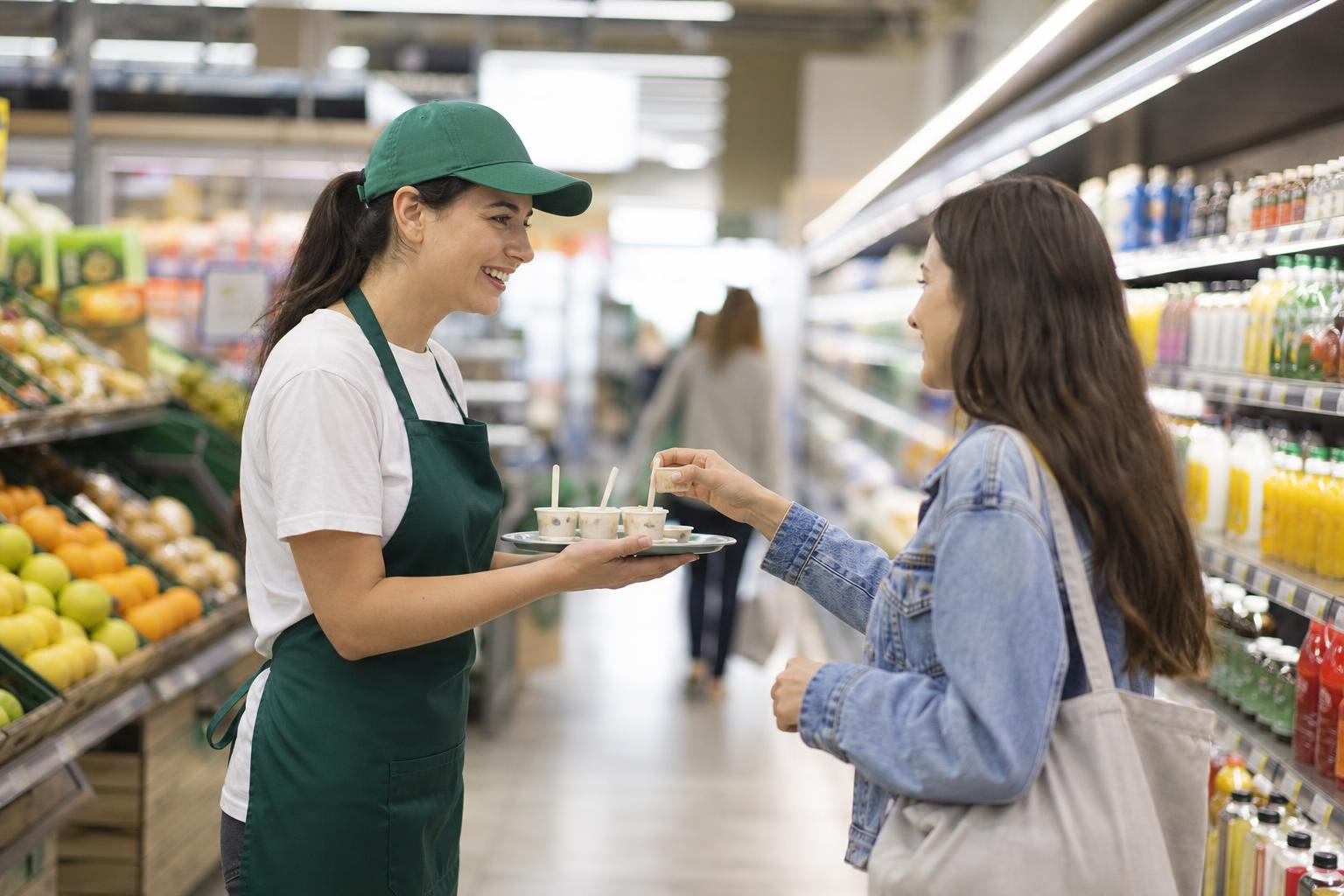
The classic approach: a demonstrator hands out samples in a supermarket aisle. An SMG analysis of 12,500 brand campaigns found that in-store sampling delivered an average sales lift of 95.2%, the highest of any in-store format. Over a third of consumers who sample a product in-store buy it during the same trip.
The limitation is reach. You can only cover so many stores, and the audience self-selects based on who happens to be shopping that day. For a deeper look at when this format makes sense, the in-store vs digital sampling guide breaks down the trade-offs.
Digital and Receipt-Verified Sampling
This is where modern acquisition sampling has moved. The consumer receives a digital offer (often via an app, email, or social ad), purchases the product at a specific retailer, and submits their receipt as proof. The brand reimburses part or all of the cost.
The advantage is precision. You can target by geography, retailer, demographic, and purchase history to reach genuine non-buyers. Platforms using this model report conversion rates 25 times higher than traditional physical sampling, and repurchase rates around 26%. The receipt-verified sampling guide covers the mechanics in detail.
Community-Led Sampling (Buy-Try-Review)
A panel of real shoppers buys the product at full shelf price, tries it at home, and then posts a verified review on the retailer website where they purchased it. The brand covers the cost of the product. This model produces two outputs from a single investment: a new buyer and a published review.
For UK FMCG brands selling through Tesco, Sainsbury’s, or Ocado, this is often the fastest compliant route to building the review coverage that drives conversion. The advocacy marketing guide explains how community panels work in practice.
Cashback Sampling
The consumer pays full price at the till, then claims a rebate through an app. This works well for categories where posting physical samples is impractical (chilled, frozen, heavy goods) and creates a real purchase signal that registers in retailer EPOS data. The comparison between cashback, rebate, and sampling formats is worth reading if you are weighing options.
Quick Comparison
| Method | Typical Conversion Rate | Best For | Key Limitation |
|---|---|---|---|
| In-store sampling | 35%+ same-trip purchase | Impulse categories, food/beverage | Limited store coverage |
| Digital/receipt-verified | 15-25% | Targeted acquisition at scale | Requires digital touchpoint |
| Community-led (buy-try-review) | 25-30% repurchase | NPD launches needing reviews | Smaller panel sizes |
| Cashback | 15-20% | Chilled/frozen, heavy goods | Rebate friction can reduce uptake |
Benchmarks and Performance Data
Hard numbers matter when building a business case for new buyer acquisition sampling in FMCG. Here are the benchmarks that practitioners and published research consistently cite.
Sample-to-purchase conversion: The average across formats sits at roughly 22%. Established brands in familiar categories see 15 to 25%. New products in unfamiliar categories see 8 to 15%. Love brands pairing samples with coupons can push conversion to 25 to 35%.
Return on investment: Sampling generates approximately £3 in revenue for every £1 spent, a 3:1 ROI. Cost per acquisition through sampling runs about 40% lower than traditional advertising.
Customer acquisition cost: Research puts the average CAC for consumer goods in the UK at approximately £16. For context, Amazon reportedly spends around £116 per new customer and eBay around £130. FMCG’s lower CAC reflects higher repeat purchase likelihood, but that advantage only materialises if the first purchase actually happens.
Repurchase after trial: NielsenIQ’s Western Europe Innovation Barometer found that about 30% of consumers repurchased an innovation item at least once within six months of launch. That figure is the floor. Well-executed sampling with follow-up can push it higher.
If you want to quantify the downstream value of reviews generated through sampling, the review ROI calculator guide walks through the maths.
The Psychology Behind Why Sampling Converts Non-Buyers
Three psychological principles explain why putting a product in someone’s hands is so much more effective than telling them about it.
Reciprocity. When someone receives something for free, they feel a subtle obligation to return the favour. In a sampling context, that “repayment” often takes the form of a purchase. This is not manipulation. It is a well-documented social norm that Robert Cialdini identified decades ago, and it works particularly well in low-involvement FMCG categories where the purchase price is small.
Risk removal. The biggest barrier to trying a new brand in grocery is not awareness. It is the fear of wasting money on something you might not like. A 300ml bottle of oat milk costs £2. That is not much, but multiplied across a weekly shop where dozens of purchase decisions compete for attention, even small risks get avoided. Sampling eliminates that risk entirely.
Commitment and consistency. Once someone has tried a product and formed a positive opinion, they are psychologically inclined to act consistently with that experience. Buying it next time feels like following through rather than making a new decision.
How Sampling Feeds the Digital Shelf
This is where new buyer acquisition sampling produces compounding returns that go beyond the initial purchase.
The Grocery Review Gap
The average review rate on UK grocery retailer websites sits between 0.1% and 0.3%. Compare that to 2 to 5% on Amazon. Most FMCG products listed on Tesco.com, Sainsbury’s, or Ocado have fewer than five reviews, and many have none at all.
This matters because products with just five reviews are 270% more likely to be purchased than products with zero reviews. For lower-priced items typical of grocery, reviews can lift conversion rates by 190%.
Sampling-for-Reviews Doubles Acquisition Value
When a sampling programme is designed to generate verified reviews alongside first-time purchases, every sample produces two outcomes: a new buyer today, and a review that converts future buyers tomorrow. This compounding effect is unique to the buy-try-review model.
Consider the Sorbent tissue brand case. Their household sampling campaign targeted 1,000 homes that regularly bought competing paper brands. It generated 2,900 verified home trials and 2,158 published reviews, with an 88% post-trial purchase intent score. That is not just acquisition. That is acquisition plus a permanent digital shelf asset.
For brands launching NPD on UK retailers, the review velocity guide explains how to maintain review recency, which matters as much as total count.
The Connection to Retailer Search and Range Retention
Products with higher ratings and stronger review volume rank better in retailer on-site search. They are more likely to be included in retailer media placements and promotional slots. And they are better positioned to survive range reviews, where buyers are looking for evidence that a product deserves continued shelf space.
A sampling campaign that generates reviews is therefore not just a marketing tactic. It is a commercial tool that strengthens your position in buyer negotiations.
Want to see how sampling-for-reviews works across UK retailers? Explore promotion options to understand the mechanics.
Real-World Cases: What the Numbers Look Like
Raffaello (confectionery). A sampling campaign by Relish Agency showed that 32.2% of recipients tried Raffaello for the first time, and 61.3% reported a positive shift in brand perception. Notably, 63.7% of samplers had not seen any recent advertising for the brand, meaning the sample was the only brand touchpoint.
Alcohol-free beer brand. After distributing one million samples across multiple venue types, the brand measured a 34% lift in purchase intent among samplers versus non-samplers, with 56% of samplers converting to actual purchases.
Laundry brand partnered with fitness studios. By placing samples in gym changing rooms, the brand found that 86% of sampled customers said they would likely purchase within 90 days, and one in four were completely new to the brand.
Olly’s and Rhythm 108 (office sampling). Gems Sampling placed snack brand samples in offices near target Tesco stores. The retailer tracked a 66% increase in sales at supported stores following each drop.
Practitioners on Quora and in YouTube walkthroughs from companies like SoPost consistently report that the gap between “sampling for awareness” and “sampling for acquisition” comes down to targeting and follow-up. Without both, conversion rates collapse.
Common Mistakes That Waste Sampling Budget
Sampling without a follow-up mechanism. Handing out a sample with no way to contact the consumer afterward, no review request, no data capture, no follow-up coupon, is like running a first date and never exchanging numbers. The follow-up strategy guide covers what to do after the sample lands.
Reaching existing buyers instead of genuine non-buyers. If your sampling programme does not actively exclude current brand purchasers, a significant portion of your budget is subsidising people who would have bought anyway. Digital and receipt-verified formats solve this by screening based on purchase history.
Measuring samples distributed rather than purchases generated. The number of samples given away is an activity metric, not an outcome metric. The metrics that matter are verified first-time purchases, repurchase rate at 30/60/90 days, and (if applicable) reviews published. Nielsen’s 2024 Consumer Insights Report found that 70% of physical samples go unused. Counting those as “reach” is misleading.
Running a one-off spike instead of a sustained cadence. A single sampling burst creates a temporary sales lift that fades within weeks. Sustained programmes that feed new buyers into the funnel month over month build compounding penetration gains and a steady stream of fresh reviews.
Ignoring compliance. UK sampling campaigns must comply with ASA CAP Code rules, retailer terms, and (where reviews are involved) CMA guidelines on incentivised reviews. The compliance checklist covers what to watch for.
Frequently Asked Questions
What is the difference between product sampling and new buyer acquisition sampling?
Product sampling is a broad term covering any activity where consumers receive a free trial of a product. New buyer acquisition sampling is a subset with a specific commercial objective: converting people who have never purchased the brand into first-time buyers. The targeting, measurement, and follow-up all differ from general sampling.
What conversion rate should I expect from an FMCG sampling campaign?
Published benchmarks put the average at about 22% across all formats. Established brands in familiar categories typically see 15 to 25%, while new products in unfamiliar categories see 8 to 15%. In-store sampling generates same-trip purchase rates above 35%.
How does sampling compare to paid media for customer acquisition?
Sampling has a cost per acquisition roughly 40% lower than traditional advertising, with a 3:1 average ROI. The advantage is that sampling creates a real product experience, which drives higher conversion and repurchase than an ad impression alone.
Why does Ehrenberg-Bass theory matter for sampling strategy?
The Ehrenberg-Bass Institute has demonstrated across decades of research that FMCG brands grow primarily through gaining new buyers, not by increasing loyalty among existing ones. This makes acquisition-focused sampling the most strategically aligned tactic for growth, because it directly targets the one metric that moves the needle: penetration.
Can sampling generate product reviews as well as new buyers?
Yes. Community-led sampling models (buy-try-review) are designed to produce both a first-time purchase and a verified review on the retailer website. This doubles the value of each sample by creating a permanent digital shelf asset alongside the initial acquisition.
How many reviews does a product need to influence purchase decisions?
Research shows that products with just five reviews are 270% more likely to be purchased than those with none. The credibility threshold where shoppers stop actively checking review counts sits around 20 to 30 reviews. Most UK grocery products are well below this level.
What is a typical customer acquisition cost in UK FMCG?
Estimates put the average at approximately £16 for consumer goods, significantly lower than pure-play ecommerce brands. The key is that FMCG’s advantage depends on repeat purchase actually happening after trial, which is why sampling programmes need follow-up mechanisms built in.
How do I make sure my sampling reaches non-buyers rather than existing customers?
Digital and receipt-verified formats allow screening by purchase history, retailer, and demographic. Community-led panels can be filtered to exclude known brand purchasers. In-store sampling offers less control, but can be directed toward stores with low brand penetration or paired with shopper data from loyalty card insights.
Ready to build a sampling programme that drives verified new buyers and reviews on UK retailer websites? Book a demo to discuss your next campaign.